The close often becomes urgent because questions arise at the same time: an invoice is missing, stock has not been counted and a loan repayment schedule has changed. You can reduce this pressure by preparing a year-end file. It should explain what happened and what remains to be assessed, with one person responsible for each answer.
The framework to review
The rules on presentation, measurement, audit and filing vary depending on the entity and its reporting framework. The matching principle requires expenses and income for the period to be reviewed independently of their payment alone. The preparation of the accounts, their approval and their filing are distinct stages. Set your timetable with the professional, taking account of the deadlines that actually apply to your company.
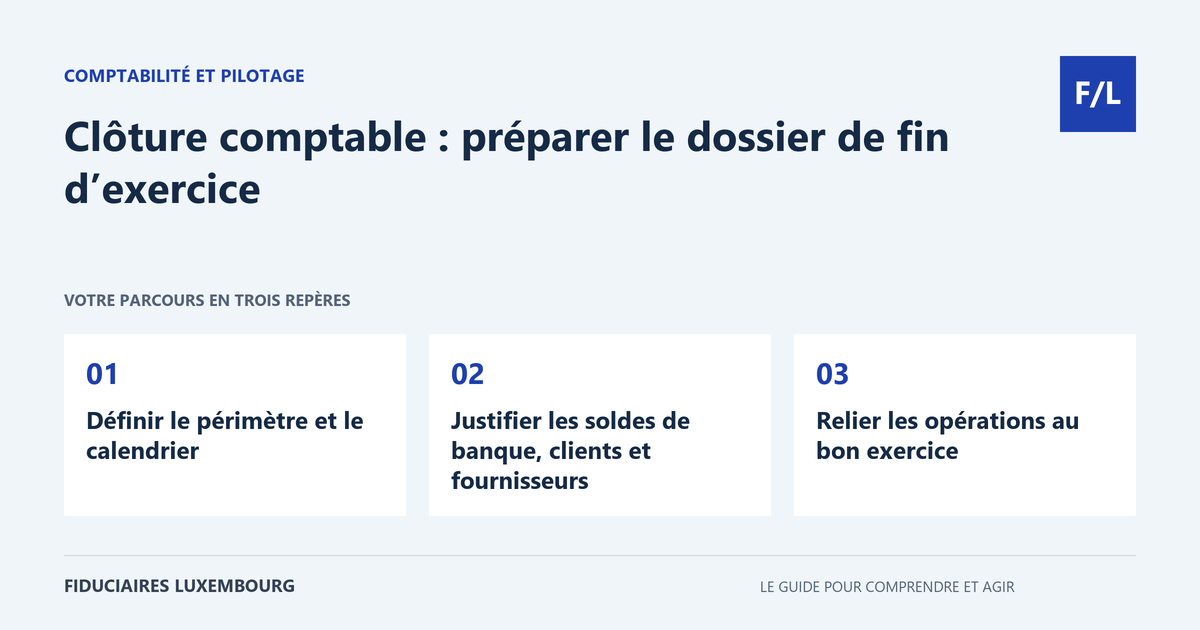
Defining the scope and timetable
Confirm the closing date, the entities concerned and the tools used during the financial year. A software migration, the opening of a new bank account or the launch of an activity may have created additional data sources. List them before requesting exports. Otherwise, the firm may discover late that some transactions were not included.
Draw up a preparation timetable: inventories, collection of the latest supporting documents, answers to questions, review of the accounts and decisions to be made. For each stage, appoint a person responsible and set a realistic submission date. The accounting close does not rely solely on the firm; several operational items of information are held by the manager or the teams.
Substantiating bank, customer and supplier balances
For banks, provide end-of-period statements and reconciliations. For customers, explain outstanding invoices, disputes, expected credit notes and payments received subsequently. For suppliers, report services performed for which the invoice has not yet arrived. A detailed statement avoids leaving the professional to guess the content of an overall balance.
Do not correct an old balance simply because it seems small or inconvenient. Find its origin and the appropriate decision. An overpayment, a deposit and an unpaid invoice are not treated interchangeably. Confirmations and communications with third parties can help clarify the situation; keep them with the relevant references.
Allocating transactions to the correct financial year
Identify contracts and invoices that span the closing date: insurance, subscriptions, rent, work in progress or sales delivered around that date. State the periods actually covered, delivery dates and progress status. The firm can then examine period allocation treatments, often referred to as “cut-off”.
This review is not carried out by changing the date of an invoice to obtain the desired result. It is based on the reality of the transaction and its supporting documents. Where information is uncertain, describe the uncertainty: services partially received, an amount under discussion or delivery not confirmed. An explicit note is better than an estimate presented as an established fact.
Documenting inventories, fixed assets and estimates
Gather inventory counts and explanations for discrepancies. For equipment, report acquisitions, commissioning, sales, disposals and assets that are no longer in use. The fixed asset register must be capable of being compared with what actually exists. Equipment removed from the workshop but still listed in the file requires investigation.
Also describe disputes, warranties, commitments and unusual events. The professional determines their accounting treatment based on the available facts and applicable rules. Your role is to communicate complete information, including when it is uncomfortable. An impairment or provision must not be an amount chosen to artificially adjust profit.
Organising a review that the manager can understand
Request a summary of significant changes: changes in sales and margins, new financing, inventory movements, exceptional expenses and matters still outstanding. Compare the figures with what you know about the business. An amount may be correctly added up while still revealing a classification that requires an explanation.
Keep the version discussed, the answers and the decisions made. Then check that the final documents are consistent with the approved versions and the required formalities. After the close, note the documents that are difficult to obtain and improve the process for the following financial year. The file thus becomes a reusable working basis, rather than a project to rebuild every year.
The table to take action
| File | Documents and information | Question to resolve |
|---|---|---|
| Banks and financing | Statements, reconciliations, contracts, repayment schedules | Are the balances and repayments explained? |
| Customers and suppliers | Detailed statements, disputes, credit notes, subsequent payments | Which transactions remain outstanding, and why? |
| Inventories and equipment | Counts, register, additions and disposals | Do the assets exist and do they remain usable? |
| Contracts and events | Periods covered, commitments, significant events | Which items relate to this financial year? |
An invoice received after year-end
Fictitious example: a company closes on 31 December. Technical work was performed and accepted on 20 December, but the invoice does not arrive until January. The person responsible prepares the work order, the accepted quotation and the invoice received subsequently. The firm thus has the information needed to examine allocation to the relevant financial year. In the same file, an invoice paid in December covers a subscription from January to December of the following year. The December payment is therefore not sufficient to conclude that the entire expense belongs to the closed financial year. The two transactions require different reasoning, made possible by the dates and documents.
Your preparation checklist
- Scope of the entities and closing date confirmed.
- Complete exports and bank reconciliations available.
- Customer and supplier balances explained.
- Inventories and fixed asset movements documented.
- Contracts covering several financial years identified.
- Disputes and significant events reported.
- Manager's review and final versions retained.
Frequently asked questions
Do all invoices have to be received before starting?
You can prepare the file in advance and track missing items. Documents received subsequently are added with their references and their impact to be reviewed.
Does the firm automatically know all our commitments?
No. A contract, dispute or operational decision may not appear in the documents already provided. Organise the flow of information with the persons concerned.
Does the close mean that the accounts have been filed?
No. Preparation, approval and filing follow distinct stages. Ask who carries out each formality and which document confirms that it has been completed.
Useful terms in this guide
Questions to ask the professional
- Which specific documents are missing from our closing file?
- Which events and estimates should we report to you before the review?
- What timetable links preparation, approval and filing?
To clarify the engagement to be assigned, also consult our accounting guide.
And for your situation?
Prepare a list of the balances and events that raise questions for you, then gather the relevant documents. To organise this work or review your annual timetable, search the professional directory for a fiduciary or chartered accountant familiar with the needs of your business. You will be able to present them with a concrete file and a clear scope.
Sources and verification
References consulted on 20 September 2026. Official procedures specify the applicable conditions and exceptions.
- Guichet.lu — méthodes d’établissement des comptes
- Guichet.lu — dépôt des comptes annuels au RCS
- Guichet.lu — obligations comptables des entreprises
This guide explains a general process. The applicable rules depend on your situation; it does not constitute personalised advice. Report a correction.
Your next step
A specific need deserves the right contact
Accounting, taxation, company formation or payroll: prepare your questions, then search the directory for the professional who can review your situation. Check their assignments and status before entrusting them with your file.