Your company issues invoices, pays suppliers and receives payments from customers: accounting must link these events. Let us look at what needs to be organised during the year so that closing becomes a controlled review.
The preparation of accounts, their approval and their filing are three separate steps. A tax or VAT return does not replace any of them.
The framework to review
The obligations relating to bookkeeping, presentation, audit and filing are not identical for all structures. The PCN has a scope of application. The involvement of an auditor should not be confused with the preparation of accounts by the firm.
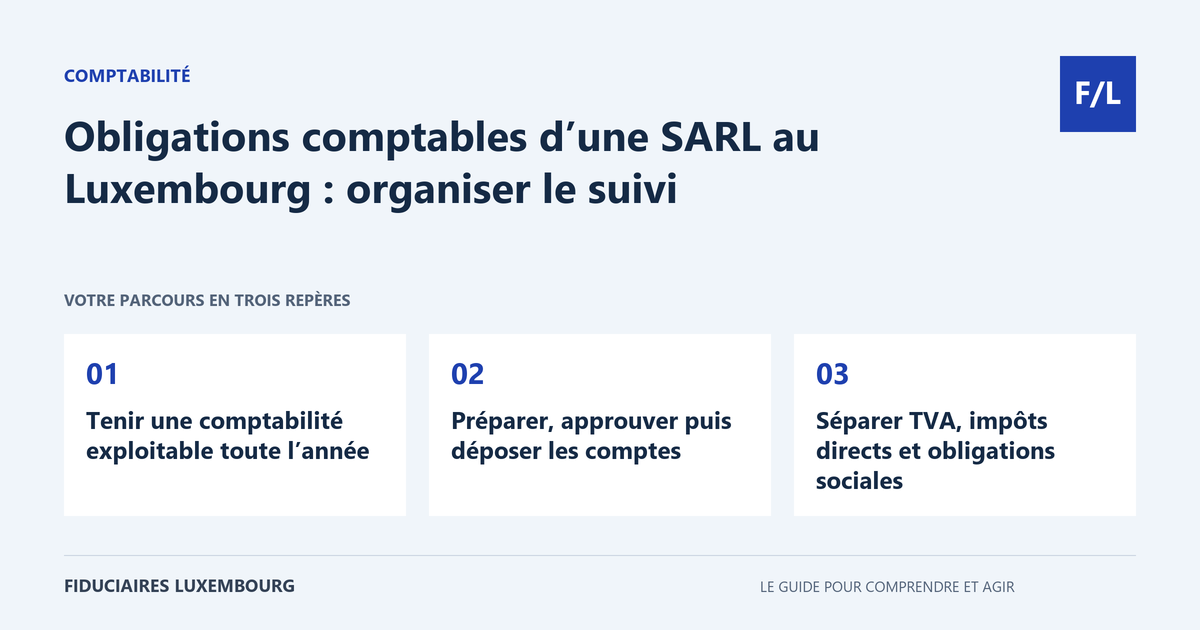
Maintaining usable accounting records throughout the year
File invoices, bank statements, contracts, expense receipts and payroll information as business activities occur. Link each entry to supporting documentation and regularly check bank balances, receivables and liabilities. A simple collection of invoices does not make it possible to identify commitments or transactions still to be received.
Agree with the firm on the monthly submission date and how incomplete documents will be handled. The manager must report unusual events: a shareholder loan, purchase of an asset, dispute, cessation of activity or transaction with a related company.
Prepare, approve and then file the accounts
For an SARL, Guichet.lu indicates approval within six months following closing, then filing with the RCS within one month after that approval, no later than seven months after closing. Early approval therefore brings forward the filing deadline.
Preparation includes reconciliations, inventory, valuations and the documents required according to the size and circumstances of the company. Obligations relating to the PCN, eCDF, notes to the accounts and audit of the accounts must be determined for the entity concerned. eCDF validation is not proof of filing with the RCS: retain the acknowledgement for each procedure.
Separating VAT, direct taxes and social obligations
The VAT frequency is assigned by the AED. The official table uses thresholds of €112,000 and €620,000 in annual turnover excluding tax; the notified regime and any changes to it must be applied. Retain the notification to substantiate the calendar applied to your company.
VAT recapitulative statements and Intrastat statistical declarations serve different purposes and are subject to different conditions. For direct taxes, identify separately corporate income tax, municipal business tax and net wealth tax according to the circumstances. The manager's personal tax returns are yet another file.
Building a list of closing evidence
A tracking table should indicate the expected document, the person responsible, its deadline and proof of completion. Show missing documents before the validation date, together with their potential effect on the accounts.
For a financial year ending on 31 December, the statutory timetable does not mean that you should wait until June to begin. Prepare inventories, customer balances, financing contracts and supporting documents from closing onwards. This planning example must still be adapted to the actual date of your financial year and to requests from the authorities.
Implement three regular checks during the financial year
First check: reconcile the bank account. Bank reconciliation identifies missing entries, duplicates and transactions that require an explanation. The balance shown by the bank and the accounting balance must be reconcilable as of the same date, even where transactions are still in transit.
Second check: review receivables and liabilities. An old invoice is not necessarily recoverable, and an unallocated payment may conceal an error. The aged customer balance helps select follow-ups and report disputes to the firm. Record the explanations so that they are not lost from one month to the next.
Third check: monitor long-term assets and commitments. Equipment purchases, contracts, loans and guarantees must be submitted together with their context. The fixed assets register is then used to reconcile the assets actually in use with the amounts shown in the accounts.
Preparing a closing without confusing evidence
Set a date for submitting documents and a date for reviewing outstanding issues. The closing file must identify inventories, invoices to be received, disputed receivables and other estimates. Cut-off between financial years explains why a transaction must be reviewed in light of its period, rather than only its payment.
When reviewing the accounts, request an explanation for significant variances. The manager must understand the balances and proposed decisions before approval. The guide to the approval meeting complements this work with the documents and decisions to prepare.
After the decision, track the eCDF and LBR filing through to its final proof. In an example timetable for a financial year ending on 31 December, approval on 15 May results in filing within the month following that date; the seven-month limit after closing does not allow this filing to be freely postponed until the end of July. Retain a copy of the documents actually filed, the decision and the acknowledgement, then update the table of remaining obligations.
| Step | Document or check | What remains distinct |
|---|---|---|
| Bookkeeping | Supporting documents and reconciliations | Validation of closing estimates |
| Approval | Shareholders’ decision | Filing formalities |
| Filing | Acknowledgement and filed documents | Tax returns |
| Taxation | Returns and payments | Social obligations and registers |
Let us consider a practical case
Fictitious educational example, intended to explain the reasoning.
An SARL receives in January an invoice relating to a service provided in December. Relying only on the payment date could give an inaccurate picture of the financial year. The manager submits the invoice and specifies the period in which the service was provided; the firm reviews its allocation. The same principle of dialogue applies to disputed invoices, inventories and old receivables. A document accompanied by its context is better than a large archive delivered without explanation at the last minute.
Points to prepare
- Closing date and approval timetable confirmed.
- Reconciliations and missing documents tracked.
- Notified VAT regime and tax deadlines recorded.
- Proof of validations, filings and payments retained.
Frequently asked questions
Does an eCDF filing complete the process?
No. Validation of accounting data and filing with the RCS are different steps; check the proof of final filing.
Can the manager delegate all tasks?
They can entrust services to a professional, but must provide the information, validate decisions falling within their duties and monitor the company’s obligations.
Useful terms in this guide
Questions to ask the professional
- Which documents must be submitted each month?
- Which validations are required before approval and filing?
To clarify the scope of your request, also consult our accounting section.
And for your situation?
Request an annual calendar that identifies those responsible and the expected evidence. With documents submitted regularly and a review of questions before approval, you can track your file without having to reconstruct the entire year at closing. Search our directory for the professional suited to your needs, then ask them for an engagement and a detailed quote.
Sources and verification
References consulted on 20 September 2026. Official procedures specify the applicable conditions and exceptions.
- Guichet.lu — dépôt des comptes annuels au RCS
- Guichet.lu — déclarations TVA
- Guichet.lu — impôt sur le revenu des collectivités
This guide explains a general process. The applicable rules depend on your situation; it does not constitute personalised advice. Report a correction.
Your next step
A specific need deserves the right contact
Accounting, taxation, company formation or payroll: prepare your questions, then search the directory for the professional who can review your situation. Check their assignments and status before entrusting them with your file.