A computer, a subscription or premises may serve several purposes. The invoice includes VAT, but what portion can actually be deducted? The answer depends on the company, the transactions it carries out and how the expense is allocated. To prepare a reliable file, it is better to explain the use than to immediately choose a round percentage.
The framework to check
Articles 48 to 52 of the VAT law govern the right to deduct, its limits and partial deduction methods. Certain exempt transactions retain a right to deduct: “without VAT charged” therefore does not always mean “without entitlement”. The statutory pro rata and methods based on actual allocation or sectors are not freely interchangeable. Authorisation or administrative conditions may apply. Private use and activities outside the scope also require separate analysis.
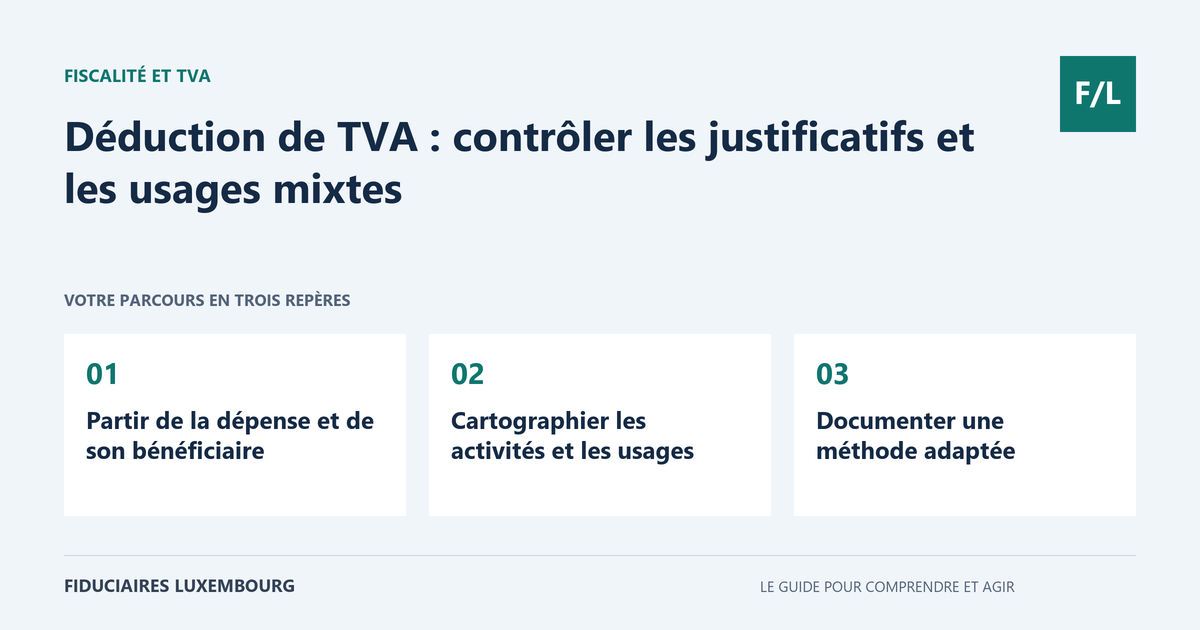
Start with the expense and its beneficiary
Check who purchased the goods or services, for what need and with which document. An expense paid with the company's card is not automatically allocated to an activity entitling it to deduction. Gather the invoice, contract and an explanation of the use. If the document names another person, have the situation clarified instead of changing the name on the document yourself.
Then distinguish the VAT treatment from the treatment of the expense in profit or loss. A question of VAT deduction is not resolved by stating “it is a business expense”. Both analyses have their own conditions. Present the facts only once, but ask the firm to specify the consequences specific to each tax.
Map activities and uses
List the transactions carried out by the company and the expenses they involve. Some expenses serve only one type of activity; others are shared. Add private or non-economic uses where they exist. This map makes it possible to ask the questions in the right order, before calculating an overall proportion based on turnover.
Do not classify all revenue without VAT in the same category. International transactions may retain a right to deduct, whereas other exempt transactions do not confer it. The rules on exemption are another specific situation. A general accounting designation is not enough: the nature of the transactions must be examined.
Document an appropriate method
The deduction pro rata is subject to a specific framework. Other methods may be based on actual allocation or sectors, subject to the applicable conditions. Do not choose the method that produces the highest amount without examining its admissibility. Have the reasoning, the data used and any authorisations recorded.
To prepare this analysis, gather the available objective evidence: areas, uses, categories of assignments, contracts or other relevant data. They do not automatically constitute the legal allocation key to apply, but they make it possible to discuss an explainable method. A “half-and-half” estimate without supporting evidence becomes difficult to defend when the activity changes or someone takes over the file.
Check the documents and the period
The method does not remove the need to check the conditions for deduction and the supporting documents. Keep usable invoices and reconcile them with the reality of the expense. Foreign VAT cannot simply be deducted as Luxembourg VAT; its treatment requires a process and conditions to be examined. VAT charged in error also requires analysis.
The deduction period and the specific features of the regime must be determined with the professional. For purchases subject to the reverse charge, separate the VAT due from the VAT that is actually deductible. Do not remove both amounts from the records on the grounds that the balance would be nil. Any such neutrality is a result to be justified, not a universal assumption.
Review assumptions when use changes
Equipment may change allocation and a company may develop a new activity. Report these developments before closing. The move from a provisional calculation to a final calculation and changes affecting certain assets may result in adjustments. Keep the initial method and the new information to enable comparison.
Link this monitoring to the fixed asset register where the asset is used on a lasting basis. This register may record the acquisition date, invoice reference and change of use, without confusing accounting depreciation with VAT adjustment. A well-maintained tracking sheet avoids having to look for the reasons for the initial treatment several years later.
The table to take action
| VAT on the expense | Portion allowed in the example | Deductible VAT | Portion remaining non-deductible |
|---|---|---|---|
| 170 € | 100 % | 170 € | 0 € |
| 170 € | 60 % | 102 € | 68 € |
| 170 € | 0 % | 0 € | 170 € |
The calculation is simple; substantiating the 60 % is the real work
Fictitious example: a shared expense includes 170 euros of VAT. It is assumed, solely to show the calculation, that examining the file leads to allowing a deduction of 60 %. The deductible portion is therefore 102 euros and the remaining 68 euros are not deducted. The decisive point is not the multiplication: it is the method that makes it possible to arrive at 60 %, its conditions and its evidence. The company therefore keeps the calculation note and the data used. The following year, it does not automatically carry forward the figure if its activities have changed. It provides the new information to determine whether an adjustment is required.
Your preparation checklist
- Identify the purchaser and the actual need.
- Gather supporting documents without altering them.
- Separate economic activity, private use and other uses.
- Classify transactions that do or do not confer a right to deduct.
- Have the method and administrative conditions determined.
- Keep the calculation, data sources and validation.
- Report changes in activity or allocation.
- Distinguish VAT due, deductible VAT and non-deductible VAT in the records.
Frequently asked questions
Does an invoice in the company's name make it possible to recover everything?
No. It is part of the file, but the use, transactions carried out and other conditions of the right to deduct remain decisive.
Can 50 % be applied for simplicity?
A percentage does not replace the applicable method. It must be substantiated and used within the framework allowed for the situation.
Does an exempt sale always exclude deduction?
No. Certain exemptions retain this entitlement. The transaction and the applicable legal basis must be identified, without reasoning solely on the absence of VAT charged.
Useful terms in this guide
Questions to ask the professional
- Which expenses must be examined separately?
- Which method applies to our shared expenses and is authorisation required?
- Which changes must we report for adjustments?
To specify the engagement to be entrusted, also consult our taxation section.
And for your situation?
Prepare a list of shared expenses and explain their use in a few lines. Add the invoices and changes that occurred during the year. To turn this information into a documented deduction method, search our directory for a professional who can examine your activity and its specific features.
Sources and verification
References consulted on 20 September 2026. Official procedures specify the applicable conditions and exceptions.
This guide explains a general process. The applicable rules depend on your situation; it does not constitute personalised advice. Report a correction.
Your next step
A specific need deserves the right contact
Accounting, taxation, company formation or payroll: prepare your questions, then search the directory for the professional who can review your situation. Check their assignments and status before entrusting them with your file.