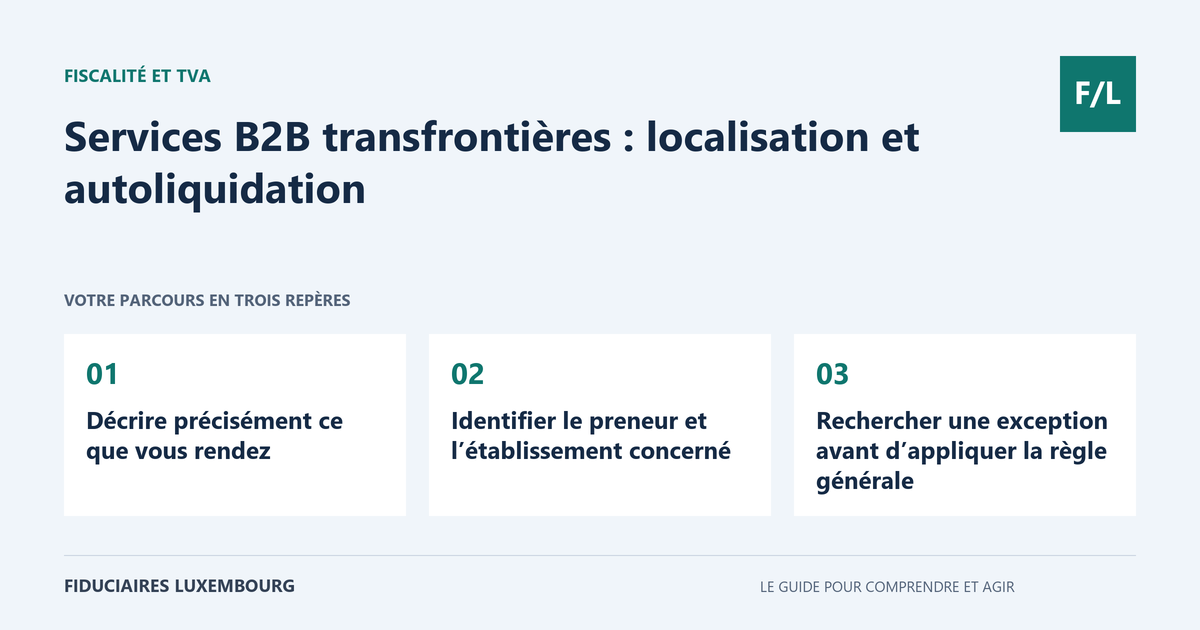
“The customer is a foreign company, so I invoice without VAT.” This shortcut works poorly as soon as the service concerns a property, an event or an establishment other than the head office. To reason correctly, separate the questions: what service, which recipient, what place of taxation, then who must declare the tax? This method helps prepare invoices and purchases of foreign services.
The framework to verify
For B2B services falling under the general rule, the place of taxation is in principle where the taxable recipient acting as such is established, taking into account the establishment concerned. Exceptions exist in particular for real estate, certain admissions to events, catering and transport hire. The reverse charge then depends on the applicable conditions. A supply outside Luxembourg’s territorial scope should not automatically be described as a Luxembourg exemption.
Describe precisely what you provide
The word “consulting” on an invoice is not enough to classify an entire service. Review the contract, the deliverables and the actual work. General business support, a service directly connected with real estate and a right of admission to an event may require different reasoning. If the offer combines several elements, explain how they are sold and used.
Avoid choosing the classification solely because it appears simpler in the software. Prepare a few representative examples of your engagements. For new services, have the treatment checked before the first invoice. A documented analysis can then serve as guidance for teams, as long as the facts and rules have not changed.
Identify the recipient and the establishment concerned
Verify who orders and receives the service in their professional capacity. The taxable person status and contractual identity must be established using the relevant information. The VAT number is one of the useful checks within the Union, but the mere presence of the word “company” in a signature does not resolve every situation.
When a customer has several establishments, do not automatically choose the address shown at the top of its letterhead. Ask for the establishment for which the service is provided to be explained. The contract, the order, the nature of the engagement and the correspondence provide information. An administrative billing address and the relevant recipient may require clarification.
Look for an exception before applying the general rule
In particular, ask whether the engagement is directly connected with real estate or constitutes admission to an event. For events, also distinguish physical attendance from virtual participation: current rules do not allow the physical location to be mechanically applied to every online service. The exact format and content of the service matter.
Catering services, passenger transport and certain hires are also subject to specific rules. This guide does not replace their examination. A useful internal form includes a “rule applied” column and a “reasons” column. It helps identify the file that falls outside the usual model instead of forcing it into that model.
Determine who declares the tax
Where the conditions are met, the reverse charge makes the customer responsible for declaring the tax. The invoice and returns must reflect this mechanism. For a service received from a foreign supplier, the absence of VAT charged therefore does not mean there is no work to do in your own return.
Examine the right to deduct separately. A business cannot conclude that the transaction is always neutral simply because it applies the reverse charge. The nature of its activities and the use of the service may limit the deduction. In particular, a business purchase made under an exemption scheme deserves analysis before being presented as having no tax cost.
Link invoices to reporting obligations
Prepare the information required for the return and, for the relevant supplies within the Union, for the recapitulative statement. Monitoring must distinguish the types of transactions and countries, without treating a service as a supply of goods. Keep the justification for the treatment with the contract and the invoice, so as not to repeat the analysis with every request from the firm.
Check the first invoices received and issued after configuration. If a supplier charges unexpected foreign VAT, ask for the file to be reviewed rather than deducting it directly in Luxembourg. If your own invoice is incorrect, arrange a traceable correction. The accounting entries and documents must remain consistent.
The table for taking action
| Question | Items to gather | What this prepares |
|---|---|---|
| What service? | Contract, deliverables, terms | Classification of the service |
| Which recipient? | Identity, status, recipient establishment | B2B rule or another situation |
| Which exception? | Real estate, event, transport, catering… | Relevant place of taxation |
| Which person liable? | Supplier’s establishment and applicable rule | Invoicing or reverse charge |
| Which obligations? | Use, right to deduct, country | Returns and documents to retain |
Two services for the same customer do not necessarily follow the same path
Fictitious example: a Luxembourg business sells a general consulting engagement to a business customer established in another Member State. It examines the B2B rule, the recipient and the reverse-charge conditions. The same customer then asks it for a service directly linked to a specific property. The business does not automatically duplicate the treatment of the first invoice. It sends the new engagement and the location of the property to the firm. The customer is the same, but the nature of the service has changed. The file retains two separate justifications, making the configuration understandable for the person who will invoice the next engagement.
Your preparation checklist
- Describe the actual service, not just its commercial title.
- Identify the customer and its professional capacity.
- Clarify the recipient establishment.
- Look for special rules before the general rule.
- Separate the person liable for the tax from the right to deduct.
- Prepare the invoice, return and any recapitulative statement.
- Review the treatment when an engagement changes in nature.
Frequently asked questions
Does B2B always mean an invoice without VAT?
No. The place, exceptions and person liable must be determined. The business relationship is not enough.
Does applying the reverse charge always make VAT neutral?
No. Tax due and its deduction are two separate questions. A limited right to deduct may leave a cost.
Can the same rule be applied to all events?
No. In particular, the nature of the service, the customer’s status and physical or virtual participation must be distinguished.
Useful terms in this guide
Questions to ask the professional
- Which engagements in our catalogue are subject to special rules?
- Which supporting documents establish the recipient and its establishment?
- How should we check our purchases of foreign services and their deduction?
To define the engagement to be entrusted more precisely, also consult our taxation section.
What about your situation?
Prepare a representative contract and an invoice received from a foreign service provider. These two examples will make it possible to examine your sales and purchases together. To set the right parameters, search the professional directory for a professional who can work based on your actual transactions.
Sources and verification
References consulted on 20 September 2026. Official procedures specify the applicable conditions and exceptions.
- AED — déterminer le lieu des prestations de services
- Commission européenne — lieu de taxation TVA
- AED — loi TVA coordonnée au 1er janvier 2026
This guide explains a general process. The applicable rules depend on your situation; it does not constitute personalised advice. Report a correction.
Your next step
A specific need deserves the right contact
Accounting, taxation, company formation or payroll: prepare your questions, then search the directory for the professional who can review your situation. Check their assignments and status before entrusting them with your file.