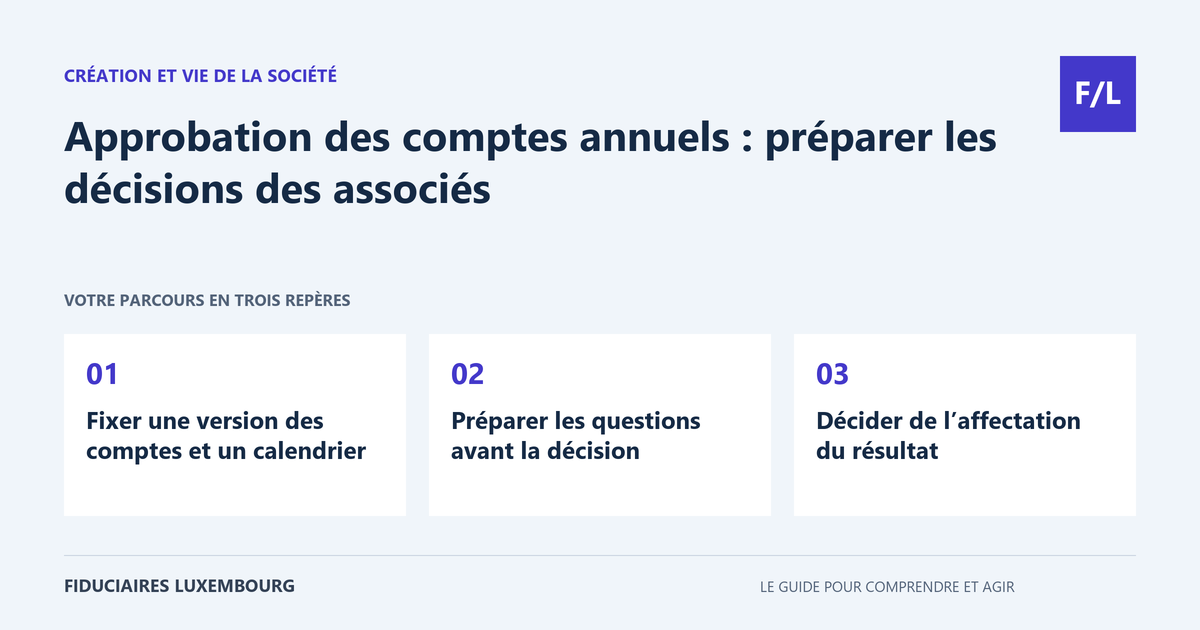
The accountant provides you with the accounts and proposes preparing the annual decisions. Before signing, take the time to understand what is being submitted to the shareholders. Approving accounts, deciding how to allocate the result and arranging their filing are three connected but distinct steps. Good preparation makes it possible to ask useful questions and keep clear evidence of what was decided.
The framework to check
For companies covered by the general regime, approval takes place within six months of the financial year-end. Filing must follow within one month of approval, without exceeding seven months after the financial year-end. The competent body and the decision-making method depend on the legal form, the law and the articles of association: do not assume that a physical meeting is always mandatory or that the manager’s signature is sufficient. This guide concerns the preparation of a company’s annual decisions, excluding special regimes.
Set a version of the accounts and a timetable
Start with the financial year-end closing file. Missing invoices, estimates and significant reconciliations must have been expressly addressed. Ask which points remain open and who validates them. A scheduled meeting does not make a provisional version final; the date and content must be coordinated.
Identify the financial year, the version and the documents concerned: balance sheet, profit and loss account, notes and reports required as applicable. Give a stable file name to the complete set provided to the decision-makers. If a correction is made, specify precisely which version it replaces and check that everyone is now working from the same set of accounts.
Prepare questions before the decision
The annual accounts must make it possible to understand the main events of the financial year. Note unusual movements, long-standing receivables, significant debts and transactions with shareholders. Request an explanation in plain language, together with the relevant supporting documents. This preparation is more useful than a quick review of the profit amount alone.
Distinguish questions concerning the closed financial year from those concerning the current situation. A decline in cash receipts since the year-end may matter for management decisions and must be brought to the attention of the competent parties. Prepare the legally required reports and information without confusing this file with an additional audit invented for all companies.
Decide on the appropriation of profit or loss
The appropriation of profit or loss explains how the result for the financial year is used. Have the profit or loss, prior results and reserves reconciled. Mandatory appropriations, the articles of association and distribution limits must be reviewed before proposing an amount to the shareholders. The profit or loss line in the balance sheet is not, by itself, an amount that can be freely withdrawn.
Include a cash flow review. A distribution that is possible based on the accounts may still weigh on future payments. Compare its timing with the cash flow plan and known commitments. If a distribution is decided, its tax treatment and formalities must be prepared separately; an entry making funds available may already have consequences to analyse.
Comply with the applicable decision-making method
Refer to the articles of association to determine the rules on notices, documents, representation and voting procedures. Depending on the legal form and applicable conditions, a decision may be taken at a meeting, by written consultation or by the sole shareholder. Ask the professional which arrangement is appropriate. A generic template must not override shareholders’ rights to information and participation.
Prepare an agenda that clearly distinguishes the resolutions. Approval of the accounts, appropriation and other decisions must not be buried in a general wording. In the event of disagreement or a request for correction, keep a record of the matter and have the next steps reviewed. Do not backdate a document to artificially align the file with the planned timetable.
Keep the decisions and submit the correct file
The minutes or the appropriate decision document must identify what was adopted and under which procedures. Check that they correspond with the approved accounts and the appropriation figures. The number of signatures does not replace verifying the authorised persons and the rules applicable to the decision.
Then provide the validated version to the person responsible for the filing of the accounts. Request verification of the result and retention of the evidence. Also assign the operational follow-up: appropriation entries, any payment, withholdings and informing partners where necessary. Each follow-up action must have a clearly identified person responsible.
The table to take action
| Document or step | What is it for? | Useful check |
|---|---|---|
| Final accounts | Present the closed financial year | Consistent version and figures |
| Shareholder information | Allow review and questions | Documents available in accordance with the rules |
| Approval decision | Record the choice of the competent body | Accounts referred to and procedures complied with |
| Appropriation of profit or loss | Determine the treatment of the result | Reserves, losses and limits reviewed |
| Filing | Complete the disclosure formality | File and proof of processing |
A profit does not mean that the bank contains the same amount
Fictitious example: a company reports a profit of 40 000 euros, but a significant portion of its sales remains to be collected. The shareholders are considering a distribution. The preparatory file first reconciles the result and the appropriation rules; it then shows the payments planned to suppliers and tax due dates. The shareholders can therefore review an amount and a timetable on an explicit basis. The example does not set any distributable amount: this depends on the accounts, any losses, reserves and applicable rules. It shows why profit or loss and cash flow must be reviewed together before the decision.
Your preparation checklist
- Set the financial year-end date and applicable deadlines.
- Identify the final version of the accounts.
- Resolve or explain outstanding year-end closing matters.
- Prepare shareholder information and questions.
- Review the rules on the appropriation of profit or loss.
- Check the decision-making method and participation rights.
- Keep decisions without backdating.
- Submit the approved file and follow up on its filing.
Frequently asked questions
Does approving the accounts mean distributing the profit?
No. Approval and appropriation are separate decisions. In particular, the profit may be retained under the applicable rules.
Does eCDF validation replace the shareholders’ decision?
No. Data validation on a platform does not replace the decision of the competent body.
Can you wait seven months even if approval takes place earlier?
The one-month deadline after approval must also be observed. The seven-month maximum does not override this deadline.
Useful terms in this guide
Questions to ask the professional
- Which points in the accounts require an explanation?
- What appropriation is possible and compatible with cash flow?
- What proof will be provided to us after filing?
To clarify the assignment to be entrusted, also consult our company formation file.
What about your situation?
Prepare your questions before the decision, with the accounts, prior results and an overview of cash flow. To organise the approval process and its follow-up, search our directory for a professional who can coordinate your company’s accounting and formalities.
Sources and verification
References consulted on 20 September 2026. Official procedures specify the applicable conditions and exceptions.
This guide explains a general process. The applicable rules depend on your situation; it does not constitute personalised advice. Report a correction.
Your next step
A specific need deserves the right contact
Accounting, taxation, company formation or payroll: prepare your questions, then search the directory for the professional who can review your situation. Check their assignments and status before entrusting them with your file.