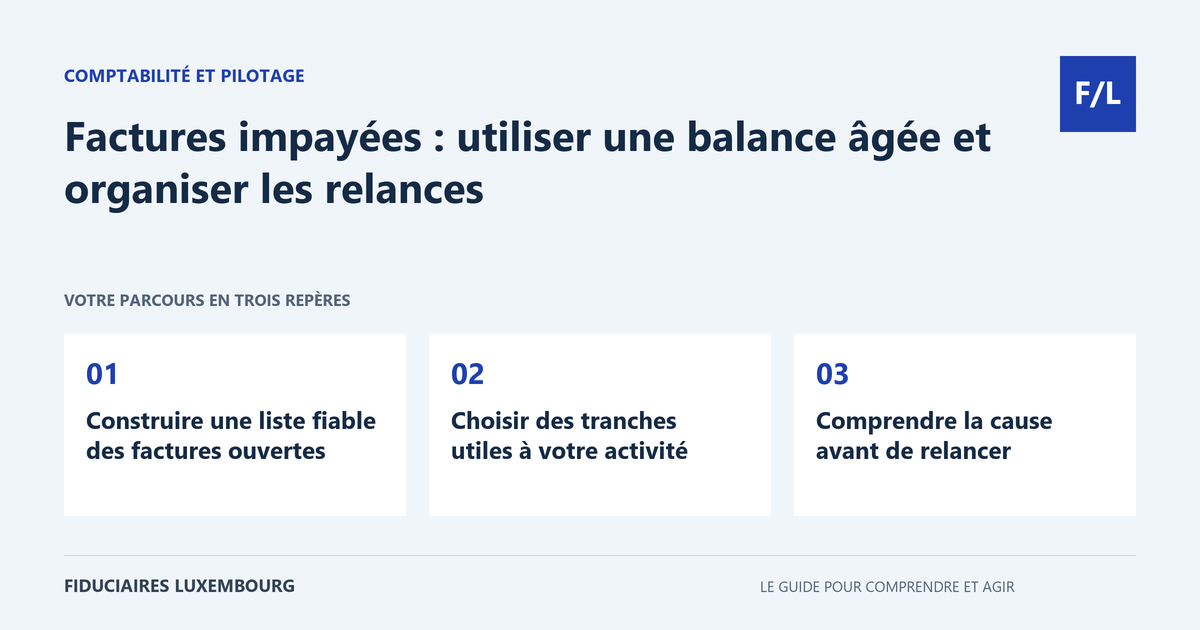
Your revenue is growing, but collections are not keeping pace. Before sending the same reminder to all customers, look at what lies behind the open invoices: a future due date, a missing document, a dispute or an unfulfilled payment promise. The aged receivables report makes it possible to turn a list of amounts into specific actions.
The framework to check
Payment terms and late-payment interest depend in particular on the type of customer: business, public authority or consumer. An internal follow-up schedule does not replace these rules. Before claiming interest, compensation or initiating proceedings, check the contract, the applicable terms and the evidence supporting the receivable. An accounting impairment and a debt waiver are also two different decisions.
Building a reliable list of open invoices
Start with the invoices, credit notes and payments allocated to each customer. Check that payments received have been correctly matched to the corresponding invoices. A customer may appear to be late simply because their bank transfer has remained unallocated. Conversely, a partially paid invoice must remain visible for its outstanding balance.
The aged receivables report allocates amounts according to their age on a given date. Specify whether the software calculates this age from the issue date or from the due date. To organise follow-ups, lateness against a verified due date is generally more meaningful. Keep a column for invoices that are not yet due so that they are not mixed with overdue amounts.
Choosing ranges that are useful for your business
You can distinguish amounts not yet due, then delays of 1 to 30 days, 31 to 60 days, 61 to 90 days and beyond. These ranges are a proposed management tool, not universal statutory deadlines. A company that invoices every week may prefer more detailed monitoring. The important thing is to keep the same convention in order to compare periods.
Also look at concentration. A single large receivable may weigh more heavily than twenty small delays. Display the total by customer and the amount under dispute. Where useful, add the salesperson or engagement manager who knows the file. Financial analysis benefits from being linked to the real relationship with the customer.
Understanding the cause before following up
A good initial discussion checks that the customer has received the invoice, that it is addressed to the correct entity and that the information required for payment is included. In some organisations, the absence of a purchase order number or service approval is enough to block payment. Resolving this issue may be more effective than a succession of identical messages.
If the customer disputes part of the service, record the reason, the amount concerned and the person who can respond. Separate the disputed amount from the remainder where relevant and validated. Do not promise either a discount or an additional deadline without knowing the scope of your authority. Any agreed solution must be retained in the file.
Tracking payment commitments
After the discussion, record a dated next action: resend a document, call back on the stated date, obtain approval or refer the file to an adviser. The “followed up” column is not enough; it states neither what was requested nor what was promised. A brief and precise history avoids restarting the discussion every time the contact person changes.
A payment promise is not a collection. In your cash-flow forecast, distinguish the selected scenario from the uncertainties. If a customer fails to meet several commitments, review the collection assumption and have the situation assessed. The working capital requirement increases when sales take longer to turn into available cash.
Providing useful signals to the accounting department
Inform the firm of disputes, proceedings, known customer difficulties, payment schedules and payments made after the reporting date. These elements may matter when assessing the value of receivables. Simply moving into an ageing range is not enough to decide mechanically on the treatment of a doubtful receivable.
Keep invoices, contracts, evidence of service delivery, correspondence and decisions. If a credit note is necessary, it must correspond to a genuine and documented correction. Issuing a credit note solely to make an unpaid invoice disappear would obscure the analysis of the sale and the risk of non-collection. The accounting, tax and legal consequences must be considered separately.
The table for taking action
| Situation | Information to obtain | Next action |
|---|---|---|
| Invoice not yet due | Correct contractual due date | Monitor without treating it as a delay |
| Administrative delay | Missing document or approval | Provide the missing item and confirm its receipt |
| Disputed amount | Reason and scope of the dispute | Have the appropriate person respond |
| Unfulfilled promise | New explanation and ability to pay | Revise the scenario and consider seeking advice |
Three delays, three different responses
Fictional example: a company has 18,000 euros in open invoices. An invoice for 8,000 euros is not yet due. An invoice for 6,000 euros is overdue because the customer is awaiting proof of receipt. The remaining 4,000 euros are subject to a disagreement over the scope of an engagement. The director therefore does not classify the 18,000 euros as one single amount “in difficulty”. They keep the 8,000 euros under future due dates, arrange for the supporting document to be sent for the 6,000 euros and organise a response to the 4,000-euro dispute. For cash-flow purposes, they retain a cautious assumption until a credible date has been obtained for the disputed amount.
Your preparation checklist
- Match payments and credit notes before following up.
- Check the due date and the convention used to calculate ageing.
- Distinguish between an administrative delay, a dispute and financial difficulty.
- Keep correspondence and commitments made.
- Assign a next action to a person and a date.
- Provide the firm with information that may affect the value of the receivable.
Frequently asked questions
Should all open invoices be followed up automatically?
No. An open invoice may not yet be due or may already be subject to agreed handling. Automation must take account of the status of the file to avoid inappropriate messages.
Should an old invoice be written off?
Its age calls for an analysis. Deletion, a credit note, a waiver and impairment do not mean the same thing. Have the appropriate treatment determined using the documents in the file.
Can a single interest rate be applied to all customers?
Do not assume so. The nature of the transaction, the contract and the applicable rules must be checked. The statutory rate may also change; use the official reference relevant to the period.
Useful terms in this guide
Questions to ask the professional
- What supporting documents do you need to assess receivables in difficulty?
- How should partial payments and credit notes be included in our monitoring?
- At what point should a debt collection professional or legal adviser be involved?
To clarify the engagement to be assigned, also consult our accounting section.
And for your situation?
Your first improvement can be very simple: review the ten largest invoices and give each one a next action. If you need to make your accounting monitoring more reliable or assess the consequences of unpaid invoices, search for a professional in our directory. A file organised by situation will enable them to answer you more precisely.
Sources and verification
References consulted on 20 September 2026. Official procedures specify the applicable conditions and exceptions.
- Guichet.lu — délais de paiement et intérêts de retard
- Guichet.lu — méthodes d’établissement des comptes
This guide explains a general process. The applicable rules depend on your situation; it does not constitute personalised advice. Report a correction.
Your next step
A specific need deserves the right contact
Accounting, taxation, company formation or payroll: prepare your questions, then search the directory for the professional who can review your situation. Check their assignments and status before entrusting them with your file.