Your bank shows one balance, while your accounts show another. This difference is not necessarily an error: some transactions pass through the two systems on different dates. The right approach is to build a bridge between the amounts. You must be able to explain every difference and know what remains to be checked.
The framework to review
Bank reconciliation is a tool for checking bookkeeping. It does not, on its own, certify the accounts or the authenticity of all transactions. The method, frequency and approvals must be adapted to the business activity and the responsibilities agreed with the professional. A bank transaction alone is not sufficient to establish the accounting or tax nature of an expense.
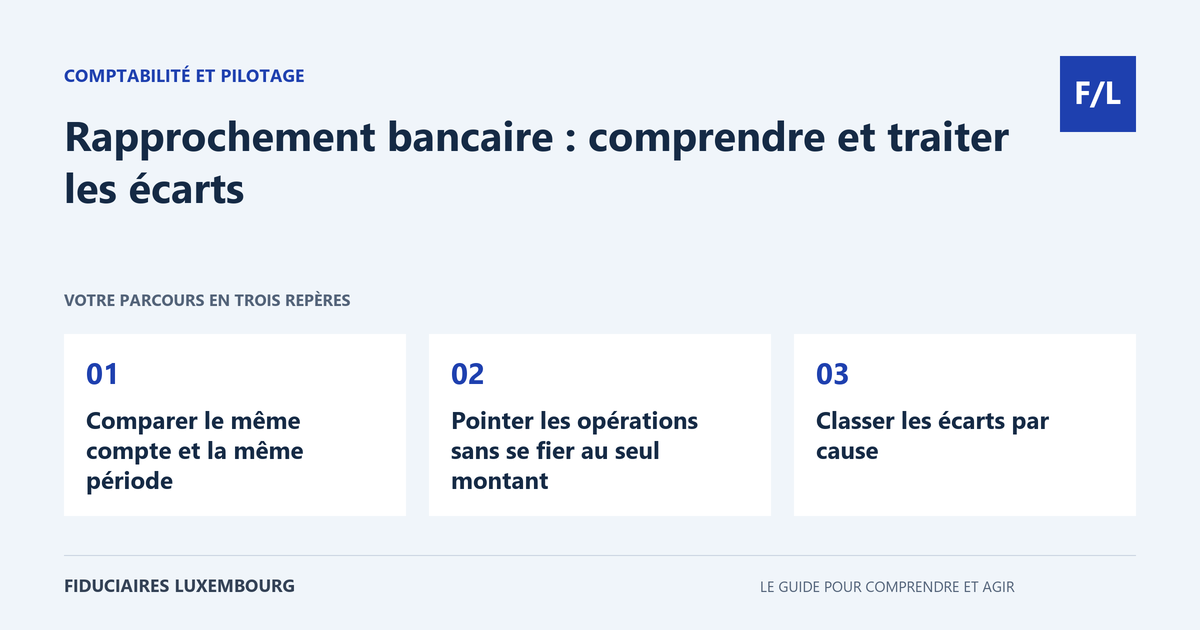
Compare the same account and the same period
Start by checking the bank account number, currency and closing date. An export for the current month compared with a trial balance closed at the end of the previous month creates a purely artificial discrepancy. Keep the complete statement, including its opening balance, transactions and closing balance. Partial screenshots make the review more difficult.
In the accounts, select the account that actually corresponds to that bank. In an organisation using several banks, cards or payment services, flows may pass through intermediary accounts. List these channels from the outset. The general ledger helps you find the entries; the statement remains the reference for transactions recorded by the bank.
Match transactions without relying on the amount alone
For each line, match the amount, date, beneficiary and reference. Two identical payments may relate to different invoices. An abbreviated description may hide a known provider under another name. Where the match is certain, mark the relevant lines and retain the link to the accounting document.
Grouped settlements require particular attention. A platform payment may aggregate several sales and deduct commissions. A customer remittance may settle several invoices. Use the detail provided by the intermediary rather than treating the net amount as a single sale. Show the items that explain the transition from gross to net.
Classify discrepancies by cause
Once transactions have been matched, the remaining lines become your work list. Separate known transactions recorded on different dates, bank transactions not yet recorded in the accounts, and entries requiring investigation. This classification avoids handling a payment in progress, bank fees and a payment without supporting documentation in the same way.
Do not let discrepancies age without a decision. Add a date of first occurrence and the name of the person responsible for responding. A discrepancy carried forward for several months may reveal a duplicate, incorrect allocation or a transaction that will no longer take place. Its age is a reason to investigate, not a reason to delete it.
Correct the right information
If a transaction is missing from the accounts, find the document and its classification before recording it. If an entry is duplicated, have the correction documented in accordance with how the software operates. If the difference is solely due to the date on which the transaction is processed by the bank, the reconciliation may retain a timing line without creating a new expense.
An exchange difference, a commission or a rounding difference requires a proper explanation. The objective is not to place all discrepancies in a suspense account. Ask the firm which discrepancies can be handled through the normal process, which require additional documentation, and which must be brought to the attention of the company director.
Have the result reviewed and follow up the following month
Prepare a brief summary: balances compared, identified differences, corrections made and outstanding items. A person who did not perform the matching should be able to understand the result without redoing all the work. Keep the export used, as data in live software may subsequently change.
At the next reconciliation, start with the old pending items. Have they been settled, corrected or explained? Then review the new transactions. This continuity turns a year-end exercise into a useful control throughout the year. It also improves the quality of the financial forecast: a poorly understood available balance distorts your payment decisions.
The table for taking action
| Observed discrepancy | Possible cause | Preparatory action |
|---|---|---|
| Payment in the accounts, absent from the statement | Instruction still in progress or incorrect bank | Check the payment status and the next statement |
| Fees on the statement, absent from the accounts | Entry to be completed | Obtain the bank supporting document |
| Payment lower than expected sales | Commission or partial settlement | Request the platform statement |
| Two entries for a single bank line | Possible duplicate | Compare references and documents before correction |
An explained discrepancy, without an artificial entry
Fictitious example: as at 30 June, the bank statement shows EUR 10,000. The bank account in the accounts shows EUR 9,050. The team finds a supplier payment of EUR 1,000 recorded in June but processed by the bank on 2 July. It also identifies EUR 50 in fees already debited but not yet recorded in the accounts. After the justified recording of the fees, the accounting balance becomes EUR 9,000. By adding back the EUR 1,000 payment still in transit to compare with the statement of 30 June, the result is EUR 10,000. The dates and documents explain the reconciliation; no expense of EUR 950 was invented to balance the accounts.
Your preparation checklist
- Same account, same currency and same closing date.
- Complete statement and accounting export retained.
- Matching by references, not only by amounts.
- Discrepancies classified, documented and assigned to a responsible person.
- Corrections approved and old lines followed up.
- Summary understandable by a second person.
Frequently asked questions
Should you wait for the annual closing?
More regular monitoring is generally easier to explain, because people still remember the transactions. The frequency depends on volume and risks; it is defined with your accounting organisation.
Is an automatic reconciliation sufficient?
It can speed up matching, but groupings, duplicates and ambiguous references must be checked. A match proposed by the software remains a proposal.
Does a nil discrepancy mean that everything is correct?
No. Errors may offset each other. The review must cover the transactions and their supporting documents, not only the final total.
Useful terms in this guide
Questions to ask the professional
- Who prepares, reviews and approves the reconciliation?
- What detail should we obtain from banks and payment platforms?
- How should old discrepancies be handled and followed up?
To clarify the assignment to be entrusted, also consult our accounting section.
And for your situation?
Choose an account and a full month to test the method. If discrepancies remain difficult to explain, send the statement, the general ledger and your list of investigations to a professional. The directory helps you find a fiduciary firm or chartered accountant with whom to organise this review on a regular basis. Find the professional suited to your needs.
Sources and verification
References consulted on 20 September 2026. Official procedures specify the applicable conditions and exceptions.
- Guichet.lu — obligations comptables des entreprises
- Guichet.lu — méthodes d’établissement des comptes
This guide explains a general process. The applicable rules depend on your situation; it does not constitute personalised advice. Report a correction.
Your next step
A specific need deserves the right contact
Accounting, taxation, company formation or payroll: prepare your questions, then search the directory for the professional who can review your situation. Check their assignments and status before entrusting them with your file.