An invoice in an inbox, a receipt on a phone and a statement in a banking portal: the documents exist, but no one can find the complete file. If this sounds familiar, start by organising their journey. Good filing enables you to answer an accounting question without relying on the memory of the person who made the payment.
The framework to check
Record-keeping and retention obligations depend on the business and the documents. Guichet.lu indicates a general accounting retention period of ten years. This reference point does not justify automatic destruction: disputes, tax obligations, contracts or personal data may require separate analysis. Have the location, format and retention conditions confirmed before changing your organisation or outsourcing archives.
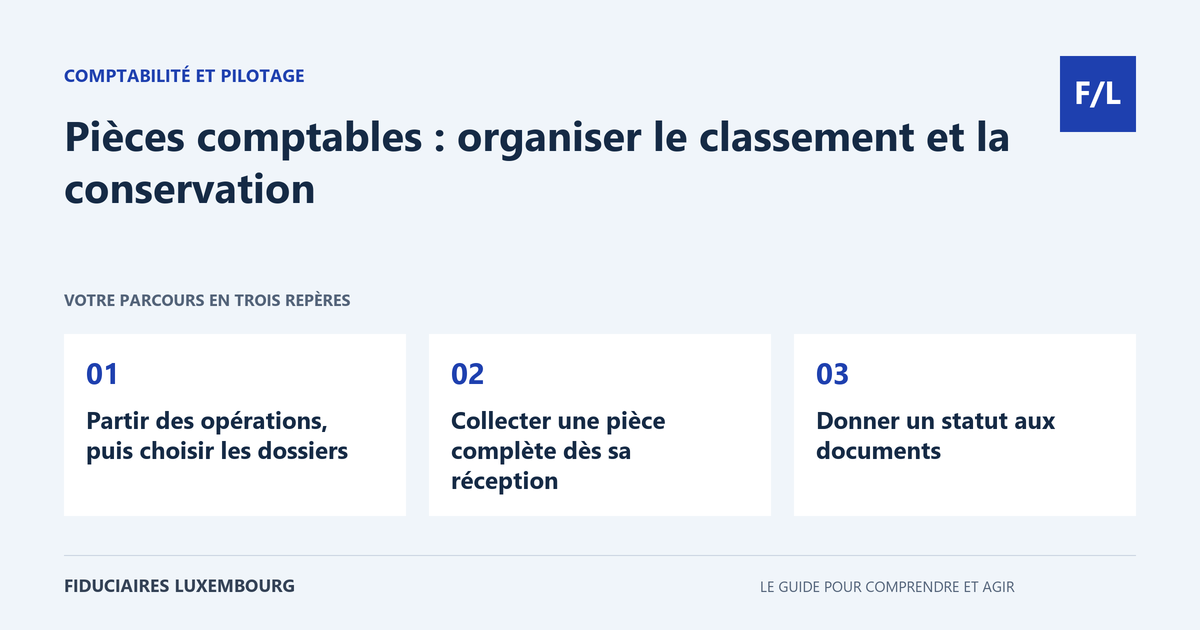
Start with transactions, then choose the folders
List your actual flows: purchases, sales, bank, cash, expense claims, salaries, contracts and investments. For each flow, name the person who receives the document, the person who checks the transaction and the person who forwards the file. In a small structure, the same person may perform several tasks; the process must nevertheless be explicit.
Adopt a few rules that are easy to follow. One folder per financial year, then by document category, may be sufficient. Within it, use a consistent date, the name of the third party and the document reference. Also retain its original number: your file name must not replace the identifier provided by the supplier. Avoid personal folders that the rest of the team cannot find.
Collect a complete document as soon as it is received
The accounting document must remain legible and usable. Check the pages, the annexes that explain the amount, the invoiced entity and the date. A cropped photograph may omit the reference of a transaction. A preview received by messaging does not always replace the complete document available in the supplier's portal.
The payment and the invoice answer two different questions. The statement proves a bank transaction; the invoice explains what was bought or sold. Link them rather than choosing one of the two. If supporting evidence is missing, note who must request it and by when. This prevents an unexplained entry from being copied each month into the list of anomalies.
Assign a status to documents
Clearly separate “received”, “to be completed”, “validated”, “sent” and “processed”. These statuses can be maintained in a document management tool or a small shared table. Their value lies in making work visible: the manager knows what is awaiting a decision, and the firm knows what it can use without asking you the same question again.
When a document is corrected, retain the link with the previous version and explain the correction. Do not silently replace an invoice that has already been used. What is needed is a comprehensible audit trail: it must be possible to start from the entry and find the document, then understand the validations and amendments that followed.
Prepare regular submission to the firm
Set a frequency suited to the volume and deadlines. The submission must include the documents and the information that the document does not state: purpose of an unusual expense, partial reimbursement, dispute or acquisition intended for several uses. A short note attached to the relevant reference is better than an explanation scattered across several exchanges.
Ask the firm to confirm the export format and its process for questions. Who receives the list of missing documents? Who closes a resolved item? How is a document received after submission handled? These answers can be specified in the engagement letter or in a shared working procedure, without creating a disproportionate document.
Test retention and exit from the tool
A backup does not replace filing, and filing does not replace a backup. Regularly test opening a document and restoring a folder. Also check who retains access when the responsible employee leaves the company. Permissions must correspond to roles; not everyone needs to see payroll documents or banking information.
Before changing software or service provider, request a test export with its references. Open the files, check the links and identify formats that still require a licence. Reversibility of accounting data must be prepared before termination: the former tool must not become the only place where your records remain understandable.
The table to take action
| Document | Reference to retain | Useful check |
|---|---|---|
| Supplier invoice | Original number and internal reference | Entity, amount, purpose and link to payment |
| Expense claim | Name, period and supporting documents | Business purpose and approval |
| Bank statement | Account and complete period | Continuity with the previous statement |
| Contract | Parties, signed version and date | Deadlines, amendments and responsible person |
A file found in a few minutes
Fictitious example: a service company has to explain an expense of 840 euros several months after its payment. The statement shows only the abbreviated name of the supplier. Thanks to the internal reference, the person in charge finds the invoice, the acceptance of the quotation and the note specifying the use of the equipment. She also notes that a credit note of 120 euros was subsequently received. The file sent to the firm contains both documents and their respective payments. Without this matching, simply filing the initial invoice would have left incomplete information. The useful outcome is therefore not merely finding a file: it is reconstructing the transaction and its subsequent developments.
Your preparation checklist
- Define a person responsible for collection for each flow.
- Retain the original number, the complete document and its useful annexes.
- Link invoice, payment, credit note and comment.
- Maintain a list of missing documents with the responsible person and deadline.
- Test restoration and export of the file.
- Have the retention policy confirmed before any destruction.
Frequently asked questions
Is complex software required to get started?
No. A simple system can be effective if it is shared, secure and used regularly. The volume, users and exchanges with the firm will then determine the necessary functions.
Can originals be discarded after they have been scanned?
Do not decide this based solely on available space. Have the requirements regarding evidence, integrity and retention, as well as the rules specific to the documents concerned, checked.
How should a document received twice be handled?
Identify the duplicate using the supplier reference, date and amount. Keep one reference version and report the duplicate; two files must not lead to two processing actions for the same transaction.
Useful terms in this guide
Questions to ask the professional
- What filing system and export format enable you to work efficiently?
- Which documents must we retain in their original form?
- How will we jointly track missing documents and corrections?
To clarify the assignment to be entrusted, also consult our accounting section.
And for your situation?
Take a recent month and apply this method to a few transactions. The difficulties encountered will reveal the real improvements to make. To organise the process and clarify your retention obligations, search our directory for an accounting firm or chartered accountant suited to your business, then bring them a specific file to review.
Sources and verification
References consulted on 20 September 2026. Official procedures specify the applicable conditions and exceptions.
- Guichet.lu — obligations comptables des entreprises
- Guichet.lu — méthodes d’établissement des comptes
- CNPD — outils et obligations des professionnels
This guide explains a general process. The applicable rules depend on your situation; it does not constitute personalised advice. Report a correction.
Your next step
A specific need deserves the right contact
Accounting, taxation, company formation or payroll: prepare your questions, then search the directory for the professional who can review your situation. Check their assignments and status before entrusting them with your file.