Your company is registered in the register and its bank account is operational. This does not mean that all VAT formalities have been completed. Before the first sales, but also before certain foreign purchases, transactions must be classified and the appropriate identification prepared. The most useful approach is to start with your actual business activity rather than a box ticked too quickly on a form.
The framework to review
Guichet.lu indicates that registration must take place within fifteen days of the start of business activity for taxable persons who are not exempt. Certain persons initially exempt must take action before specific transactions, including cross-border services or relevant acquisitions. The arrangements depend on the status and the transactions. The exemption scheme does not remove the need for every formality. This guide prepares the file for a Luxembourg business activity; a business not established in Luxembourg, a VAT group or a sector-specific scheme requires a specific review.
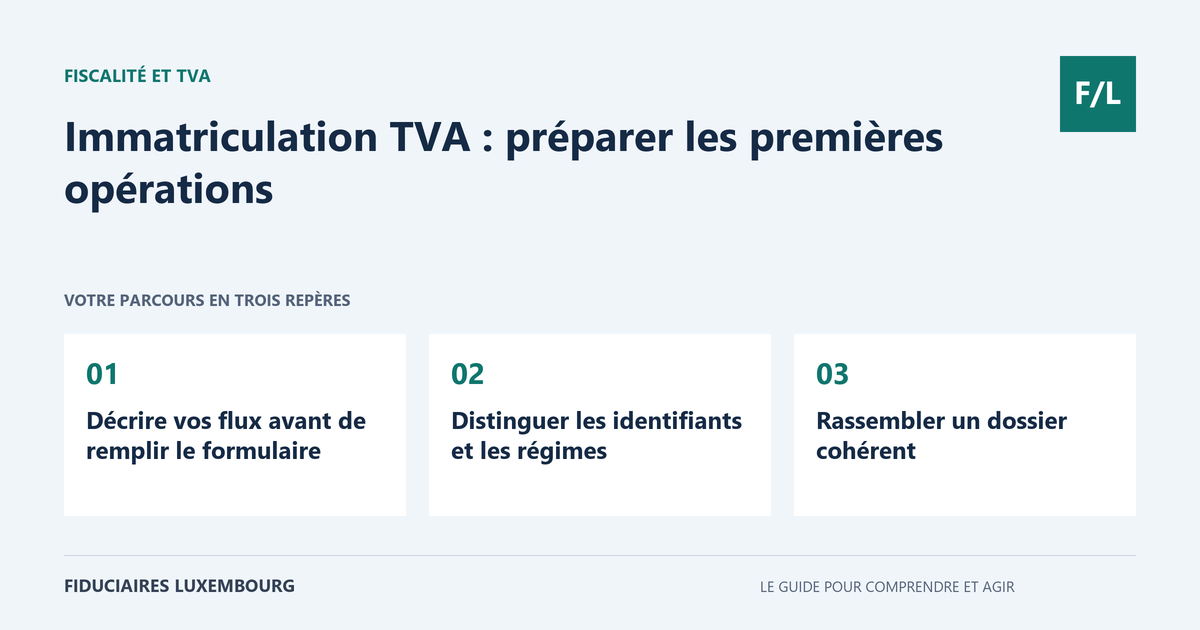
Describe your flows before completing the form
Draw up a simple map of the business activity: what you sell, what you buy, the countries of dispatch and destination of goods, and the types of customers. A shop holding stock in Luxembourg, a consultant and an online platform do not face the same questions. Also write down who concludes the contract and who physically carries out the transaction.
Do not limit the exercise to expected revenue. Initial purchases of software, advertising or equipment may involve a foreign supplier. Inform the firm of these items before assuming that no formality is required as long as you have not made any sales. A modest transaction may raise an identification issue even where turnover is not high.
Distinguish identifiers and schemes
The register number identifies the entity within its legal framework. The VAT number relates to a different arrangement. The business permit concerns the conduct of the relevant activity. Compile a file that makes it possible to find the three pieces of information when they apply, without substituting one for another on forms or invoices.
Have the intended scheme reviewed: standard taxation, exemption scheme or a specific situation. Being a VAT taxable person does not mean that every sale necessarily bears VAT charged to the customer. Conversely, the absence of VAT on your sales does not answer all questions concerning your purchases. Record the assumptions adopted and the situations that will require a new analysis.
Compile a consistent file
Prepare the identification and representation details, the start date, the description of the activity, relevant forecasts and the requested bank details. Depending on your situation, the supporting documents may differ. Consult the official procedure applicable to a natural or legal person and have the list checked before submission.
Consistency matters as much as the presence of documents. An activity described very broadly in the articles of association may be narrower at the outset. Explain what is starting now and what relates to a future project. Forecasts must be capable of being linked to your commercial assumptions, without an artificial figure chosen to obtain a particular scheme.
Organise the submission and follow-up
Determine who prepares the application, who validates it and who follows up communications with the AED. If you entrust the work to a firm, specify the documents to be provided and the person responsible for additional responses. An application that has been sent must not disappear from your task list before the reply has been received and reviewed.
Keep a copy of the initial return, proof of submission and messages received. Check that the name, address and activity match the file. Where a document is missing, provide an organised and identifiable response. Do not submit conflicting applications through several people without coordination: this makes follow-up more difficult for everyone.
Prepare for the period after registration
Once the information has been received, update your records, invoice templates and calendar with the obligations that actually apply. Check access rights and responsibilities for returns. The allocation of a number does not constitute general validation of all the rates, exemptions or deduction rights that you may subsequently use.
Schedule a review after the first transactions. Compare what actually happened with the initial file: new country, new type of customer, unusual purchase or additional activity. Report changes to the professional to determine the required adjustments. The file remains useful only if it follows the development of the business.
The table to take action
| Planned flow | Information to specify | Question to resolve |
|---|---|---|
| Local sales | Goods or service, business or private customer | Tax treatment and invoice template |
| Consulting for a foreign customer | Country, status and establishment of the recipient | Place of taxation and obligations |
| Subscription purchased abroad | Supplier, service and recipient | Tax due by the customer and identification |
| Purchase of goods within the EU | Route, seller, volumes and dates | Acquisition and related obligations |
| Online sale | Countries of storage and delivery, customer base | Appropriate scheme and flow monitoring |
A small business activity can have a cross-border file
Fictitious example: an entrepreneur is preparing a local business activity and is considering the exemption scheme. Before her first sale, she subscribes to advertising and software from foreign providers. She does not classify these purchases as simple expenses with no VAT consequences. She gathers the contracts, supplier identities and invoices, then has the resulting obligations reviewed. The firm also reviews her future customers and invoicing scheme. The initial file therefore reflects both sales and purchases. This preparation prevents her from discovering several months later that reasoning based solely on low turnover was incomplete.
Your preparation checklist
- List planned sales and purchases, with the countries.
- Distinguish the natural person, company and relevant establishments.
- Identify the intended scheme and its conditions.
- Consult the official procedure corresponding to the situation.
- Gather documents consistent with the actual start date.
- Appoint a person responsible for monitoring communications.
- Check the first invoices and the calendar after receiving the information.
Frequently asked questions
Does registration in the register automatically result in the correct VAT position?
Do not assume so. The formalities serve different purposes, and the VAT file must be handled according to the transactions.
Must you wait for the first sale before reviewing VAT?
No. Certain purchases, particularly foreign purchases, may already require analysis and formalities.
Does the number received confirm that all VAT on purchases is deductible?
No. The right to deduct depends on conditions specific to the expenses and transactions. It does not result from the number alone.
Useful terms in this guide
- VAT taxable person
- VAT number
- VAT exemption scheme
- Registration Duties, Estates and VAT Authority (AED)
Questions to ask the professional
- Which transactions trigger our formalities and on what date?
- Which documents must be attached to our initial return?
- Who monitors changes in business activity and the first filing obligations?
To define the assignment to be entrusted, also consult our tax section.
And for your situation?
Your next step can be very simple: one page describing your first five types of sales and purchases, with the relevant countries. To turn this map into an appropriate file and schedule, search our directory for a professional accustomed to the transactions you are planning.
Sources and verification
References consulted on 20 September 2026. Official procedures specify the applicable conditions and exceptions.
This guide explains a general process. The applicable rules depend on your situation; it does not constitute personalised advice. Report a correction.
Your next step
A specific need deserves the right contact
Accounting, taxation, company formation or payroll: prepare your questions, then search the directory for the professional who can review your situation. Check their assignments and status before entrusting them with your file.