The work is complete, but the invoice comes back with a request for correction. A trade name has replaced the client company, the service period is missing, or the VAT treatment is not explained. These details delay payment and complicate the accounting file. Before choosing an attractive layout, let us create a document that makes it possible to understand who is invoicing what, to whom and under what conditions.
The framework to check
The required details result in particular from Article 63 of the VAT Law and from the identification rules applicable to the business. A complete invoice includes the relevant dates, a unique number in a sequential series, the parties, the description and the calculation details. Certain details depend on the regime. A simplified invoice may be permitted under certain conditions, in particular for a total not exceeding 100 euros; exclusions exist. Public contracts also follow their own electronic invoicing process.
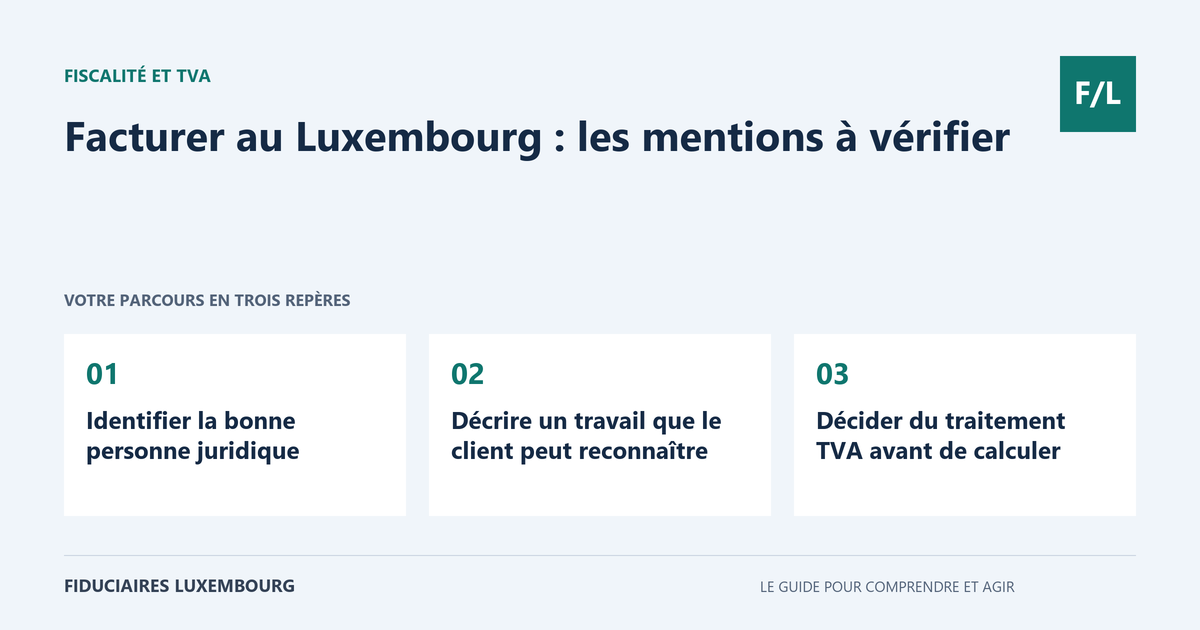
Identify the correct legal entity
Use the supplier's identity and the client's identity from the documents governing the relationship. A trade name, an establishment and a parent company are not interchangeable. If your contact asks you to invoice another entity, obtain an explanation and check who actually ordered the service. The mere fact that two companies belong to the same group is not sufficient to substitute one for the other.
Prepare a validated client file: company name, address, administrative contact and useful tax information. Distinguish the registration number in the register from the VAT number. They do not serve the same purpose. For your own business, also check the details relating to its legal form and its authorisation, where applicable. Keep the date of the latest check.
Describe work that the client can recognise
Avoid lines such as “miscellaneous service” where the file allows for a precise description. State the goods or service, the quantity or scope, as well as the relevant period. An order reference helps link the documents, but it must not be the only element understandable to the person reviewing the invoice.
Distinguish the issue date from the completion date where they differ and must appear. For work carried out in several phases, reconcile amounts already invoiced with new items. A deposit omitted from the final invoice may result in part of the price being claimed twice. Contract monitoring should make this reconciliation straightforward.
Decide on the VAT treatment before calculating
First determine the nature of the transaction, the client's status, the countries concerned and the relevant rules. Do not choose “without VAT” solely because the client is foreign or has a number. Checking the number is a supporting document in the file; it does not replace the analysis of the supply or service.
Organise taxable amounts and taxes according to the applicable treatment. Show the justification and the required details in the event of exemption or reverse charge. For recurring situations, ask the firm for a matrix suited to your activities, including the cases that require its opinion. This is safer than a menu of rates used without explanation.
Organise numbering and corrections
Assign the number at the time provided for in your invoicing procedure and prevent duplicates between users. If you use several series, document their purpose: establishment, activity or another justified organisation. The person responsible for the accounting must be able to understand the series and find the documents without having to reconstruct your method each month.
After issue, do not silently replace the file sent with a different version. Keep a record of the original document and the correction. Depending on the issue, a corrective document or a credit note may be required. Link them clearly. An invoice rejected by a portal and an invoice commercially cancelled are two events that need to be explained, not two equivalent buttons.
Prepare payment and transmission
Separate required details from payment convenience: reference to be used, verified bank details, agreed due date and contact for questions. Check a change of IBAN through a known channel before changing the template. This organisational precaution reduces the risk that a correctly calculated document nevertheless directs payment to the wrong account.
Send the invoice through the correct channel and retain usable proof of sending or submission. A PDF sent to an operational contact may remain invisible to the department that pays. For a public client, check the requirements for a structured invoice and the requested references. Then organise payment follow-up using your aged receivables balance.
The table to take action
| Section | Check before sending | Comparison document |
|---|---|---|
| Identities | Correct entity, correct address, correct identifiers | Contract and client file |
| Transaction | Clear description, period and quantities | Order, delivery or work record |
| Calculation | Consistent prices, discounts, deposits and VAT treatment | Commercial agreement and tax analysis |
| Document | Unique number and checked dates | Invoicing journal |
| Transmission | Correct recipient and correct format | Client instructions and proof of submission |
An accurate invoice sent to the wrong company
Fictional example: an agency completes an assignment for company A, but sends the invoice to company B because its contact uses a group-wide signature. The amount and the service are correct. Before amending the document, the agency reviews the order, identifies the contracting party and asks the client to confirm the administrative process. It retains the initial invoice and has the correction handled with the accounting department. For the next assignment, it validates the entity before the work begins and records the invoicing contact. The benefit comes from this upfront check, not from a detail added at random at the bottom of the page.
Your preparation checklist
- Validate the client entity before issue.
- Reconcile the description, period and order.
- Have unusual VAT situations confirmed.
- Check deposits and discounts.
- Check the number, dates and recipient.
- Archive the version sent and proof of transmission.
- Track corrections and payments without overwriting the history.
Frequently asked questions
Does a foreign VAT number always permit an invoice without VAT?
No. The transaction, its place of taxation and the applicable conditions must be assessed. The number does not answer all these questions.
Is a simple PDF sufficient for a public client?
Do not assume so. The public contracts and concessions concerned require a compliant electronic invoice, transmitted through the appropriate channel.
Should the same template be used for all clients?
A common basis is useful, but the fields and details must correspond to the client's status and the actual treatment of the transaction.
Useful terms in this guide
Questions to ask the professional
- Which categories of transactions should we distinguish in our software?
- Which cases need to be validated before sending?
- How should we document our corrections and our number series?
To clarify the assignment to be entrusted, also consult our taxation file.
And for your situation?
Take three invoices representative of your business and run them through this grid. You will quickly identify the information missing from your process. To review the required details and VAT treatment of your transactions, search our directory for a professional to whom you can present these examples and your contracts.
Sources and verification
References consulted on 20 September 2026. Official procedures specify the applicable conditions and exceptions.
- Guichet.lu — établir une facture
- AED — contenu des factures en matière de TVA
- AED — loi TVA coordonnée au 1er janvier 2026
This guide explains a general process. The applicable rules depend on your situation; it does not constitute personalised advice. Report a correction.
Your next step
A specific need deserves the right contact
Accounting, taxation, company formation or payroll: prepare your questions, then search the directory for the professional who can review your situation. Check their assignments and status before entrusting them with your file.