Two businesses report the same accounting profit: will they pay the same municipal business tax? The calculation depends on several steps, and the name of the municipality does not answer every question. To prepare a useful file, start with the activity, the taxable profit and the establishments concerned. You can then understand where the amount comes from, rather than looking for a single percentage to apply to the result.
The framework to review
MBT applies to commercial, industrial, mining and craft businesses located in Luxembourg, in accordance with the applicable rules. The profit retained may require adjustments distinct from those for CIT. The ACD states an allowance of EUR 17,500 for taxpayers subject to CIT, compared with EUR 40,000 for the other relevant taxpayers; the basic rate is then 3%, before application of the municipal coefficient. This guide does not apply the calculation for a capital company to all self-employed activities.
Identify the activity and actual locations
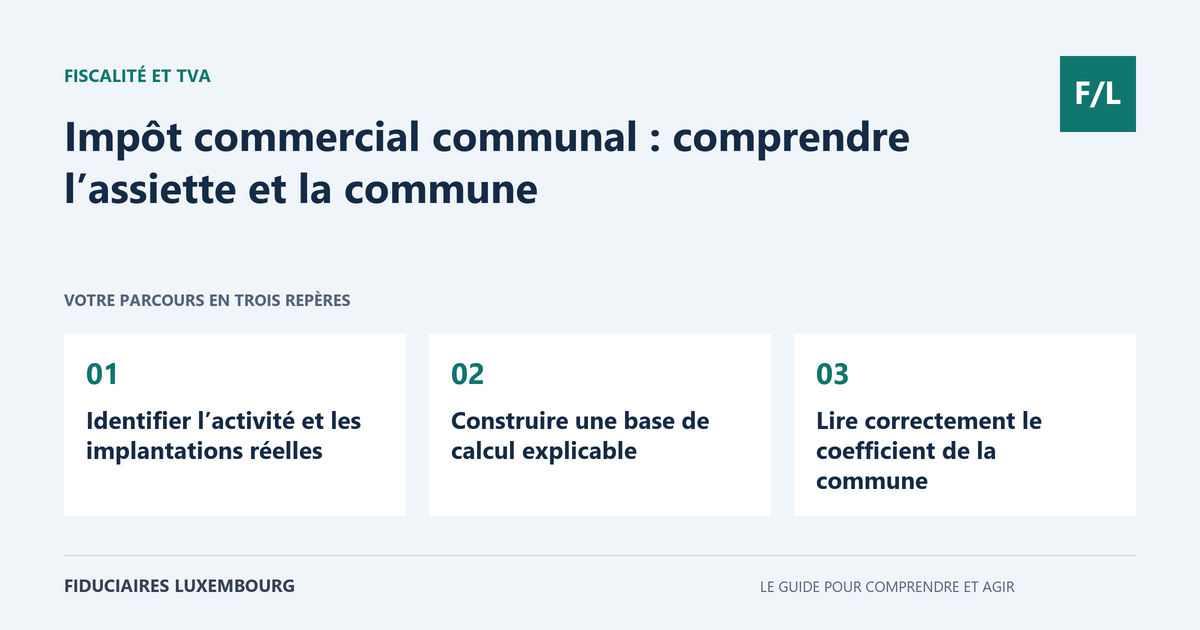
Describe the activity carried out and the legal form, then indicate the places where the business actually operates. A person preparing the file must be able to understand the situation from the contracts, the premises used and the organisation. Do not choose the tax classification solely on the basis of a commercial label or an address appearing on an invoice.
If several establishments or municipalities are involved, inform the professional from the outset. The matter is not necessarily resolved by the registered office address. A location or relocation must be described with its dates and practical effects. The guide on address changes and registered office transfers helps organise the corresponding documents.
Build an explainable calculation base
Start with the tax file for the financial year, then identify the adjustments specific to municipal business tax. Keep the items reviewed and the justification for their treatment. A calculation may appear consistent in total while containing two offsetting errors. The reconciliation table must therefore remain clear line by line.
Shareholdings, activities abroad, prior losses or certain expenses may require specific analysis. Prepare the supporting documents without assuming that their CIT treatment is reproduced exactly for MBT. Our guide on CIT and its advance payments helps distinguish the two follow-ups and avoid having one estimate replace the other through simple copying.
Read the municipal coefficient correctly
The municipal coefficient is multiplied by the calculated base; it is not added to 3%. Thus, to understand the mechanism alone, a coefficient of 250% corresponds to a multiplier of 2.5. This example does not indicate the rate of a particular municipality. The official annual source must be consulted for the place and period actually concerned.
The ACD refers to the publication of coefficients for the year 2026. Keep the reference used in the file so that you can explain a difference between two financial years. Do not choose a municipality on the basis of an old table or an overall rate found without its assumptions. The place of business and location obligations must remain consistent with the operation of the business.
Organise advance payments and cash flow
MBT advance payments normally fall due on 10 February, 10 May, 10 August and 10 November. They therefore do not follow the same timetable as CIT. In your tracking of tax advance payments, create a column for the type of tax, the year, the reference, the amount requested and the payment date.
When expected results change, have the estimate updated and consider whether a reasoned request for amendment should be made. An internal forecast table does not by itself change the amount payable. Record known payments in the cash flow plan and distinguish old balances from current advance payments in order to explain variations in cash outflows.
Reconcile the return, the assessment notice and the accounts
The tax return uses data from the accounts, but the acknowledgement of receipt does not prove that the assessment was established in accordance with your estimate. Upon receipt of the tax assessment document, compare the base, the calculation items and the credits. File the working version used to prepare the return in order to make this comparison possible.
In a capital company, MBT is not a tax-deductible expense as it may be under the framework applicable to certain sole proprietorships or partnerships. Therefore, check the treatment of tax entries when reconciling to taxable profit. If a discrepancy remains unexplained, prepare the documents and have the relevant remedies and deadlines reviewed promptly rather than silently adjusting the table.
The table for taking action
| Step | Question to resolve | Document to retain |
|---|---|---|
| Scope | Which activity and which establishments? | Description and locations |
| Tax base | Which adjustments are retained? | Reconciliation table |
| Calculation | Which allowance and which coefficient? | Dated calculation and annual source |
| Advance payments | To which year does the payment relate? | Notice and payment reference |
| Assessment | What differences are there with the return? | Assessment notice and reconciliation |
A percentage error is enough to distort the forecast
Fictitious example limited to multiplication: an already validated tax base amounts to EUR 6,000. With a hypothetical coefficient of 250%, the result of this step is 6,000 × 2.5, or EUR 15,000. Simply adding EUR 250 or multiplying by 250 would produce an incorrect amount. The actual file must first determine the adjusted profit, the applicable allowance and the coefficient of the municipality concerned. This example therefore constitutes neither an announced municipal rate nor a complete estimate of a business's taxation.
Your preparation checklist
- Describe the activity, status and establishments.
- Record changes in locations.
- Keep the reconciliation to adjusted profit.
- Check the applicable allowance.
- Document the coefficient and year.
- Keep CIT and MBT payment schedules separate.
- Reconcile advance payments with their year.
- Compare the assessment with the filed return.
Frequently asked questions
Is MBT always a percentage of accounting profit?
The calculation starts from a tax base that may differ from the accounting result. The adjustments and allowance must be reviewed.
Is the municipal coefficient a rate added to 3%?
No. It operates as a multiplier of the tax base. Its expression as a percentage must be read correctly.
Is the advance payment timetable identical to that for CIT?
No. The ordinary MBT due dates are one month later than those for CIT.
Useful terms in this guide
Questions to ask the professional
- Which establishments are involved in our file?
- Which adjustments differ from CIT?
- Does the coefficient used correspond to the relevant year?
To clarify the assignment to be entrusted, also consult our taxation section.
And for your situation?
Bring your activity description, locations and latest tax calculation. To understand the bases retained and prepare payments, search our directory for a professional capable of linking the accounts to the tax rules applicable to your business.
Sources and verification
References consulted on 20 September 2026. Official procedures specify the applicable conditions and exceptions.
- ACD — calcul de l’impôt commercial communal
- ACD — coefficients communaux pour 2026
- ACD — avances d’impôt
This guide explains a general process. The applicable rules depend on your situation; it does not constitute personalised advice. Report a correction.
Your next step
A specific need deserves the right contact
Accounting, taxation, company formation or payroll: prepare your questions, then search the directory for the professional who can review your situation. Check their assignments and status before entrusting them with your file.