Your company has paid four advance payments, but the balance sheet shows a different tax expense. Does this indicate an error? These amounts do not describe the same thing. The estimated tax for the financial year, payments already made and the balance determined by the tax authorities must be reconciled. Here is a method for understanding IRC and preparing your file without reducing the entire calculation to a rate applied to accounting profit.
The framework to review
This guide is primarily intended for a fully taxable Luxembourg capital company. Since the 2025 tax year, the basic IRC rate is 14% up to EUR 175,000 of taxable income; between that amount and EUR 200,000, it is EUR 24,500 plus 30% of the excess over EUR 175,000; above that, the rate is 16%. The surcharge for the employment fund and other taxes must be reviewed separately. Transparent or exempt entities do not automatically fall within this framework.
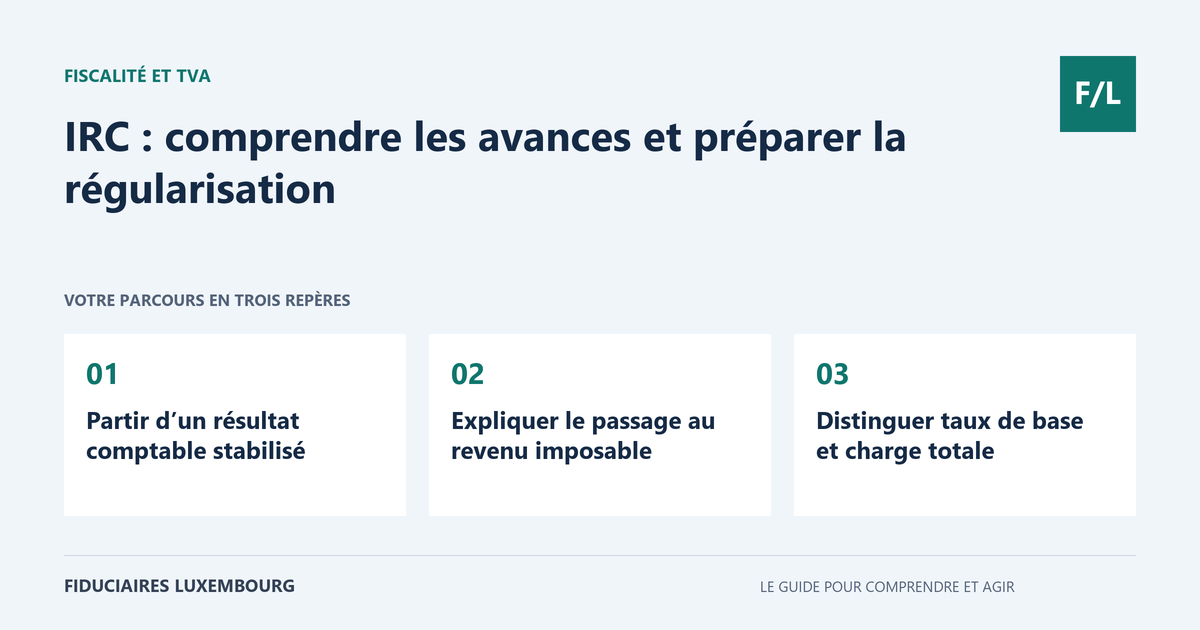
Start from a finalised accounting result
Gather the trial balance, the annual accounts being prepared and supporting documents for closing entries. Identify items that are still provisional: an expected invoice, inventory to be adjusted, a disputed receivable or an unreconciled transaction. The tax calculation must be capable of being updated when an accounting assumption changes. A figure communicated orally without a version does not constitute a reliable working basis.
Prepare the file with our guide to accounting close. Show tax adjustments in a separate table, together with their rationale and reference document. The company’s taxable income may differ from its accounting profit; the two figures must remain reconcilable rather than replacing one another in discussions.
Explain the reconciliation to taxable income
List expenses whose deductibility must be reviewed, income subject to specific treatment and transactions with shareholders or related companies. Describe the facts before selecting a tax category. An account description may help identify an issue, but it is not sufficient to prove that the selected treatment is correct.
Keep track of recurring adjustments and exceptional events. An adjustment used last year must be reviewed if the contract, amount or activity has changed. Any prior losses and tax credits require their own supporting documents. Do not include them in the calculation merely because an old table still contains an available box.
Distinguish the basic rate from the total tax burden
The scale includes a transition range: the company does not abruptly move from a 14% tax rate on all its income to 16% as soon as the first euro exceeds EUR 175,000. Check the tax year of the scale. A model retaining 17% for a current year since 2025 must be corrected, without changing historical calculations to which that former rate applied.
The surcharge for the employment fund represents 7% of IRC, not seven percentage points added to the basic rate. Municipal business tax is subject to a separate calculation. A nominal overall rate presented for a municipality and given assumptions does not replace the complete estimate for the file, particularly where allowances, losses, tax credits or net wealth tax apply.
Track advance payments and update the forecast
The ordinary due dates for IRC advance payments are 10 March, 10 June, 10 September and 10 December. Record each tax advance payment with its year and reference. The balance for a prior year and the advance payment for the current year may be paid close together: they must not be grouped together as one indistinct instalment.
If expected results change significantly, prepare an estimate and the elements that could support a reasoned request for modification. Do not unilaterally change the amount requested. Include known due dates and expected balances in your cash flow plan, distinguishing between notified amounts and assumptions still to be confirmed.
File, then review the notice received
The corporate tax return file must clearly identify the financial year and relevant appendices. The ACD has set 31 December 2026 as the deadline for filing returns for the 2025 tax year. This deadline does not replace the deadlines for approving or filing annual accounts. Organise the preparation early enough to resolve substantive issues.
After receiving the assessment notice, reconcile the tax base used, tax assessed, offsets and advance payments actually allocated. Keep any differences from the estimate, together with the explanation provided by the firm. If you dispute an item, have the procedure and deadline applicable to the document received reviewed promptly; do not assume that a simple request for an explanation suspends all deadlines.
The table to take action
| Amount | What it represents | Useful check |
|---|---|---|
| Accounting profit | Profit arising from the accounts | Version and closing |
| Taxable income | Tax base after tax treatments | Reconciliation table |
| Advance payments paid | Payments allocated to a year | Statements and references |
| Assessed tax | Amount resulting from the assessment | Assessment notice and offsets |
A balance payable is not a second full charge
Fictitious example: a file results in final IRC of EUR 12,000, including the surcharge, and EUR 9,000 of advance payments are correctly offset. Without any other item, the balance is EUR 3,000. The company must not understand this EUR 3,000 as a new tax added to the EUR 12,000 total expense. The accounts must reconcile expense, liability and payments. This example assumes amounts already validated; it illustrates payment and does not calculate taxable income or the company’s other taxes.
Your preparation checklist
- Set the version of the accounts used.
- Document each tax adjustment.
- Check the scale for the relevant year.
- Distinguish IRC, surcharge, municipal business tax and net wealth tax.
- Reconcile advance payments by year.
- Update the cash flow forecast.
- Keep the tax return and acknowledgement of receipt.
- Review the assessment notice and any differences.
Frequently asked questions
Do advance payments determine the final amount?
No. They are reconciled against the tax assessed for the relevant year. A settlement may remain payable or an excess may be identified.
Does the 16% rate represent all of the company’s taxation?
No. It is the basic rate in the relevant bracket. The surcharge and other taxes must be reviewed.
Does filing the accounts replace the tax return?
No. They are separate procedures, even though they use some of the same accounting information.
Useful terms in this guide
Questions to ask the professional
- Which adjustments explain the difference from accounting profit?
- Do the advance payments still correspond to the forecast?
- How will we read the differences when the assessment notice is received?
To clarify the engagement to be entrusted, also consult our taxation file.
And for your situation?
Prepare the accounts, reconciliation table and advance payment notices before your discussion. Search our directory for a professional who can prepare the calculation, explain its assumptions and organise the monitoring of payments with you.
Sources and verification
References consulted on 20 September 2026. Official procedures specify the applicable conditions and exceptions.
- ACD — tarif de l’impôt sur le revenu des collectivités
- ACD — charge fiscale des collectivités
- ACD — avances d’impôt
- ACD — déclarations de l’année d’imposition 2025
This guide explains a general process. The applicable rules depend on your situation; it does not constitute personalised advice. Report a correction.
Your next step
A specific need deserves the right contact
Accounting, taxation, company formation or payroll: prepare your questions, then search the directory for the professional who can review your situation. Check their assignments and status before entrusting them with your file.