Moving offices and changing the registered office may occur at the same time, but they are not exactly the same operations. The most common risk is thinking that a signed lease and an address updated on the website are sufficient. To organise the change, start with the functions of each address, then assign each formality to a person. This guide concerns a transfer within Luxembourg; an international transfer requires a separate review.
The framework to review
The authority to decide on the transfer, the form of the instrument and the procedures depend in particular on the corporate form and the articles of association. An amendment to the articles of association may require the involvement of a notary. Changes of address or place of business must also be reviewed in light of the business permit and applicable notifications. An update with the RCS does not automatically replace the other procedures.
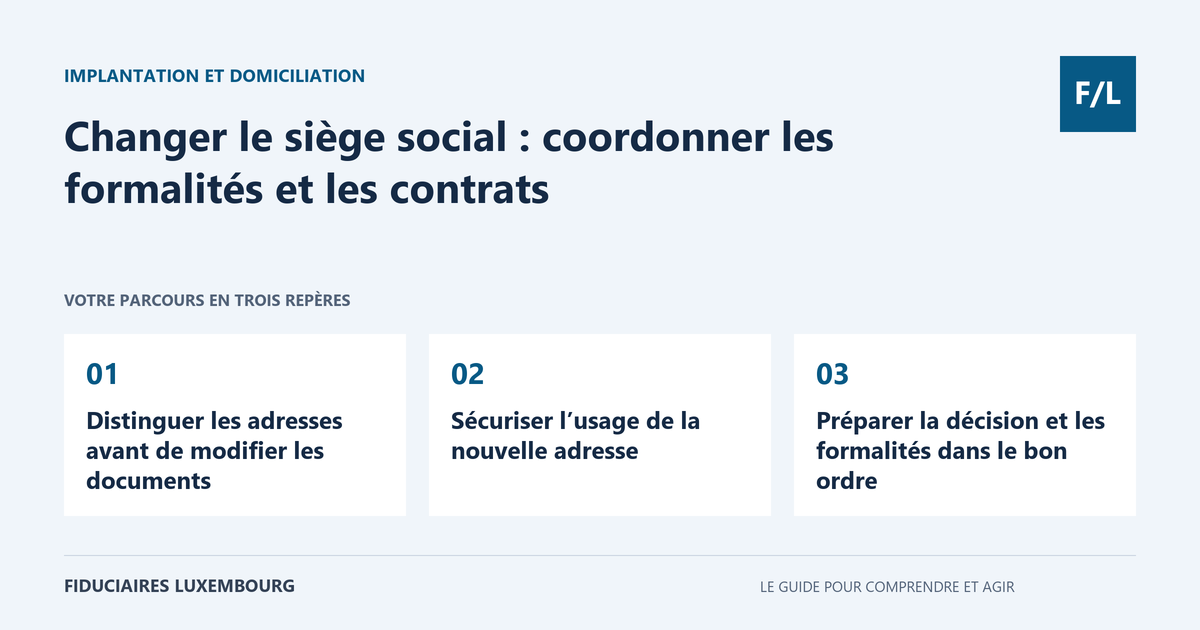
Distinguishing addresses before amending documents
Prepare a list of the registered office, the place of business, any establishments and correspondence addresses. State their actual use. A business may relocate a team without all these elements changing in the same way. Have the operation assessed so that the decision corresponds to what will actually be organised.
Review the articles of association and the latest register entry. Also check the lease or the domiciliation agreement. The business address displayed on a quotation does not in itself constitute proof of the current legal address. This initial comparison can sometimes reveal a discrepancy predating the relocation project.
Securing the use of the new address
Before setting the date, review the right to use the premises and the contractual conditions. Check the name of the occupant, the actual availability of the premises, the authorised use and the services included. If the project is based on domiciliation, clarify mail receipt, authorised persons and alert arrangements in the event of an emergency.
Compare this location with the needs of the business activity and the business permit. A mailbox and operational premises do not provide the same services. If the activity requires a workshop, storage or specific conditions, have their compatibility reviewed before terminating the previous arrangement.
Preparing the decision and formalities in the right order
Ask which body may decide, which rules in the articles of association apply and which documents must be prepared. Avoid reusing minutes found for another form of company. Specify the complete new address and the relevant dates. The professional must be able to compare the decision, the form data and the coordinated articles of association where required.
Then organise the required filing and publications, with one person responsible for the final check. Keep proof of processing. Have notifications to the relevant authorities reviewed, in particular those relating to the activity, VAT and employment, depending on your situation. A shared table prevents everyone from assuming that the procedure is being handled by someone else.
Ensuring mail receipt during the transition
LBR Circular 26/02 states that update requests are sent to the registered office on record: failure to receive them does not stop the deadlines. The indicated regularisation period is thirty days from the date of dispatch. Therefore, check who receives, dates and forwards mail, including during leave or between two contracts.
Establish a transition period with the relevant service providers, according to contractual possibilities. Test the forwarding chain with ordinary mail and ask how registered mail will be reported. Postal forwarding may help ensure continuity, but it does not correct registers and does not replace the actual existence of the registered office.
Updating partners and closing the file
Prepare a list of banks, insurers, customers, suppliers and platforms that use the address. For each, note the required channel and any supporting document. Banking procedures may require an updated document; anticipate this if significant transactions are planned during the transfer. Also check contracts that contain a notification address.
Update invoice templates, signatures, quotations and practical information on the website, then carry out a check on a document that has actually been issued. File termination and handover evidence for the premises where applicable. The file may be closed when the formalities have been checked and mail receipt responsibilities are operational, not simply when the boxes have been moved.
The table to take action
| Area | Action to organise | Final check |
|---|---|---|
| Legal | Decision and instruments adapted to the articles of association | Consistent and validated documents |
| Registers | Required filing and publication | Registered address checked |
| Activity | Notifications or permits to review | Response from the relevant bodies |
| Uninterrupted receipt and forwarding | Responsible person and substitute identified | |
| Contracts | Bank, insurance and partners | Documents and contact details accepted |
| Materials | Invoices, quotations and practical information | Sample of corrected documents |
The lease starts, but mail is still going elsewhere
Fictional example: a company takes new offices at the beginning of the month. The team updates the website, but the provider at the former address still receives administrative mail. The person in charge prepares a list separating the decision, register, permit, contracts and receipt. They identify the formalities that still need to be completed and organise documented temporary forwarding. They do not assume that the commercial announcement is sufficient to inform the authorities. During the final check, they verify the registered address and acknowledgements from the main partners. The transition now has a responsible person and a verifiable end date.
Your preparation checklist
- Compare the registered office, business operations and correspondence.
- Review the articles of association and the contract for the new address.
- Check compatibility with the activity.
- Have the competent body and the instruments determined.
- Track RCS formalities and required publications.
- Identify each administrative notification.
- Organise mail, alerts and cover during absences.
- Check contracts and documents actually issued.
Frequently asked questions
Does changing offices always change the registered office?
A distinction must be made between the place where the team works and the statutory address. Have the change assessed before completing the formalities.
Is postal forwarding sufficient?
It may facilitate the transition, but it does not update the registers or other obligations.
Does this guide cover a move abroad?
No. An international transfer may raise additional legal and tax issues and must be reviewed separately.
Useful terms in this guide
Questions to ask the professional
- Which body decides under our articles of association?
- Which procedures are separate from filing with the RCS?
- Who ensures mail receipt during the transition?
To clarify the assignment to be entrusted, also consult our domiciliation file.
What about your situation?
Prepare the articles of association, the contracts for both addresses and your planned date. This file makes it possible to discuss a realistic timetable. To coordinate the formalities and the location, search our directory for the professional whose services match your situation.
Sources and verification
References consulted on 20 September 2026. Official procedures specify the applicable conditions and exceptions.
- Guichet.lu — dépôts modificatifs et rectificatifs au RCS
- Guichet.lu — demande ou modification d’autorisation d’établissement
- LBR — circulaire 26/02 du 14 septembre 2026, mise en conformité RCS et RBE
This guide explains a general process. The applicable rules depend on your situation; it does not constitute personalised advice. Report a correction.
Your next step
A specific need deserves the right contact
Accounting, taxation, company formation or payroll: prepare your questions, then search the directory for the professional who can review your situation. Check their assignments and status before entrusting them with your file.