Goods move between your suppliers, your warehouse and your European customers. Accounting records invoices, but it does not always contain the information required for Intrastat. To avoid an urgent data collection exercise every month, purchases, sales and logistics must be connected. Here is how to organise this work and understand why a VAT return does not replace a statistical declaration.
The framework to check
Intrastat collects statistical information on trade in goods between Member States of the European Union. In Luxembourg, STATEC administers the system. Thresholds, levels of detail and rules specific to certain movements must be checked for the relevant period. Supplies of services do not fall within the same scope. VAT obligations, recapitulative statements and any customs or excise formalities remain separate.
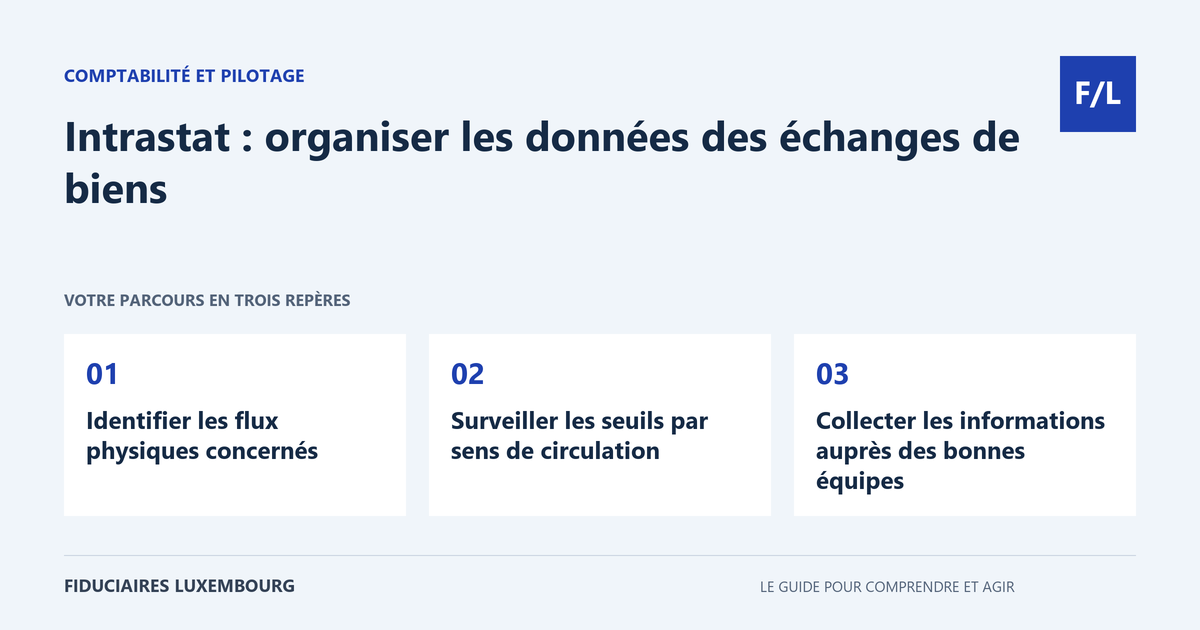
Identifying the relevant physical flows
Start with the route taken by the goods: where do they depart from and where do they arrive? In principle, the Luxembourg system covers goods that physically cross the country's border from or to another Member State. The country of the invoicing supplier does not necessarily describe this route. A triangular transaction where the goods do not pass through Luxembourg must therefore be distinguished from a receipt into your warehouse.
Specific rules apply to certain goods and movements, including specific means of transport. Returns, movements without a sale or processing transactions may also require classification. Draw up a list of usual flows and special cases, then have the treatment of the latter confirmed. The Intrastat system does not consist of copying all invoices bearing a European address.
Monitoring thresholds by direction of movement
The official Guichet.lu information sheet updated in February 2026 indicates exemption thresholds of 250,000 euros for arrivals and 200,000 euros for dispatches. Track amounts by flow and anticipate approaching the threshold. Check with STATEC the month in which filing must start and the level of detail applicable to your situation, particularly when the business starts or changes significantly.
Do not offset arrivals against dispatches. A business may be concerned for one direction of movement without being concerned for the other. The type of declaration also changes depending on the applicable amounts and rules. Keep a record of the annual calculation and of exchanges with the relevant department; a decline in activity should not lead to silently discontinuing filings without checking whether an exemption applies.
Collecting information from the right teams
The invoice provides values and references, while logistics knows the movements, quantities and characteristics of the goods. Assign a person responsible for each data item: classification, country, nature of transaction, mode of transport and other required fields depending on the type of declaration. The concepts of country of origin and partner country must be distinguished; they do not necessarily correspond to the seller's registered office.
Prepare a product sheet and a history of classification changes. Do not choose a code merely because its description seems similar. The actual characteristics of the goods matter. For inventory, the inventory and valuation guide helps connect the references used in the tools. The same item must remain identifiable between the order, movement, invoice and declaration, even if the software uses different formats.
Reconciling declarations without forcing them to match
Compare Intrastat flows with accounting records, VAT returns and relevant recapitulative statements. The scopes and dates are not always identical. A discrepancy must be explained, not removed by changing an amount so that two totals look alike. Keep a reconciliation schedule specifying excluded transactions, timing differences and documented adjustments.
The guide to intra-Community supplies addresses the evidence and VAT conditions for these sales. Intrastat does not in itself validate an exemption. Conversely, a transaction correctly reported for VAT may require statistical data absent from the invoicing file. Coordinate the people responsible for both tasks so that questions are handled once, with shared supporting documents where relevant.
Filing, correcting and ensuring continuity
The official information sheet distinguishes a paper filing no later than the sixth working day of the following month and a filing via IDEP.WEB no later than the sixteenth working day. The channel and type of declaration depend on the applicable rules and volumes; online filing is recommended. These deadlines are not fixed calendar dates. Set an internal deadline that leaves time for checks and outstanding questions.
Keep the files submitted, supporting evidence and corrections. If you discover an error, identify the month, flow and data item concerned, then follow the prescribed correction process. Arrange cover in case of absence and document cases already resolved. The audit trail must make it possible to reconstruct a figure without restarting the entire enquiry with the carrier, buyer and accounting department.
The action table
| Step | Data to prepare | Useful check |
|---|---|---|
| Movement | Actual departure and arrival | Crossing into Luxembourg and countries concerned |
| Product | Code and characteristics | Documented classification |
| Value | Amount and required adjustments | Reference to supporting documents |
| Declaration | Month, flow and level of detail | Appropriate threshold and deadline |
| Reconciliation | Discrepancies with VAT and accounting | Explanation retained |
Inbound and outbound flows to be reviewed separately
Fictitious example: a business tracks 270,000 euros of arrivals of goods from other Member States and 80,000 euros of dispatches to those States during the year under review. It does not subtract 80,000 from 270,000 to obtain a net amount. It reviews separately the arrivals, which exceed the cited exemption benchmark, and the dispatches, then confirms the required start date and type of declaration. This case does not replace the review of specific movements or of the rules applicable for the month concerned.
Your preparation checklist
- Describe the actual routes of the goods.
- Separate goods from supplies of services.
- Track arrivals and dispatches separately.
- Check thresholds and the type of declaration.
- Assign fields to the competent teams.
- Document codes and special cases.
- Explain discrepancies with other declarations.
- Keep filings, corrections and the cover procedure.
Frequently asked questions
Is Intrastat an additional VAT return?
It is a separate statistical obligation. The data can be reconciled, but the declarations do not replace each other.
Must supplies of services be included in the same way as goods?
The system concerns trade in goods; supplies of services are subject to other possible obligations.
Can the net amount of European purchases and sales be used?
No. Arrival and dispatch flows are tracked separately, each with its own scope.
Useful terms in this guide
Questions to ask the professional
- Which flows in our business are actually concerned?
- Which level of declaration must we use?
- Who provides and checks the missing logistics data?
To clarify the assignment to be entrusted, also consult our accounting section.
And for your situation?
Prepare a description of goods flows and your volumes by flow. Search our directory for a professional to organise accounting reconciliations and coordinate preparation of the declarations with your logistics team.
Sources and verification
References consulted on 20 September 2026. Official procedures specify the applicable conditions and exceptions.
This guide explains a general process. The applicable rules depend on your situation; it does not constitute personalised advice. Report a correction.
Your next step
A specific need deserves the right contact
Accounting, taxation, company formation or payroll: prepare your questions, then search the directory for the professional who can review your situation. Check their assignments and status before entrusting them with your file.