A European customer provides you with its VAT number and comes to collect the goods. Can you consider the file complete? The number is an important check, but it does not tell the story of the goods’ journey. To prepare an intra-Community supply, commercial, tax and logistics information must be gathered. The aim is to be able to explain the same transaction from the order through to its declaration.
The framework to check
The exemption for an intra-Community supply between professionals depends on conditions, including movement to another Member State, the relevant identification of the buyer and reporting obligations. Transport evidence is assessed in particular in light of Article 45a of European Regulation 282/2011. Its assessment depends on the documents and the organisation of transport. This guide prepares a sale of goods; services, sales to private individuals, installed goods and chain transactions require separate analysis.
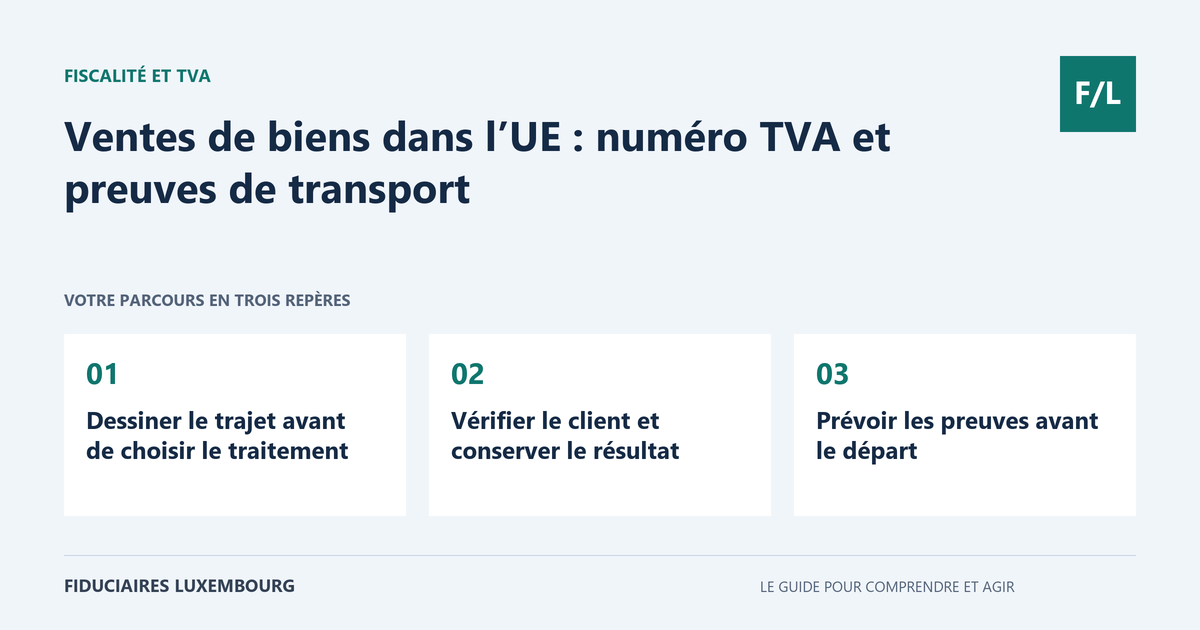
Map out the journey before choosing the treatment
Write down the places of departure and arrival, the identity of the seller and that of the buyer. Add the person organising the transport. The customer’s nationality or the currency is not sufficient: a foreign company may purchase goods that remain in Luxembourg. Conversely, transport may depart from a warehouse located in a country other than that of the seller’s registered office.
If an intermediary resells the goods before they arrive, report this immediately. A single physical movement may accompany several sales, whose treatment is not identical. Do not force a chain transaction into the model of a simple intra-Community supply. A sketch of the flows and contracts is often the best document to provide to the firm.
Check the customer and retain the result
Check the number provided in VIES and retain the dated result with the file references. Match the identity shown on the order, the invoice and the information obtained. If the number belongs to another group entity, request clarification before using it. The check must concern the actual relationship, not merely a number that works.
An unavailability message does not mean that a number is invalid. A negative response must also be reviewed: pending activation or registration may, in particular, explain the situation. Request the necessary information from the customer and, where necessary, the involvement of the competent authorities. Do not replace an unresolved result with a simple “known customer” note in the file.
Plan the evidence before departure
Specify who will provide the documents, to whom and within what internal timeframe. Gather the transport and receipt documents, as well as other relevant supporting evidence, as appropriate. The documents must be consistent with one another: references for the goods, quantities, dates, locations and parties involved. A large but contradictory file does not become more convincing because it contains more files.
When the customer takes charge of the goods, your team will not necessarily receive the same documents as it would with its own carrier. Plan this collection from the order stage and have the arrangements confirmed. Delivery terms and control of the transport have a practical effect on your ability to gather the evidence. A collection signature does not necessarily indicate the final destination.
Reconcile the invoice and returns
The invoice includes the identifiers and wording corresponding to the selected treatment. The sales data also feed into the relevant reporting obligations, including the recapitulative statement. Define responsibilities: who gathers the flows, who checks the numbers and who reports corrections after issuance.
Prepare a reconciliation between the sales journal, deliveries and the amounts submitted to the firm. A cancellation, return or credit note may change the tracking. Keep the versions and explain period or amount differences, without artificially shifting a sale to make two totals match. The check is useful precisely when it reveals a difference that needs to be understood.
Handle exceptions without concealing missing documents
Keep a separate list of incomplete files, stating the expected document, the person responsible and the next action. A “to review” classification is preferable to a file presented as complete when the central evidence is missing. Define with the professional the treatment to apply when the issue is not resolved at the time of invoicing or reporting.
Also review returns, losses during transport and changes of destination. The initial file may no longer describe what actually occurred. At closing, compare goods in transit and recorded sales with stock tracking. This will prevent logistics and accounting from using two different accounts of the same goods.
The table to take action
| Step | Evidence to gather | Useful check |
|---|---|---|
| Order | Identities and agreed terms | The customer matches the contracting party |
| Identification | Dated VIES result and relevant communications | The number matches the relationship |
| Transport | Relevant transport and receipt documents | Locations, goods and dates match |
| Invoice | Issued document and tax justification | Treatment consistent with the flow |
| Returns | Reconciliation of sales and statements | Differences and corrections explained |
The customer organises transport: prepare for the return of documents
Fictional example: a Luxembourg wholesaler sells a batch to a company established in another Member State. The customer appoints its carrier. Before collection, the wholesaler identifies the documents it will need to receive and the person responsible for forwarding them. It checks the number, retains the order and tracks the departure. The expected confirmation does not arrive: the file remains on the exceptions list, with a follow-up request and review by the firm. It is not marked complete solely because payment has been received. This organisation makes it possible to deal with the issue while the contacts and transport references are still easy to find.
Your preparation checklist
- Map out the physical and contractual flows.
- Check the customer and its relevant number.
- Keep the dated VIES check.
- Plan the collection of evidence with the parties involved.
- Reconcile documents, invoice and reporting obligations.
- Track returns and changes of destination.
- Have incomplete files reviewed before concluding on the tax treatment.
Frequently asked questions
Is a European customer sufficient to create an intra-Community supply?
No. The movement of goods and the other conditions must in particular be examined. The customer’s address alone does not describe the flow.
Does VIES certify the supply?
No. The tool concerns the VAT number. Transport evidence and commercial consistency must still be established.
Does payment received replace transport documents?
No. It establishes a financial movement, not by itself the journey and receipt of the goods.
Useful terms in this guide
Questions to ask the professional
- Which documents must be obtained under our transport arrangements?
- How should missing evidence be treated at the time of reporting?
- Which chain transactions require separate review?
To clarify the engagement to be entrusted, also consult our tax section.
And for your situation?
Choose a recent delivery and try to reconstruct its journey using only the documents in the file. The missing information will tell you what to improve. To define the evidence and checks suited to your flows, search our directory for a professional and present this specific case to them.
Sources and verification
References consulted on 20 September 2026. Official procedures specify the applicable conditions and exceptions.
- Single Window for Logistics — opérations intracommunautaires
- Your Europe — vérifier un numéro dans VIES
- AED — loi TVA coordonnée au 1er janvier 2026
This guide explains a general process. The applicable rules depend on your situation; it does not constitute personalised advice. Report a correction.
Your next step
A specific need deserves the right contact
Accounting, taxation, company formation or payroll: prepare your questions, then search the directory for the professional who can review your situation. Check their assignments and status before entrusting them with your file.