A request from the AED arrives and several financial years or transactions are concerned. The first useful step is to understand precisely what is requested, then to retrieve the evidence in a clear order. A well-organised file does not guarantee the outcome of the audit, but it makes it possible to respond with facts and to quickly identify what requires an explanation or correction.
The framework to check
The VAT law provides for the keeping of detailed accounts and, upon request, the provision of documents and information useful for the audit, including invoices, books, bank statements, contracts and transport documents. Technical arrangements may concern electronic data. The scope, deadlines and avenues for challenge depend on the document received and the procedure; this guide therefore does not set any universal deadline for responding or lodging an appeal.
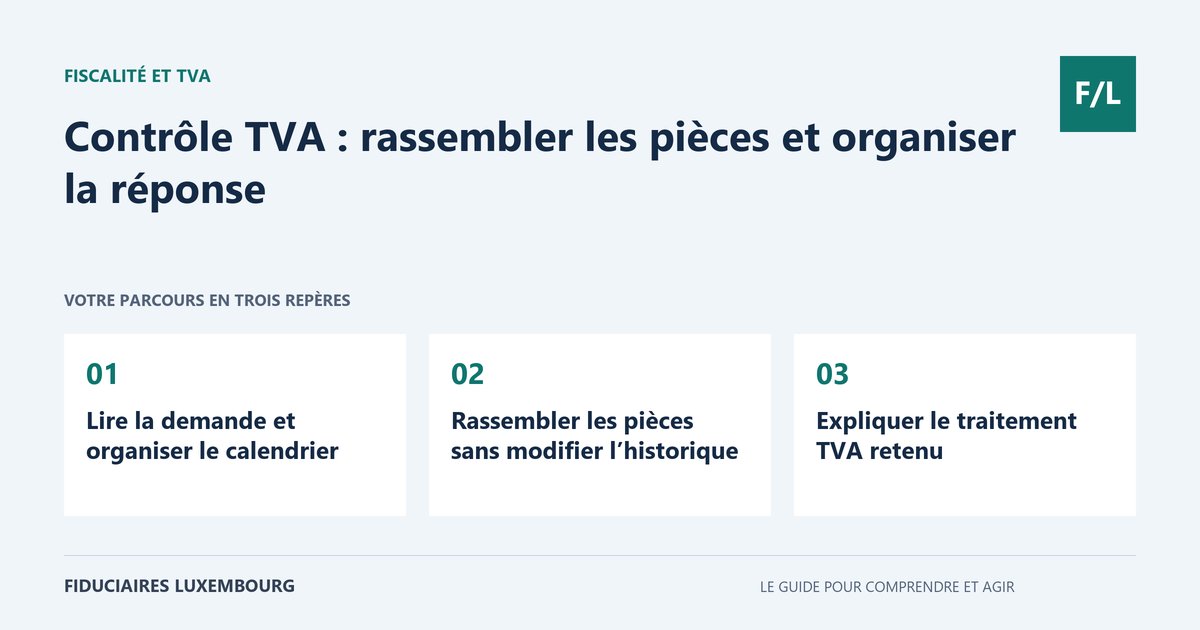
Read the request and organise the timetable
Identify the administration, the file, the periods and the transactions concerned. Keep the date and method of receipt, as well as the envelope or relevant electronic items. Check the indicated response channel. If there is doubt about the authenticity of a message, have the request confirmed by an official contact before sending documents containing confidential information.
Promptly inform the person responsible for VAT and, where necessary, the adviser handling the procedure. Assign the questions to the appropriate contacts: sales, purchases, logistics, accounting or management. If the deadline appears difficult to meet, consider the steps to take with the administration without assuming that a request for an extension will be automatically accepted. Keep evidence of every exchange and of every response received.
Gather documents without altering the record
Start with the relevant accounting entries and returns, then retrieve their supporting documents. The guide to filing accounting documents helps create a stable file. Name documents clearly and retain the original versions. An annotated working copy may be useful, but it must remain separate from the document that proves the transaction.
The audit trail links the economic reality to its treatment: order, contract, delivery or service, invoice, recording and payment. A bank statement does not always replace an invoice; an invoice alone does not prove all the conditions of a regime. If a document is missing, report this and look for a copy or other relevant evidence. Do not recreate a backdated document to complete the file.
Explain the VAT treatment applied
For each transaction under review, describe what was sold or purchased, the parties, the relevant places and dates. Then explain the classification, rate, exemption or reverse-charge mechanism applied. A general statement such as “European transaction” is rarely sufficient to understand the reasoning. The documents and rules must correspond to the audited period, not merely to current practice.
For sales of goods within the Union, consult the guide to intra-Community evidence. For purchases and expenses with mixed use, the VAT deduction guide helps prepare for questions. Separate established facts from assumptions that still need to be checked. A precise explanation may also reveal a treatment that needs correcting: then document the correction according to the appropriate process.
Reconcile amounts and prepare exports
Establish a bridge between journals, VAT accounts, returns and payments. Identify credit notes, adjustment entries and period shifts. If several software systems are involved, check that the export covers the correct scope and does not contain duplicates. Totals must be reproducible from retained data, with an explanation of discrepancies rather than a manual adjustment without a trace.
Where the request concerns a FAIA computerised audit file, check the specifications and expected elements with the software manager and your accounting contact. This file does not replace supporting documents. Nor is it an annual return to be sent spontaneously in all cases. Test its consistency and readability before transmission, then keep the exact version provided to the administration.
Respond clearly and follow up
Prepare an organised response in the order of the questions. Each explanation must refer to an identified document or a comprehensible table. Have the technical points reviewed by the competent person before sending. Submit the requested items through the appropriate channel, in compliance with communication and confidentiality obligations. Keep an inventory of the documents submitted to avoid contradictions during a subsequent exchange.
After sending, follow up on additional requests and documents received. An informal discussion does not replace the formalities required to challenge a decision. Have the relevant document, its effects and the applicable deadlines promptly reviewed by your adviser. Once the file is closed, correct the identified causes of error in the invoicing, filing or return process in order to make subsequent audits simpler.
The table for taking action
| Column | Content | Purpose |
|---|---|---|
| Question | Exact reference of the request | Avoid overlooked issues |
| Documents | Names and references of supporting documents | Retrieve the evidence |
| Explanation | Facts and treatment applied | Link the transaction and the return |
| Person responsible | Person who prepares and checks | Track the work |
| Status | To be completed, reviewed, submitted | Keep to the timetable |
Explain a discrepancy rather than rewriting the figures
Fictitious example: a reconciliation reveals a difference between the total of a sales journal and the amounts on a return. The team identifies a credit note recorded in another period and an adjustment entry. It checks their treatment, prepares a bridge table and attaches the relevant documents. If an error remains, it addresses it with its adviser in accordance with the appropriate procedure. The case illustrates a research method; it does not presume that these two items always explain a discrepancy or that they avoid any reassessment.
Your preparation checklist
- Keep the request and proof of receipt.
- Identify periods, questions and deadlines.
- Name the responsible persons and relevant adviser.
- Gather originals and reliable copies.
- Link the facts to the VAT treatment.
- Reconcile accounts, returns and payments.
- Check the requested exports.
- Keep the response, submitted documents and follow-up.
Frequently asked questions
Is an invoice always sufficient as evidence?
It is part of the file. Depending on the VAT treatment, other elements may be required to demonstrate the reality and conditions of the transaction.
Must a FAIA always be sent every year?
This guide concerns the preparation of a file requested as part of an audit. Check the scope and arrangements of the applicable request.
Can I ignore a document while a discussion continues?
Exchanges do not automatically suspend deadlines. Have the effects and response options of the document received reviewed promptly.
Useful terms in this guide
Questions to ask the professional
- Which points of the request require particular analysis?
- Which supporting documents are still missing?
- Which deadlines and formalities must we follow separately?
To clarify the assignment to be entrusted, also consult our taxation section.
And for your situation?
Gather the request received and the returns for the periods concerned. Search our directory for a professional to organise the reconciliations and prepare the response, with legal advice where the procedure requires it.
Sources and verification
References consulted on 20 September 2026. Official procedures specify the applicable conditions and exceptions.
This guide explains a general process. The applicable rules depend on your situation; it does not constitute personalised advice. Report a correction.
Your next step
A specific need deserves the right contact
Accounting, taxation, company formation or payroll: prepare your questions, then search the directory for the professional who can review your situation. Check their assignments and status before entrusting them with your file.