The balance sheet total has increased. Is that good news? It all depends on what has grown: equipment, unpaid customer invoices or debts. The balance sheet captures a situation at a given date; the items that make it up must then be understood. Here is a reading path to turn a few accounting lines into useful questions about your business and its financing.
The framework to check
Standard annual accounts include the balance sheet, the profit and loss account and the notes, which must be read together. The valuation rules and the accounting framework used influence the amounts presented. This guide provides a reading method; it does not replace the preparation of accounts in accordance with the entity’s obligations, an audit, or a solvency analysis tailored to a credit or investment decision.
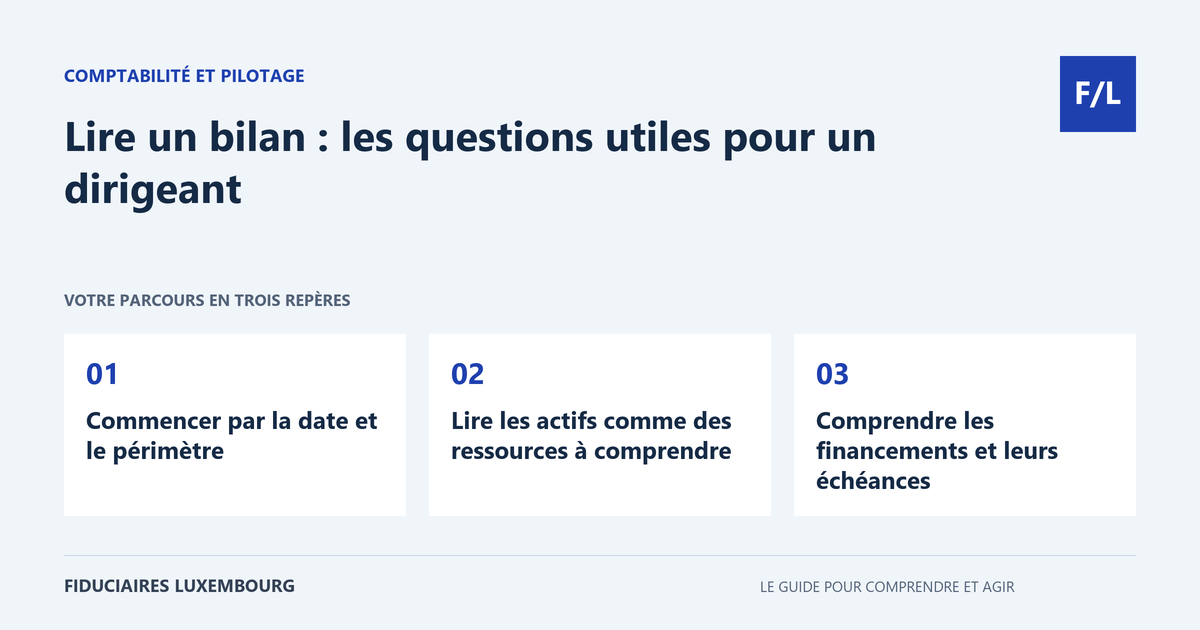
Start with the date and scope
Identify the company, the financial year-end date, the currency and the duration of the financial year. Check whether these are individual or consolidated accounts, final or still provisional. A comparison between two years must take account of a change in scope or method. Without these reference points, a growth percentage can tell a misleading story.
Review the notes and comments accompanying the accounts. Ask for explanations of significant reclassifications. The balance sheet presents a situation at a given point in time: a repayment or collection occurring afterwards may help to understand it, but figures should not be mentally adjusted without distinguishing the dates.
Read assets as resources to be understood
Separate fixed assets, inventories, receivables and cash. For each significant item, ask what it contains and how its value is supported. A machine, old inventory and a disputed invoice do not immediately become cash simply because they appear as assets. The nature and quality of the item matter as much as its amount.
For receivables, review ageing and known collections with the guide on the customer aged balance. For inventories, reconcile quantities and values with the inventory file. For fixed assets, check the register, depreciation and any disposals. Each total should be traceable to usable detail.
Understand financing and its due dates
Identify equity, borrowings, trade payables and other liabilities. Equity does not correspond to the bank balance. It reflects, in particular, contributions and accumulated results according to the presentation of the accounts. Changes in it must be explained by transactions occurring during the financial year.
For debts, ask for a repayment schedule. The same total may consist of a loan repayable over several years or amounts due shortly. Identify relevant guarantees and commitments, including those described outside the main statement. Financing provided by a shareholder must be analysed according to its terms, without automatically being treated as permanent capital.
Link the balance sheet to the cash cycle
Consider inventories, trade receivables and operating payables together. Their timing gap contributes to the working capital requirement. A company that sells more may tie up more money in inventory and invoices awaiting collection. Revenue growth is therefore not enough to explain financing needs.
Compare several dates when the business is seasonal. The year-end balance may be more favourable or more strained than in an ordinary month. Use the cash flow plan to extend the analysis over time. The balance sheet provides starting points; the forecast adds due dates, upcoming transactions and collection assumptions.
Prepare questions before drawing a conclusion
Select the most significant changes and ask what caused them: acquisition, customer delay, repayment, distribution or change in valuation. Avoid ratios whose scope and limitations you do not know. An indicator can help compare consistent periods without becoming a universal quality score applicable to all sectors.
Finally, reconcile the balance sheet with the profit and loss account and cash movements. Note what is explained, what requires supporting documentation and what calls for a decision. The meeting with the firm then becomes a discussion of specific facts: customer follow-up, inventory level, repayment schedule or financing, rather than a succession of totals that are difficult to interpret.
The table to take action
| Item | Useful question | Detail to request |
|---|---|---|
| Fixed assets | Are the assets still in use? | Register and movements |
| Inventories | Are quantities and values supported? | Inventory and ageing |
| Customers | When and how much will be collected? | Aged balance and disputes |
| Debts | When will payment be required? | Repayment schedule and guarantees |
| Equity | Which movements explain the change? | Contributions, results and distributions |
Two balanced balance sheets, two cash situations
Simplified fictional example: a company has 100,000 euros in assets, financed by 40,000 euros in equity and 60,000 euros in debts. Its assets include 50,000 euros in customer invoices, some of which are disputed. The equality 100,000 = 40,000 + 60,000 is correct, but it does not indicate whether debts due soon can be paid. Receivables and due dates must be examined. Another company with the same totals could hold mainly cash. Arithmetic balance is therefore not enough to compare their situations.
Your preparation checklist
- Identify the date, currency and scope.
- Distinguish between provisional and final accounts.
- Read the notes together with the balance sheet.
- Request details of significant assets.
- Review due dates and guarantees.
- Explain movements in equity.
- Link inventories, customers and suppliers.
- Turn discrepancies into questions and decisions.
Frequently asked questions
Does a balanced balance sheet prove solvency?
No. The accounting equality alone does not provide information about the quality of assets or the ability to pay when amounts fall due.
Is equity available in the bank account?
No. It does not represent a reserve of cash that can be mobilised immediately.
Can the balance sheet be read without the notes?
The notes provide useful details on methods, items and commitments. The documents must be considered together.
Useful terms in this guide
Questions to ask the professional
- Which changes explain the evolution of the balance sheet?
- Which assets require a value review?
- Which due dates create a cash requirement?
To clarify the assignment to be entrusted, also consult our accounting section.
And for your situation?
Bring the last two balance sheets, their notes and your main questions. Search our directory for a professional who can explain the items to you and link this analysis to your company’s management decisions.
Sources and verification
References consulted on 20 September 2026. Official procedures specify the applicable conditions and exceptions.
- Guichet.lu — méthodes d’établissement des comptes annuels
- Bpifrance Création — indicateurs de gestion
This guide explains a general process. The applicable rules depend on your situation; it does not constitute personalised advice. Report a correction.
Your next step
A specific need deserves the right contact
Accounting, taxation, company formation or payroll: prepare your questions, then search the directory for the professional who can review your situation. Check their assignments and status before entrusting them with your file.