Sales are increasing, yet profit is falling. Before concluding that the business is no longer working, look at what has changed in prices, costs and organisation. The profit and loss account describes how profit or loss is generated over a period. A structured reading helps to understand margins, identify specific events and prepare the next decisions.
The framework to check
The profit and loss account forms part of the annual accounts, together with the balance sheet and the notes. Income and expenses are allocated to their financial year in accordance with the applicable rules, independently of payment alone. Presentation depends on the reporting framework and the entity's obligations. The management groupings proposed here are intended to help understand the business; they do not replace legal line items or adjustments required for tax calculation.
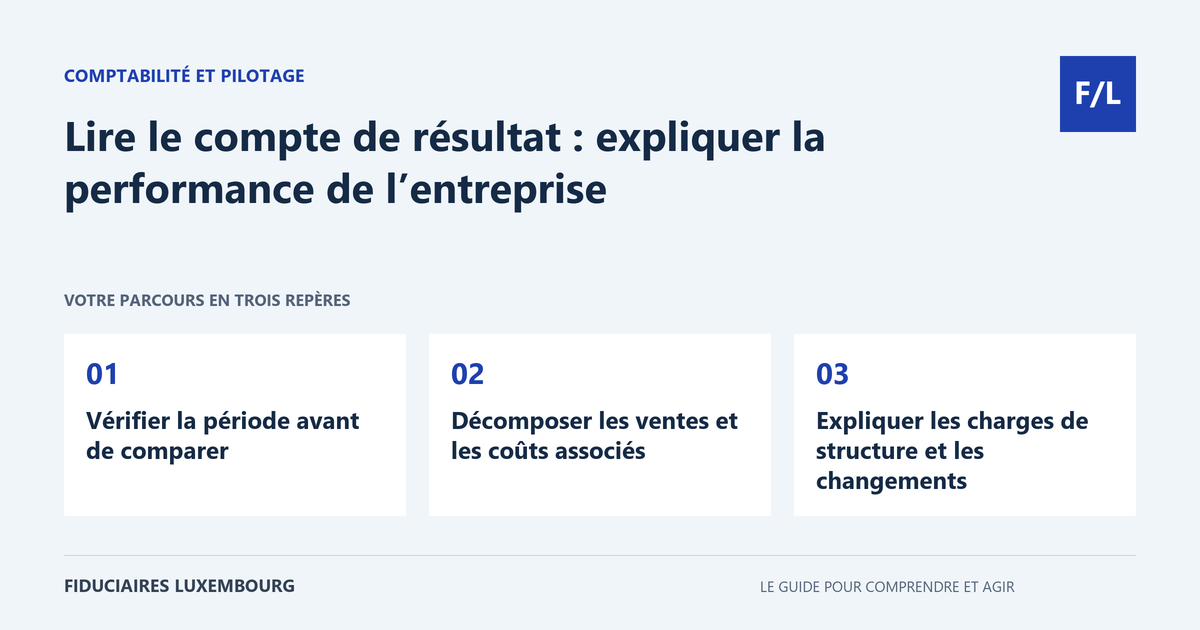
Check the period before comparing
Note the start and end dates, the duration and the status of the document. Comparing twelve months with nine months without explanation produces an unhelpful variance. Also check whether both periods cover the same business activity. An acquisition, the opening of an establishment or the discontinuation of a service may change the scope and require a separate reading.
Ask whether the closing entries have been included. Supplier invoices not yet recorded or services to be accrued may change the analysis. The guide preparing the closing helps identify these points. A monthly management account may be useful, provided you know what it includes and what remains estimated.
Break down sales and associated costs
Review sales by business activity, product or customer type where the data allows. An overall increase may conceal a decline in a profitable segment and growth in another that is more costly. Distinguish, as far as possible, the effect of the number of sales, pricing and the mix of offerings. The total alone does not make it possible to choose an appropriate commercial action.
Then reconcile the costs directly linked to those sales, using a consistent definition of the margin under review. The contribution margin should not be confused with any other margin simply called “margin” in a table. State the expenses included so that comparisons between periods or activities remain understandable.
Explain overheads and changes
Group expenses that are useful for analysis: premises, team, tools, services and other operating resources. Compare the amounts with business activity, then look for the events that explain the variances. An increase may relate to a recruitment intended to develop the following months; it is not automatically an anomaly to be eliminated.
Separate recurring items from one-off events, while keeping them in the accounts. A launch expense, a major repair or a dispute may require specific commentary. Management adjustments must be explicit: removing all unfavourable expenses on the grounds that they are unusual would produce an artificially reassuring view.
Understanding expenses without immediate payment
Depreciation allocates the cost of certain assets according to the methods adopted; it does not correspond to the exact annual payment for those investments. Impairments and other estimates must also be explained. Consult the guide fixed asset register and depreciation to link expenses to assets and their use.
Conversely, repayment of the principal of a loan may weigh on cash flow without being an expense for the period in the same way as interest. A customer invoice may contribute to income before it is collected. The profit and loss account and the bank account therefore tell two different stories, which should be reconciled rather than forced to show the same balance.
Link profit to subsequent decisions
Prepare a short commentary on the main variances: finding, documented cause, expected effect and action. A decline in profit may call for a review of prices, purchasing controls or a capacity review. The choice depends on the facts. Also check financial costs or income and the tax treatment before explaining the final profit.
The balance sheet complements this analysis with resources and financing, while the cash flow plan helps anticipate payments. Use these documents together during regular reviews. Keep a record of decisions to check later whether the measures taken had the intended effect or whether the initial assumption needs to be revised.
The table for taking action
| Indicator | Question | Limitation to bear in mind |
|---|---|---|
| Turnover | How much have we sold? | Does not measure profit |
| Profit | What remains after income and expenses? | Does not correspond to the bank balance |
| Cash flow | What funds are available or expected? | Does not alone measure profitability |
| Defined margin | What contribution does an activity make? | Depends on the cost scope |
Selling more can leave less margin
Simplified fictional example: an activity goes from 100 000 to 120 000 euros in sales excluding VAT. Variable costs rise from 40 000 to 66 000 euros. The corresponding margin therefore falls from 60 000 to 54 000 euros despite the increase in sales. If the fixed expenses included in this model remain at 45 000 euros, the simplified profit falls from 15 000 to 9 000 euros. The effect of prices, costs and the sales mix must be investigated. The example excludes other financial and tax items to isolate this mechanism.
Your preparation checklist
- Compare consistent periods and scopes.
- Check entries that are still provisional.
- Break down sales if the data allows.
- Clearly define the margin being analysed.
- Explain recurring and one-off expenses.
- Link depreciation and investments.
- Reconcile profit, balance sheet and cash flow.
- Associate each significant variance with an action.
Frequently asked questions
Do more sales guarantee more profit?
No. Margin, costs and the resources used may develop unfavourably despite an increase in turnover.
Is profit equal to the money available?
No. Payment dates, investments and financing notably explain the differences.
Can two margins be compared without knowing their definition?
The comparison may be misleading if the included expenses or scope differ.
Useful terms in this guide
Questions to ask the professional
- Which factors explain the change in margin?
- Which items are still estimated?
- Which decisions will we monitor at the next review?
To clarify the engagement to be entrusted, also consult our accounting section.
And for your situation?
Prepare comparative profit and loss accounts and an available sales breakdown. Search our directory for a professional who can explain the variances and build useful indicators with you for your decisions.
Sources and verification
References consulted on 20 September 2026. Official procedures specify the applicable conditions and exceptions.
- Guichet.lu — méthodes d’établissement des comptes annuels
- Bpifrance Création — construire un compte de résultat prévisionnel
- Bpifrance Création — indicateurs de gestion
This guide explains a general process. The applicable rules depend on your situation; it does not constitute personalised advice. Report a correction.
Your next step
A specific need deserves the right contact
Accounting, taxation, company formation or payroll: prepare your questions, then search the directory for the professional who can review your situation. Check their assignments and status before entrusting them with your file.