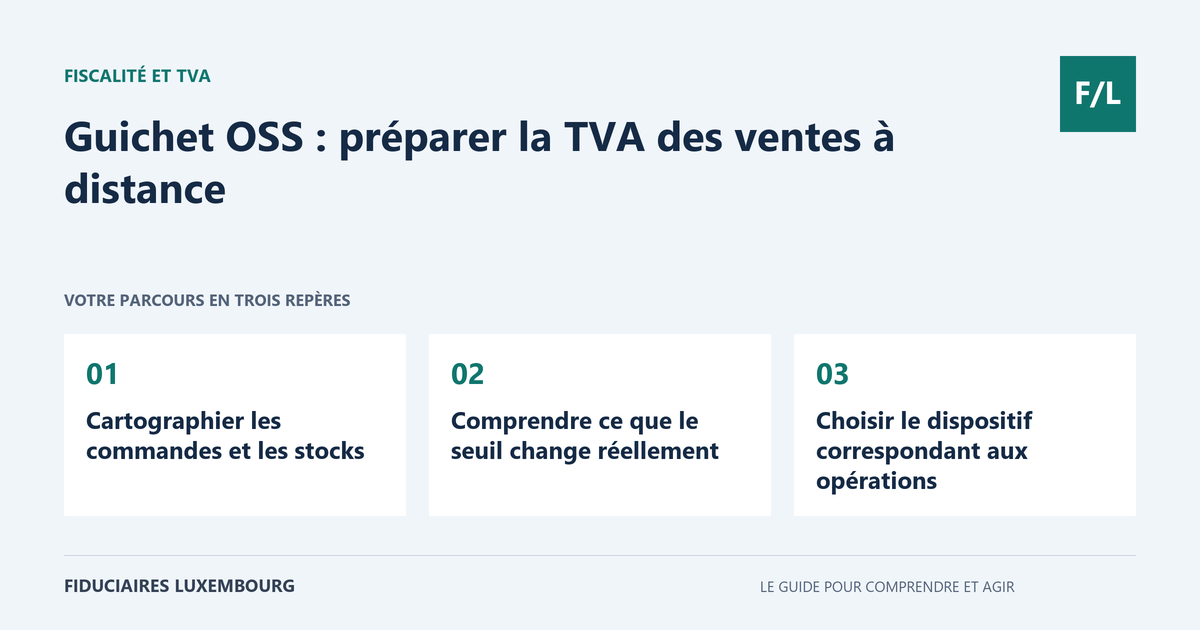
Your shop is starting to deliver to private individuals in several European countries. The order dashboard shows a single turnover figure, but VAT requires a more precise analysis: where do the goods depart from, where do they arrive, who is selling and to which customer? The one-stop shop can simplify certain returns. It works better when shop and logistics data have been prepared before growth.
The framework to review
OSS schemes are optional and have distinct scopes. The Union scheme covers, in particular, intra-Community distance sales to consumers; imports fall under a different arrangement. The EUR 10,000 threshold applies, subject to conditions, to the aggregate of intra-Community distance sales and certain cross-border electronic, telecommunications and broadcasting services. It is assessed over the previous and current years, with an establishment in a single Member State and eligible flows. It is neither a VAT exemption scheme nor a threshold per country.
Mapping orders and stock
List the countries in which goods are stored and those to which they are delivered. A shop managed in Luxembourg may ship from a foreign warehouse. The company's registered office, website address and bank account are therefore not sufficient to classify sales. Show stock movements separately from deliveries to customers.
Also distinguish consumers, business customers and the possible role of a marketplace. Depending on the arrangement, a platform may be involved in VAT processing without resolving all of your own obligations. Keep contracts, sales reports and commission statements. Net proceeds paid by the platform are not the tax details for each order.
Understanding what the threshold actually changes
The EUR 10,000 threshold does not mean that the first purchases by each customer, or the first sales in each country, are exempt. Under the applicable conditions, it is relevant to determining the place of taxation of certain transactions. The relevant amounts are aggregated, and the rules for the previous year also matter. An option for taxation at destination must be reviewed separately.
In your management dashboard, isolate the relevant aggregate and transactions that do not fall under this mechanism. Do not mix this tracking with that of the small business VAT exemption scheme, whose thresholds and conditions differ. Crossing a threshold should trigger documented action regarding settings and procedures, not merely a coloured cell in the file.
Choosing the arrangement corresponding to the transactions
The OSS one-stop shop includes several schemes. A sale of goods already stored in the Union is not, for that reason alone, a distance sale of goods imported directly to the customer. Domestic movements, imports and business transactions require their own classification. Have it confirmed what falls within the Union scheme and what still needs to be dealt with elsewhere.
Once the scheme has been chosen, its application to covered transactions is not decided country by country according to your convenience. Prepare the effective date and formalities with the firm before launching the relevant flows. OSS returns are in addition to relevant national obligations. The aim is to coordinate the processes to avoid an omission or double reporting.
Preparing data that allows recalculation
For each order, retain useful information on the product, customer, places of departure and arrival, amounts, tax and adjustments. Define common references between the shop, carrier, payment platform and accounting. Without a matching identifier, discrepancies quickly become difficult to explain as volume increases.
Check rates according to the country, the nature of the goods and the applicable period. A single rate configured for all destinations is not a simplification strategy. Test several representative orders before going live and after a significant change. Keep the expected result and the observed result in order to explain the settings to the person who will assist you later.
Handling returns, corrections and returns
A goods return, cancellation or post-sale reduction must remain linked to the original order. Keep the country and original period, then apply the appropriate correction procedure. Do not deduct all refunds from the month's total without checking the transactions to which they relate.
The Union scheme follows a quarterly timetable, with a return to be filed within the prescribed period even where there are no transactions when nil return filing conditions apply. Organise review and payment as two coordinated tasks. Then reconcile tax data with sales and bank data: commissions and payment timing differences often explain a difference between turnover and money received.
The table to take action
| Relevant flow | Amount excluding VAT | Aggregate | Control point |
|---|---|---|---|
| Relevant distance sales to country A | 4 000 € | 4 000 € | Include in the same European tracking |
| Relevant distance sales to country B | 3 000 € | 7 000 € | Do not restart the counter by country |
| Relevant cross-border electronic services | 2 000 € | 9 000 € | Aggregate with eligible goods |
| New relevant sale | 2 000 € | 11 000 € | Review the change as soon as the sale causes the threshold to be exceeded |
The payment table does not replace the sales table
Fictional example: a shop sells in three countries and receives a net transfer from its platform each week. It previously prepared its tracking based on this amount alone. By reconciling exports, it identifies commissions, refunded orders and sales collected one week later. It creates a common reference for each order and separates sales, taxes, fees and settlements. The firm can then check classification by country and corrections. The useful change is not only registration with the one-stop shop: it is the ability to reconstruct the data feeding the return.
Your preparation checklist
- List storage locations and routes.
- Distinguish business customers and consumers.
- Identify the role of platforms.
- Track the relevant aggregate without a separate counter by country.
- Have the scheme, effective date and remaining obligations confirmed.
- Test rates and exports across several orders.
- Link each return to its initial sale.
- Reconcile returns, payments and accounting.
Frequently asked questions
Does the EUR 10,000 threshold apply per Member State?
No. It applies to the aggregate of the relevant transactions, subject to the applicable conditions, and not to an independent counter for each destination.
Does OSS replace the national VAT return?
No. One-stop shop returns are additional. Certain transactions and obligations remain within national systems.
Are OSS and IOSS interchangeable?
No. The import arrangement covers a different scope. The actual route of the goods and the conditions of the scheme must be reviewed.
Useful terms in this guide
Questions to ask the professional
- Which flows from our shop fall under which scheme?
- Which fields must appear in our exports?
- How should foreign stock, returns and national returns be coordinated?
To clarify the assignment to be entrusted, also consult our taxation section.
And for your situation?
Before opening a new delivery country, prepare three test orders, one return and a platform settlement statement. This file will provide a concrete basis for discussion. Search our directory for a professional able to review your commercial organisation and its VAT flows.
Sources and verification
References consulted on 20 September 2026. Official procedures specify the applicable conditions and exceptions.
- AED — guichet unique OSS
- Commission européenne — fonctionnement du guichet unique
- AED — régimes OSS, déclaration et paiement
This guide explains a general process. The applicable rules depend on your situation; it does not constitute personalised advice. Report a correction.
Your next step
A specific need deserves the right contact
Accounting, taxation, company formation or payroll: prepare your questions, then search the directory for the professional who can review your situation. Check their assignments and status before entrusting them with your file.