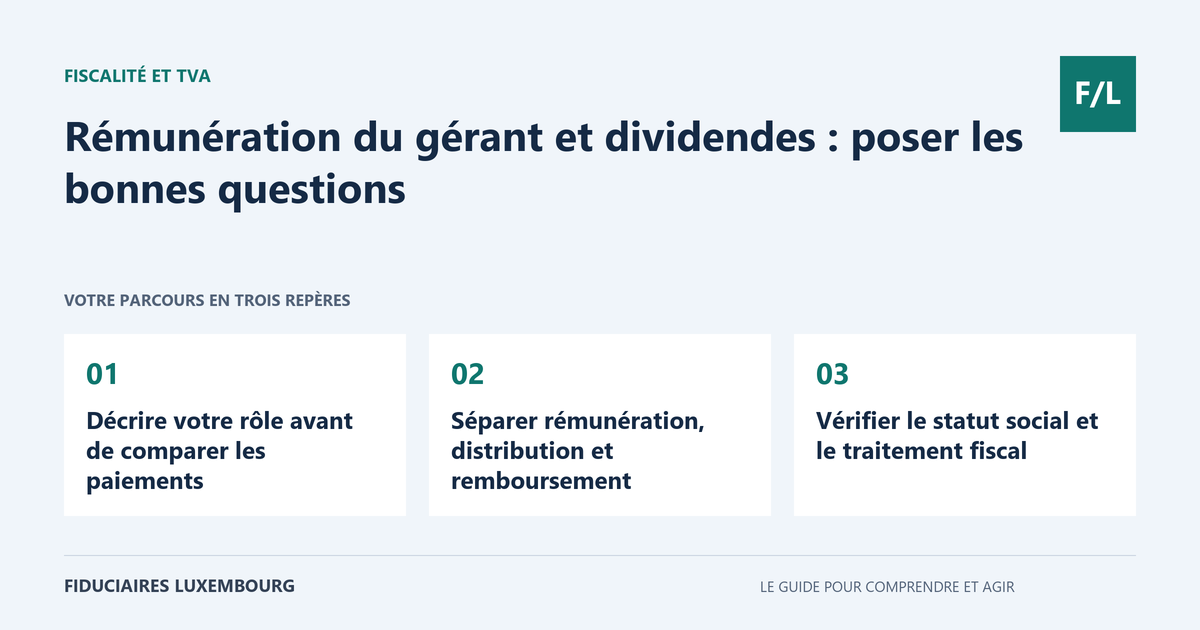
You manage your company and hold shares in it. How should you structure the amounts you receive? The answer does not start with choosing the lowest tax rate. It starts with determining what you do, what the company owes you and what it can distribute. Let us look at the questions to prepare in order to obtain a comparison that genuinely reflects your situation.
The framework to review
The treatment depends in particular on the corporate form, the mandate, the activity, the shareholding and residence. The CCSS notably treats as self-employed managers holding the business permit who own more than 25% of the shares in an SARL. A dividend derives from rights in the company and requires a distribution in accordance with the applicable rules. Withholding taxes and the taxation of the recipient must be reviewed separately; no combination is universally optimal.
Describe your role before comparing payments
Prepare a summary of the functions actually performed: management, operational work, representation and any other activities. Attach the appointment documents and existing remuneration decisions. The title of manager indicates a mandate, but does not on its own describe the entire organisation. The professional needs to understand what you do on a day-to-day basis.
Also indicate the shares held, the business permit and the countries in which you work. If you work in several companies or abroad, present the full picture. A simulation built on only one activity may omit a social security coordination rule or an important tax consequence. Do not reduce residence to the address shown on an old document.
Separate remuneration, distribution and reimbursement
Remuneration corresponds to a role or work within its own framework. The dividend arises from rights in a company and from a distribution decision. Reimbursement of a justified business expense or of a shareholder advance has yet another basis. Classify flows according to their cause rather than according to the description selected when the transfer is made.
Review the shareholder current account to identify amounts actually advanced and documented reimbursements. An outflow of money does not remove the need for justification. If personal expenses have been paid by the company, report them to the accountant rather than quietly incorporating them into a favourable category. Benefits granted by reason of shareholder status may raise an issue of hidden distribution.
Review social security status and tax treatment
Monthly remuneration shown on a payslip may concern a manager affiliated as self-employed. The CCSS distinguishes income from the applicable status; the format of the document is not the answer. Have the affiliation and professional assessment basis reviewed before applying the rates of an ordinary employee. A change in functions or shareholding should also trigger a review.
For tax purposes, compare the treatment at company level with that of the recipient. The withholding tax deducted upon payment is not necessarily the final tax. Residence rules and tax treaties may matter. Request a dated simulation with its assumptions, distinguishing gross amounts, charges, withholdings, estimated final tax and possible adjustments.
Compare scenarios on a common basis
Set the same period and the same economic amount for each scenario. Net monthly remuneration and a gross annual dividend cannot be compared directly. Add processing costs and the consequences for social protection where relevant. Show any data that remains uncertain to avoid a false sense of precision.
The scenario must also be legally feasible and compatible with cash flow. An expected profit is not a distribution already available. Review the accounts, applicable limits and financing needs before deciding on a payment. Use the cash flow plan to identify due dates that the payment could put at risk.
Formalise decisions and track discrepancies
Ask which decisions, agreements or documents govern the contemplated remuneration. Check the competent body and consistency with the articles of association. For a distribution, coordinate the decision, accounting entries and tax formalities. Do not leave the person executing bank transfers to determine their classification alone based on an oral instruction.
Keep a schedule of amounts decided, paid and declared. At year-end, reconcile payments with supporting documents and statements. If activity or income changes substantially, update the relevant estimates. A clear organisation leaves a record that the manager, accountant and professional responsible for filings can all understand.
The table to take action
| Flow | Basis to document | Question before payment |
|---|---|---|
| Remuneration | Role, decision and applicable framework | What status and what filings? |
| Dividend | Rights in the company and compliant decision | What distributable amount and what tax treatment? |
| Repayment of advance | Actual debt owed to the shareholder | What balance and what conditions? |
| Expense reimbursement | Justified business expense | What supporting document and what allocation? |
Two simulations that were not comparing the same thing
Fictional example: a company director receives a proposal for net monthly remuneration and an estimate of a gross annual dividend. She believes that she can compare the two amounts. Before deciding, she requests a table for one year with the same total cost to the company, followed by the estimated charges and taxes for each assumption. The professional also checks her social security status, residence and the possibility of distribution. Some data remains to be clarified and is flagged. The comparison becomes useful when it explains the conditions and consequences, not when it simply displays the highest amount received.
Your preparation checklist
- Describe roles, mandates and activities in each country.
- Indicate shareholding and business permit.
- Separate flows according to their origin.
- Check affiliation and the social security assessment basis.
- Compare the taxation of the company and the recipient.
- Use a comparable period and amount.
- Check legal feasibility and cash flow.
- Keep decisions, payments and filings consistent.
Frequently asked questions
Does a payslip prove that the manager is an employee for CCSS purposes?
No. Managers may receive remuneration presented in this form while still falling under self-employed status.
Is a dividend always the least costly option?
The legal framework, taxes at the different levels and the recipient's situation must be taken into account. A universal answer would be misleading.
Can every amount withdrawn be called a reimbursement?
No. A reimbursement must correspond to a debt or an expense that is genuinely justified. The bank reference does not create that basis.
Useful terms in this guide
Questions to ask the professional
- What status corresponds to my actual functions?
- What assumptions make the scenarios comparable?
- What documents must we adopt before making payments?
To clarify the assignment to be entrusted, also consult our taxation section.
And for your situation?
Prepare your functions, your shareholding, your other activities and payments already made. With these elements, search our directory for a professional able to provide an explained comparison and coordinate its tax, social security and accounting consequences.
Sources and verification
References consulted on 20 September 2026. Official procedures specify the applicable conditions and exceptions.
- CCSS — affiliation des indépendants et gérants
- CCSS — revenu professionnel de l’indépendant
- Guichet.lu — distributions de dividendes
This guide explains a general process. The applicable rules depend on your situation; it does not constitute personalised advice. Report a correction.
Your next step
A specific need deserves the right contact
Accounting, taxation, company formation or payroll: prepare your questions, then search the directory for the professional who can review your situation. Check their assignments and status before entrusting them with your file.