You transfer personal funds to your company’s account to pay its first invoices. The transfer is simple; its classification is less so if nothing is documented. Is it a capital contribution, a loan or reimbursement of an expense paid in advance? Asking this question from the outset helps avoid discovering a disagreement when you wish to recover the funds.
The framework to review
A company and its shareholders do not constitute a single pool of funds. Debt financing differs from equity. Rights, authorisations, conflicts of interest, repayment terms and tax consequences must be reviewed according to the legal form and the agreements. The deductibility of interest is not automatic: arm’s length, limitation and other rules may apply. Do not transpose the rules of another country to a Luxembourg company.
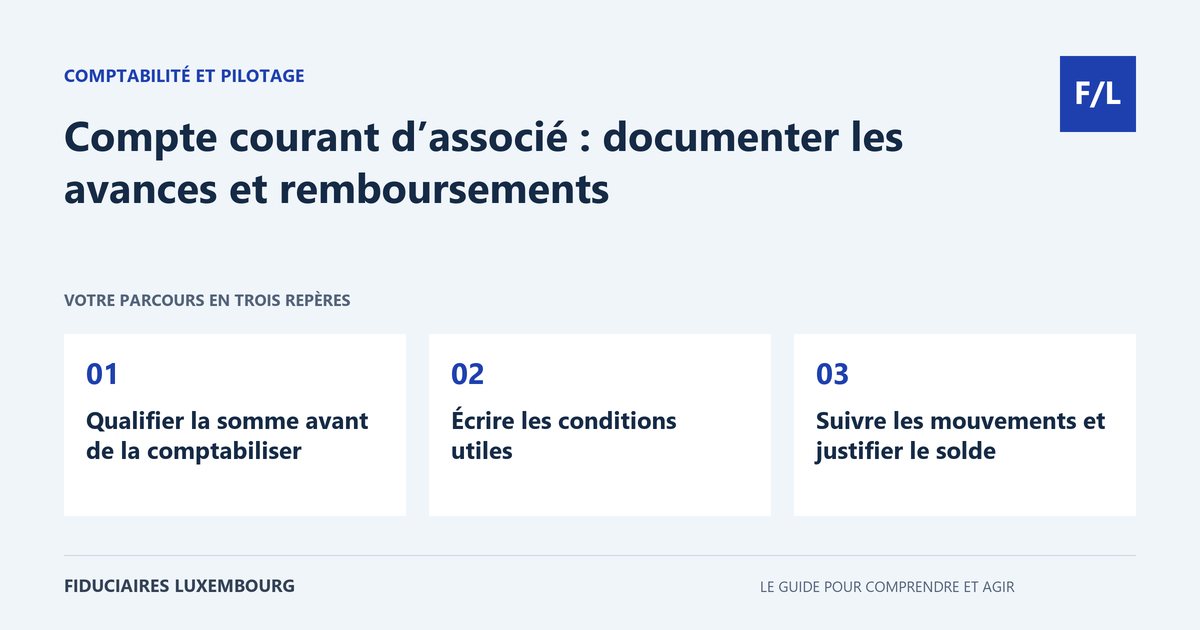
Classify the amount before accounting for it
A contribution to share capital grants rights according to the transaction and the articles of association; it is not repaid like a simple advance. A shareholder current account records receivables or payables between the shareholder and the company according to their nature. The wording of the transfer, even if it states “contribution”, is not sufficient to determine the treatment.
Also distinguish an advance of funds from reimbursement of a business expense paid personally. In the latter case, the invoice, the purpose and proof of payment must be retained. The company must not record the expense twice when the document subsequently arrives through another channel. Use a common reference to track the supporting document and the reimbursement.
Set out the relevant terms
Prepare the information to discuss with professionals: lender, borrower, amount or cap, currency, term, possible remuneration, due dates and repayment terms. State the necessary authorisations and the persons who may sign. An agreement helps make expectations understandable; it does not replace the review of the applicable rules.
If several shareholders finance the company, do not assume that their rights follow exactly their percentages of share capital. The amounts, dates and agreements may differ. Document each relationship. A bank or other financier may also request subordination or a restriction on advances: have the actual effect of these commitments reviewed before promising repayment.
Track transactions and substantiate the balance
Maintain a statement for each shareholder, including the opening balance, payments, expenses paid in advance, repayments and other explained entries. Reconcile this statement with supporting documents and bank records. An old amount without supporting documentation may become difficult to understand when there is a change of firm, a transfer or a succession.
Avoid silently offsetting personal expenses, remuneration and a dividend. These flows have different bases and may require their own decisions or formalities. If the company has paid an expense whose purpose is unclear, report it to the professional. A simple entry in a shareholder account does not automatically regularise the situation.
Review interest without taking tax shortcuts
Where interest is contemplated, have the rate, basis, period, dates and payment terms specified. The rate must be analysed in its context: risk, term, guarantees, currency and characteristics of the relationship. Copying that of another file does not constitute sufficient justification.
Recording an expense does not guarantee its tax deduction. The rules relating to transfer pricing, interest limitation and specific situations must be reviewed separately. For the recipient, the treatment of the amount also depends on their situation. A comparison between interest, remuneration and a dividend therefore deserves a full review, rather than an answer based solely on the displayed rate.
Prepare for repayment and changes in circumstances
Before a repayment, check the substantiated balance, the agreements, commitments to financiers and the cash position. Also consider upcoming needs. A significant outflow may jeopardise the payment of suppliers, salaries or tax due dates. The amount shown in the tracking does not mean that all conditions for immediate payment are met.
Anticipate the departure of a shareholder or the sale of shares. The fate of the shares and that of the advance must be addressed explicitly in the file. Who retains the receivable? Is it repaid, assigned or maintained? With what supporting documents and under what terms? These questions must be resolved with the competent parties before the transaction is completed.
The table to take action
| Flow | Initial document | Point to clarify |
|---|---|---|
| Capital contribution | Transaction deeds and decisions | Rights received and formalities specific to share capital |
| Advance of funds | Agreement and proof of transfer | Term, remuneration and repayment |
| Expense paid personally in advance | Invoice, purpose and proof of payment | Business purpose and absence of double treatment |
| Dividend distribution | Decision and financial statements file | Distributable amount and tax treatment |
Reconstructing a balance before repayment
Fictitious example: a shareholder transfers EUR 15,000 to the company as part of a documented advance. She then personally pays a business invoice of EUR 600, submitted with its supporting document. The company repays EUR 4,000 to her. In this simplified example, without interest or any other transaction, the tracking shows EUR 11,600: 15,000 + 600 − 4,000. This calculation is not sufficient to authorise a new payment. The team reviews the agreement, commitments made to a financier and available cash. If the EUR 600 had already been reimbursed by another means, adding it would create a double count; this is why references for supporting documents remain essential.
Your preparation checklist
- Distinguish between capital, advance, expense and distribution.
- Prepare an appropriate agreement and the necessary authorisations.
- Maintain a separate statement for each shareholder with supporting documents and references.
- Have any remuneration and its tax consequences reviewed.
- Check the conditions before any repayment.
- Address the current account explicitly in the event of a transfer or departure.
Frequently asked questions
Is the wording “contribution” sufficient?
No. The nature of the transaction must be determined and the deeds or agreements that substantiate it must be retained. The bank wording does not replace this analysis.
Is interest always deductible?
No. Its treatment depends on several rules and on the situation. Former general presentations must be compared against the provisions and guidance in force.
Does the sale of shares automatically settle the current account?
Do not assume so. The shares and the receivable may be subject to separate treatments. The transfer file must specify what has been agreed.
Useful terms in this guide
Questions to ask the professional
- What documents and authorisations are required for this advance?
- What rules govern the proposed remuneration and repayment?
- How can the balance be confirmed and a change of shareholder handled?
To clarify the assignment to be entrusted, also consult our accounting section.
And for your situation?
Gather the transfers, expenses paid in advance and agreements before making a new financing decision. To clarify the file, search our directory for a professional who can coordinate the accounting, tax and legal analysis with the necessary parties. You will then have an explicit basis for financing the company and organising the next steps.
Sources and verification
References consulted on 20 September 2026. Official procedures specify the applicable conditions and exceptions.
- Guichet.lu — financement par fonds propres
- ACD — circulaire L.I.R. 168bis/1 du 25 mars 2022, limitation des intérêts
- ACD — modifications fiscales publiées le 3 janvier 2025
This guide explains a general process. The applicable rules depend on your situation; it does not constitute personalised advice. Report a correction.
Your next step
A specific need deserves the right contact
Accounting, taxation, company formation or payroll: prepare your questions, then search the directory for the professional who can review your situation. Check their assignments and status before entrusting them with your file.