A business that is already operating may seem easier to take over than to create. It has customers, tools and a history. That history also contains commitments that the stated price does not reveal. Before imagining yourself in your new role, build a file that explains what you are buying, what the business can actually finance and what remains to be clarified.
The framework to review
The acquisition of shares in a company and the acquisition of a business or assets do not have the same scope. The shares change owner while the company retains its own rights and obligations. An asset acquisition requires determining the items and obligations transferred, including rules protecting employees where a transfer of undertaking applies. The contract, authorisations and tax consequences require an analysis specific to the transaction; no general tax neutrality can be presumed.
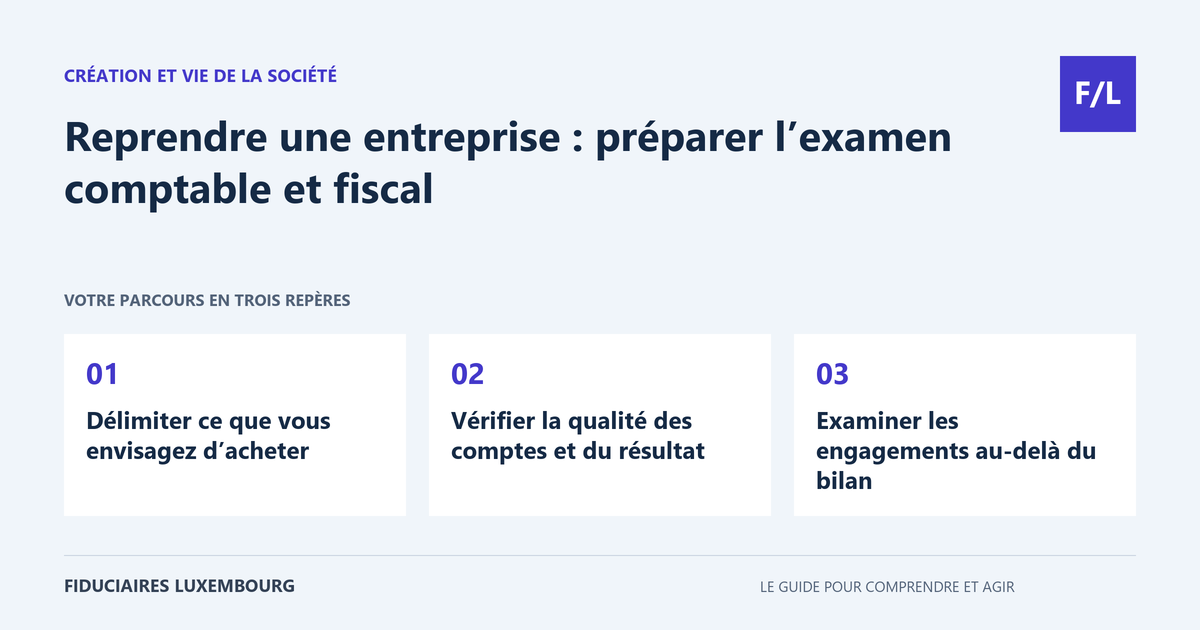
Defining what you intend to buy
Write a precise description: shares in which company, what proportion, what voting rights, or which assets and activities? Specify the premises, brands, software, files and contracts essential to the business. This work avoids negotiating a price for a long time when you and the seller are not discussing the same scope. A common trade name is not enough to identify the owner of each item.
An acquisition audit must follow this scope. Organise a document room with restricted access, dated versions and a list of questions. Request sensitive information gradually and according to each party’s rights; an interest in a takeover does not authorise the uncontrolled circulation of customer or employee data. Keep a record of the documents actually reviewed and of answers still missing.
Checking the quality of the accounts and profit
Gather several financial years and a recent financial position, then reconcile the accounts with the information explaining them. Review sales by business activity, customer concentration, overdue receivables, inventory and deferred expenses. A strong most recent financial year may depend on a single order or postponed investment. The guide to reading the profit and loss account helps distinguish sales growth from margin improvement.
Build a documented bridge between accounting profit and the profit used for your forecast. Specify the costs that will continue after the manager’s departure and those related to their replacement. Do not automatically remove every expense presented as exceptional. If an event recurs, or if your own organisation requires an equivalent expense, the adjustment may conceal an ongoing need. Have significant estimates and proposed adjustments explained.
Reviewing commitments beyond the balance sheet
Request financing agreements, guarantees, leases, commitments with related parties and litigation files. Maturities, change-of-control clauses and termination options may affect the feasibility of the takeover. Also verify the rights to the tools and creations used: paying for the shares does not remedy a missing licence or a contract signed by the wrong entity.
The tax and social security review covers returns, payments, correspondence with authorities and ongoing audits. A certificate or filed return alone does not prove that all past treatments are correct. For teams, have the transfer rules and applicable obligations assessed before developing a scenario to reduce or amend contracts. The ITM recalls the preservation of rights in the context of a relevant transfer of undertaking.
Financing the first months after the takeover
Distinguish the purchase price, transaction costs, necessary investments and money required by operations. The working capital requirement may increase with the season or payment terms. A profitable business may lack cash if its invoices are collected after wages and suppliers are paid. Prepare a central scenario and a less favourable scenario.
The thirteen-week cash flow plan makes it possible to schedule these needs. Identify who pays each expense: the acquirer, the target company or another entity. This distinction matters as much as the total. Do not automatically use the target’s cash to finance the purchase of its own shares; the legal possibility and financial conditions must be reviewed separately.
Turning findings into negotiable decisions
Classify the points according to their consequence: price to be revised, document to obtain, condition precedent, seller’s undertaking or transition arrangements. A contractual warranty merits a review of its scope, exclusions, duration and implementation. Its practical value also depends on the ability of the person giving it to honour their commitment.
Before signing, have a summary reviewed that distinguishes confirmed facts, assumptions and unresolved points. Then prepare the handover: contacts, access, filing calendar, bank, suppliers and monitoring of commitments. For a transaction involving SARL shares, continue with the share transfer file. The decision must remain understandable even to someone who did not attend all the meetings.
The table for taking action
| Finding | Useful review | Possible decision |
|---|---|---|
| Key customer | Contract, margin and renewal | Test a decrease in volume |
| Old receivables | Collections and disputes | Revise the financing requirement |
| Lease due for renewal soon | Terms and required consent | Secure continuity of the premises |
| Debt or guarantee | Balance, maturity and beneficiary | Clarify treatment in the agreement |
Financing does not stop at the stated price
Fictional example: the negotiated price is 200,000 euros. The acquirer also plans for 15,000 euros in costs, 25,000 euros to upgrade tools and 40,000 euros in initial cash requirements. Their plan must therefore explain 280,000 euros in resources and their allocation among the persons concerned. This illustrative calculation is neither a valuation nor a recommended financing structure. It shows why having only the purchase price is not enough to get started under good conditions.
Your preparation checklist
- Define the shares or assets and the exact scope.
- Organise document access and confidentiality.
- Compare several financial years and a recent financial position.
- Explain profit adjustments.
- List contracts, disputes and guarantees.
- Review employees and authorisations.
- Finance costs, investments and the operating cycle.
- Assign each unresolved point before signing.
Frequently asked questions
Are profitable accounts enough to make a decision?
No. You must also understand the quality of profit, commitments, cash flow and the resources needed after the takeover.
Does buying assets remove all obligations?
No. The contractual scope and applicable rules, particularly those concerning the transfer of employees, require separate analysis.
Does a seller’s warranty replace reviewing the file?
No. It must be negotiated and understood; it does not eliminate missing information or all risks.
Useful terms in this guide
Questions to ask the professional
- Which findings genuinely change the decision or the price?
- What cash requirement must be financed after the purchase?
- What conditions must be met before signing?
To define the engagement to be entrusted, also consult our company formation file.
And for your situation?
Prepare the intended scope and the first available accounts. Search our directory for a professional able to review the figures with you and coordinate, depending on the file, the necessary legal and tax work.
Sources and verification
References consulted on 20 September 2026. Official procedures specify the applicable conditions and exceptions.
- Guichet.lu — reprise d’entreprise
- Bpifrance Création — diagnostic financier de reprise
- ITM — contrats de travail en cas de transfert d’entreprise
This guide explains a general process. The applicable rules depend on your situation; it does not constitute personalised advice. Report a correction.
Your next step
A specific need deserves the right contact
Accounting, taxation, company formation or payroll: prepare your questions, then search the directory for the professional who can review your situation. Check their assignments and status before entrusting them with your file.