How much must be sold for the business to cover its costs? This question is more useful than a sales target chosen at random. The break-even point makes it possible to link price, volume and costs, provided realistic assumptions are made. Let us look at how to build a simple calculation, translate it into concrete work and identify what it does not say about your cash flow.
The framework to check
The break-even point is a management tool, not a legal threshold for tax exemption or proof of solvency. The formulas presented are based on a defined scope of products and costs and on assumptions about cost behaviour. They do not replace the annual accounts or the company's tax obligations. VAT rules and the status of the activity must be handled according to the relevant Luxembourg case.
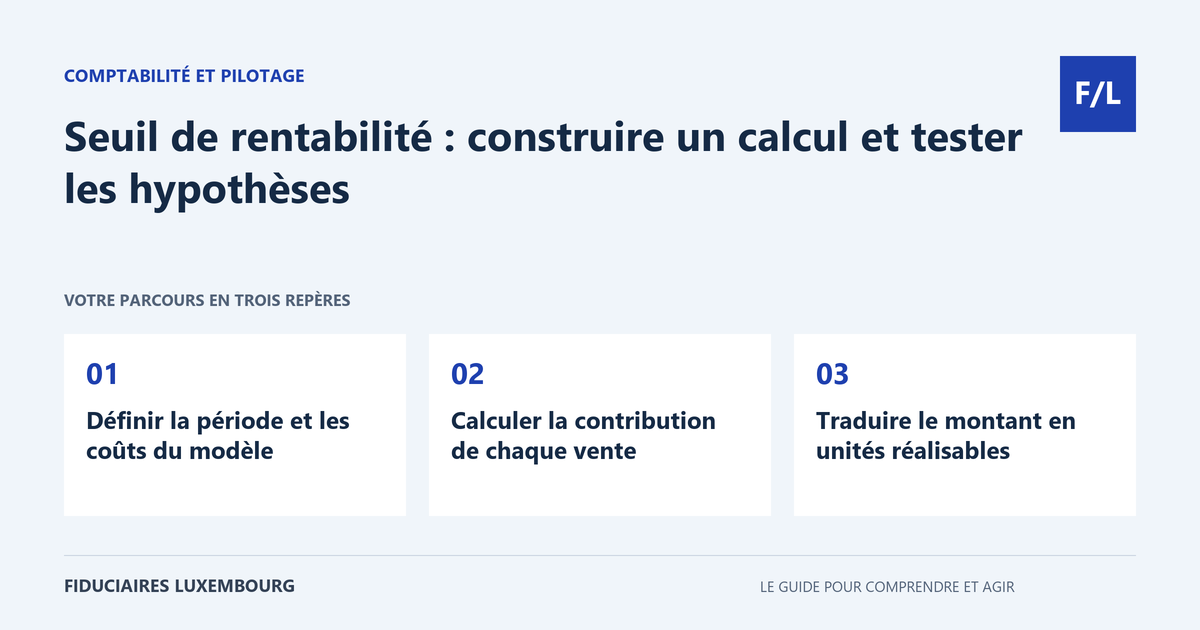
Define the period and the model costs
Choose the period under review and specify the activity covered. Include the resources needed to operate it, including those you plan for but do not yet pay for. An estimate that omits the planned remuneration for work or essential tools may show an easy-to-reach target while leaving the project economically fragile.
Distinguish fixed costs over the period under review from costs that change with volume. Some costs have a component of each type or change in steps. Document your choice rather than automatically placing all expenses from the same category into one classification. The assumptions must be open to discussion with someone who knows your organisation.
Calculate the contribution of each sale
The contribution margin corresponds to sales less the selected variable costs. Its rate is calculated by dividing this margin by sales. With a positive and consistent rate, the break-even point is obtained by dividing fixed costs by this rate expressed as a decimal. A rate of 40% is therefore entered as 0.40.
If the margin is zero or negative, increasing volume does not solve the problem in this model: each sale does not contribute to covering fixed costs. Reconsider the price, the variable cost and the nature of the offering. For several products, the average rate depends on the sales mix; it must be reassessed when that mix changes.
Translate the amount into achievable units
Convert the required turnover into orders, services or billable days, using an explained average price. Then compare the volume with your capacity. A target expressed in billed days must leave room for prospecting, administration and non-sellable periods. The calculation becomes useful when it is compared with the schedule and available resources.
If the volume requires an additional hire, piece of equipment or premises, incorporate these costs back into the model. A fixed cost may remain stable at one level of activity and then increase sharply. The threshold calculated before this change is no longer sufficient to assess the new step. Present the scenarios separately rather than retaining one seemingly precise answer.
Use the break-even date while recognising its timing limitations
The break-even date expresses the point in time when the threshold is reached. A proportional conversion of the threshold into days assumes, in particular, a regular distribution of activity and a stated duration convention. For a seasonal business, it is more meaningful to track the planned monthly cumulative total than to infer an exact date from uniform annual turnover.
The theoretical date does not indicate when customers will pay. Compare the model with the cash flow plan: an investment, a payment term or a loan repayment may create a funding requirement before or after the break-even date. Profitability and liquidity should be discussed together, using separate tables.
Test the assumptions that change the decision
Prepare a few useful alternatives: a lower average price, rising variable costs or slower sales. Explain what changes and keep the other assumptions constant to understand the effect. A sales discount can increase volumes while significantly reducing the contribution from each sale. The scenario must show both effects, not just the additional turnover.
Update the data using the income statement and observed costs. Then compare the forecast with actual results in the budget monitoring. The threshold is not a figure to calculate once for a business start-up file: it is a benchmark to review when prices, resources or sales conditions change.
The table to take action
| Assumed margin rate | Threshold calculation | Sales required |
|---|---|---|
| 40% | 48,000 / 0.40 | €120,000 |
| 35% | 48,000 / 0.35 | Approximately €137,143 |
| 30% | 48,000 / 0.30 | €160,000 |
A target in days can reveal a capacity problem
Fictional example: a business expects a price of 750 euros excluding VAT per billed day and 150 euros of variable costs per day, i.e. a contribution of 600 euros. With annual fixed costs of 48,000 euros, it must bill 80 days to cover the selected costs. If its saleable capacity is only 65 days, the project must be reviewed: price, costs, capacity or scope. The calculation assumes a constant contribution and excludes any new cost linked to increased capacity; it does not constitute a cash flow forecast.
Your preparation checklist
- Define the period and activity under review.
- Include the resources actually required.
- Document fixed costs, variable costs and steps.
- Calculate a consistent margin.
- Convert the threshold into saleable volume.
- Compare this volume with capacity.
- Test prices, costs and sales pace.
- Update the model with actual data.
Frequently asked questions
Is the threshold an amount of cash to retain?
No. It expresses a sales level in a cost model. Cash requirements follow different data and due dates.
Can an exact date be set for every activity?
A proportional date assumes distribution assumptions. Seasonality requires more detailed monitoring.
Is selling more always sufficient?
No. A positive contribution is required, and the necessary additional costs or capacity must be taken into account.
Useful terms in this guide
Questions to ask the professional
- What costs and remuneration does our model include?
- Is the required volume commercially and materially possible?
- Which assumption has the greatest effect on the threshold?
To clarify the assignment to be entrusted, also consult our accounting section.
What about your situation?
Prepare your prices, your costs and your realistic production or billing capacity. Search our directory for a professional to build an understandable model and link it to your profit and cash flow forecasts.
Sources and verification
References consulted on 20 September 2026. Official procedures specify the applicable conditions and exceptions.
- Bpifrance Création — méthode du seuil de rentabilité
- Bpifrance Création — indicateurs de gestion
- Bpifrance Création — construire un compte de résultat prévisionnel
This guide explains a general process. The applicable rules depend on your situation; it does not constitute personalised advice. Report a correction.
Your next step
A specific need deserves the right contact
Accounting, taxation, company formation or payroll: prepare your questions, then search the directory for the professional who can review your situation. Check their assignments and status before entrusting them with your file.