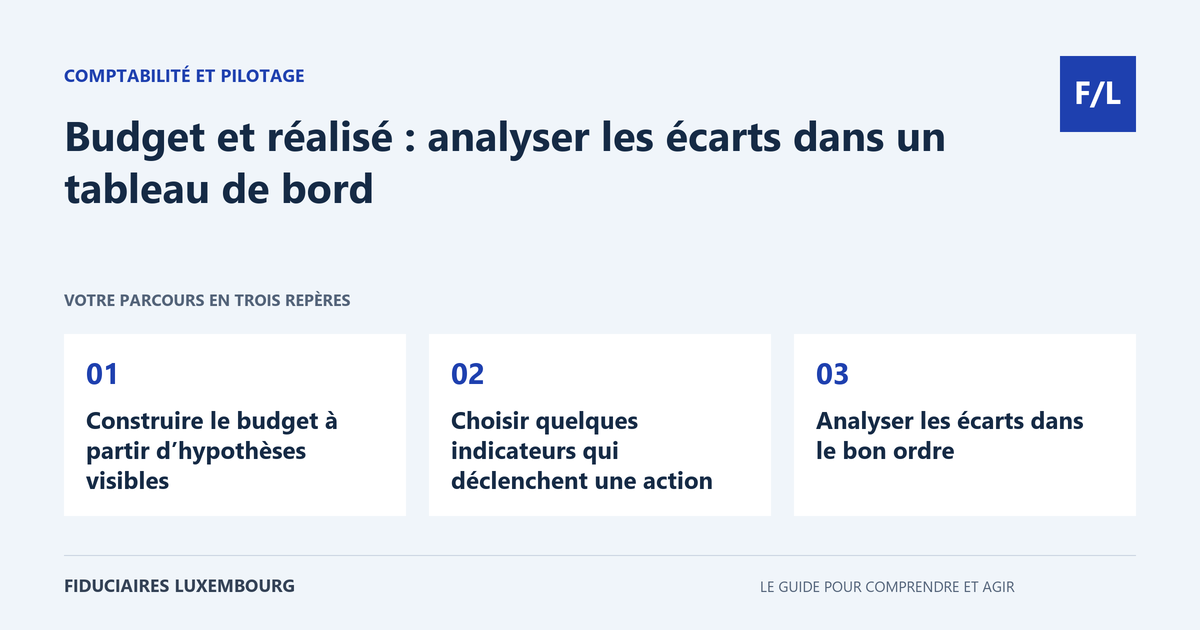
The dashboard shows a red column. What should be done on Monday morning? If the variance leads to neither an explanation nor a decision, the dashboard provides only part of the expected service. Good budget monitoring links an initial assumption, reliable data and an action that someone is responsible for. Here is a method for organising this meeting without multiplying unnecessary indicators.
The framework to check
The budget and dashboard are internal management tools. They do not replace the annual accounts, filings or decisions required by the company's legal form. A forecast is a documented assumption, not an assured result. When a dashboard uses employee or customer data, its access and level of detail must be adapted to the needs of the people who consult it.
Building the budget from visible assumptions
Break down projected sales into understandable components: customers, volumes, prices and start dates. Add the resources needed to achieve them. Growth of 15% entered without explanation is difficult to discuss or adjust. Concrete assumptions allow the sales manager and operations manager to check that they are talking about the same project.
Keep a dated version of the approved budget and the main assumptions. Note the uncertain elements and when you will be able to confirm them. The financial forecast becomes more useful when figures remain linked to observable facts: order, recruitment, capacity, contract or deadline. An annual total alone does not show the pace of activity.
Choosing a few indicators that trigger action
Select indicators according to your decisions: signed sales, invoicing, defined margin, receipts, inventory or workload. Give each one a definition, a source and a person responsible. If two employees calculate the same indicator differently, the meeting may be used to reconcile figures rather than make decisions.
Specify the useful frequency. Some items are tracked every week, others at the monthly close. Reconcile commercial and accounting data when their timing differs. An order is not always an invoice, and an invoice is not yet a receipt. The guide to reading the profit and loss account helps keep these concepts distinct.
Analysing variances in the right order
Start by checking data quality and scope. A budget variance may result from an unrecorded invoice or from a month being compared with a different period. Once these points have been checked, review the timing, volumes, prices and unforeseen events. A specific cause makes it possible to choose a proportionate response.
Interpret the sign according to the indicator. An expense above budget and sales above budget do not tell the same story. A deferred expense may temporarily improve the month while still remaining payable later. Do not celebrate a saving before checking that it does not simply correspond to a missing document or a delayed project.
Updating the forecast without erasing the budget
Add a revised forecast for the end of the year: known actuals plus an estimate for the remaining periods. Keep the initial budget in order to understand what has changed. If you replace the target each month with the latest actuals, you lose the ability to assess the initial assumptions and the decisions made.
Show the selected actions and their expected impact, with a review date. An action may concern a follow-up, a price, a supplier order or recruitment. Link the financial impact to the cash flow plan when the payment schedule matters. The expected gain in profit or loss may reach the bank account on a different date.
Organising a short and traceable meeting
Prepare significant variances before the meeting. For each one, present the finding, the explanation, the available supporting documents and the decision expected. Avoid an automatic comment on every line if most of them do not change any action. The dashboard must help focus attention without concealing a sensitive item solely because its amount is small.
End with a simple record: action, person responsible, deadline and monitoring indicator. At the next meeting, revisit these points before adding new topics. Check whether the measures have changed the margin or the expected pace of activity. The guide on the break-even point can complement the discussion when the economic balance of the model changes.
The table for taking action
| Monthly indicator | Budget / actuals | Question to consider |
|---|---|---|
| Sales | 50 000 € / 44 000 € | Volume, price or timing difference? |
| Subcontracting | 12 000 € / 10 000 € | Real saving or lower activity? |
| Rent | 3 000 € / 3 000 € | Stable scope? |
| Receipts | 48 000 € / 35 000 € | Customer delay or different timing? |
A sales variance contains two pieces of information
Fictional example: the budget provides for 100 services at 500 euros, i.e. 50 000 euros. Actuals are 90 services at 480 euros, i.e. 43 200 euros. The total variance is minus 6 800 euros. With the stated breakdown, the volume effect at the budgeted price represents minus 5 000 euros and the price effect on the actual volume minus 1 800 euros. The sum reconciles to the total variance. The person responsible can then examine demand and discounts granted separately. This simplified calculation assumes comparable services; a change in the mix of offerings would require further analysis.
Your preparation checklist
- Document the budget assumptions.
- Keep its initial version.
- Define each indicator and its source.
- Compare consistent periods and scopes.
- Check the data before interpretation.
- Distinguish timing, volume and price.
- Add an explicit revised forecast.
- Assign actions and check their effects.
Frequently asked questions
Should the budget be replaced by the latest forecast?
Keep both. The budget shows the initial assumption and the revised forecast reflects new information.
Is a lower expense always favourable?
It may result from a delay, a missing invoice or lower activity. The cause must be examined.
How many indicators should be tracked?
The number depends on the decisions to be made. Defined and used indicators are preferable to a large dashboard with no person responsible.
Useful terms in this guide
Questions to ask the professional
- Which assumptions explain our budget?
- Which variances require a decision this month?
- Who will check the effect of each selected action?
To clarify the assignment to be entrusted, also consult our accounting section.
And for your situation?
Prepare the budget, the actual data and the decisions you would like to anticipate more effectively. Search our directory for a professional to build a dashboard suited to your working rhythm and link the indicators to the accounts.
Sources and verification
References consulted on 20 September 2026. Official procedures specify the applicable conditions and exceptions.
- Bpifrance Création — indicateurs de gestion
- Bpifrance Création — construire un compte de résultat prévisionnel
This guide explains a general process. The applicable rules depend on your situation; it does not constitute personalised advice. Report a correction.
Your next step
A specific need deserves the right contact
Accounting, taxation, company formation or payroll: prepare your questions, then search the directory for the professional who can review your situation. Check their assignments and status before entrusting them with your file.