In an association, accounting is often entrusted to a volunteer who does their best with the documents received. To keep this work manageable, it is necessary to understand the obligations and prepare a file that the next treasurer can take over. The new Luxembourg rules require an organisation suited to the size of the ASBL, with steps that go beyond monitoring the bank account.
The framework to check
The law of 7 August 2023 on ASBLs and foundations has applied to all these entities since the end of the transitional period, on 24 September 2025. Entry into the new accounting regime must be assessed according to the association’s history and its financial year. Large associations, ASBLs recognised as being of public utility and foundations notably have distinct audit requirements. Non-profit status does not automatically exclude tax, social security or data protection obligations related to the activities carried out.
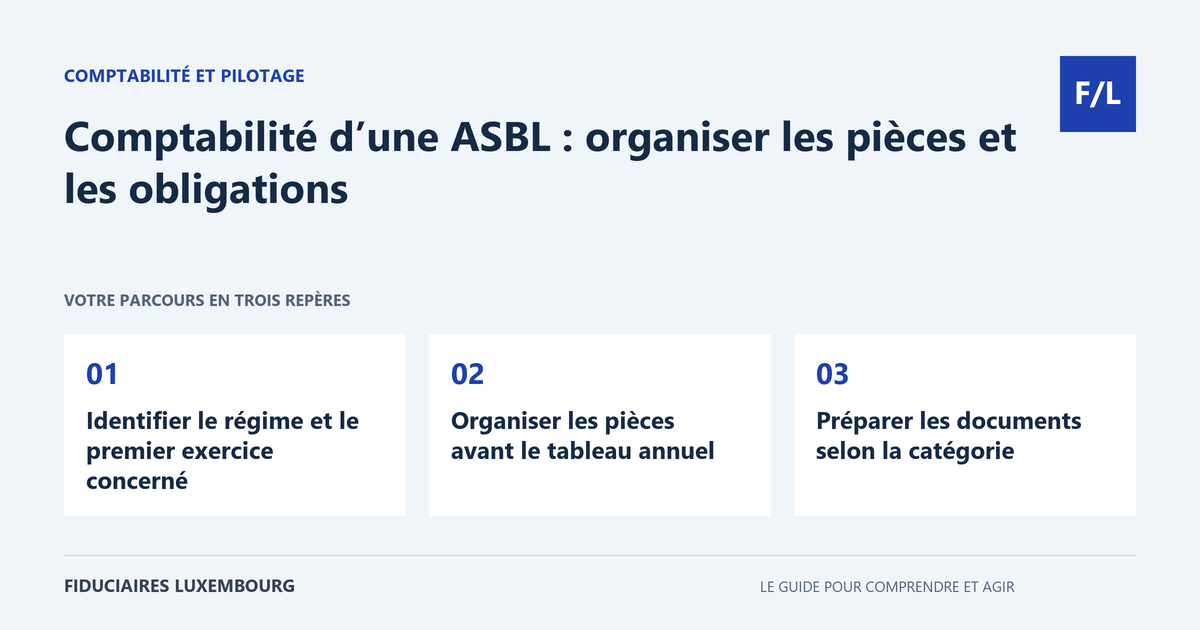
Identifying the regime and the first financial year concerned
Gather the articles of association, their amendments and the closing dates. The official transition documentation distinguishes, in particular, articles of association amended in 2024, with 2025 accounts to be filed in 2026, and those amended in 2025 or not amended in time, with 2026 accounts to be filed in 2027. These benchmarks must be applied to your situation; do not mechanically transpose a calendar example to a non-calendar financial year.
Then check the size category based on the legal criteria for full-time equivalent staff, income and assets. A change of category takes account of repetition over two financial years, whereas a new association requires an appropriate estimate. A grant received in one year alone therefore does not, by itself, make it possible to immediately determine the applicable regime. Keep the calculation and the reference financial years.
Organising supporting documents before the annual statement
Assign a reference to invoices, receipts, expense reimbursements and other supporting documents. Link each transaction to an activity or source of funding where useful. For cash receipts, provide monitoring that makes it possible to understand the amounts received, their deposit and the expenses paid. The bank account balance alone is not enough to explain all the association’s transactions.
Simplified accounting for a small ASBL must record all income and expenses. It also requires filing and a payment approval method. Define who prepares, who authorises and who reconciles balances. In a small team, controls can remain simple: the essential point is that another person can understand significant transactions and find the supporting documents without relying on a single volunteer.
Preparing documents according to the category
For a small ASBL, the process notably includes the statement of income and expenses, the notes and a draft budget for the following financial year. Medium-sized associations prepare annual accounts with a balance sheet, profit and loss account and notes. Large associations, ASBLs recognised as being of public utility and foundations must, in particular, have their accounts audited by an approved statutory auditor. Do not confuse this engagement with simple data-entry assistance.
The notes are not an optional document simply because the main statement appears clear. Use the current requirements and templates, notably following the 2025 regulation, and check the expected information. Official sources specify that a nominal list of donors and the amounts of their donations must not be published with the accounts. Distinguish the necessary internal traceability from documents intended for public filing.
Linking activities, grants and the budget
Monitor funds whose use is governed by an agreement and the supporting documents expected by the funder. An available bank balance is not necessarily unrestricted. Show the projects, their planned costs and commitments still to be paid. This view helps the board of directors make decisions without confusing cash received, the authorised budget and money available for a new action.
Prepare a realistic budget with the people who organise the activities. The guide to budgets and variances provides a method for comparing forecasts with actual results. The aim is not to produce a perfect document at the beginning of the year, but to explain changes: a cancelled event, a deferred grant, additional expenditure or different attendance. Keep the approved budget and separately identify revised forecasts.
Approving, filing and handing over the file
The accounts must be submitted to the general meeting within six months of the closing date, then filed within one month of their approval, and no later than seven months after the closing date. Prepare the schedule by working backwards from these deadlines: collection, checks, documents, notice of meeting and decision. For a small ASBL, the draft budget follows its approval process, but is not among the annual accounting documents to be filed as described by the official guide.
After filing, retain the evidence and organise the handover. The official guide provides for accounting records to be retained for ten years for small associations; other document retention requirements must also be examined. Review banking and administrative access, notably the MyGuichet professional space, when changing treasurer. RCS and RBE information also requires separate monitoring from annual accounts.
The table for taking action
| Category | Accounting documents | Specific audit |
|---|---|---|
| Small ASBL | Statement of income/expenses and notes | Complete filing and reconciliations |
| Medium-sized ASBL | Balance sheet, profit and loss account, notes | Applicable regime to be checked |
| Large ASBL | Annual accounts and required report | Approved statutory auditor |
| ASBL of public utility | Accounts and specific requirements | Approved statutory auditor regardless of small size |
A change of treasurer that does not interrupt monitoring
Fictitious example: a small association is preparing an event funded in part by aid earmarked for the project. Its treasurer leaves their role before the closing date. The file handed over to the successor contains numbered supporting documents, reconciled balances, outstanding commitments and the funding agreement. The board also retains the approval and filing schedule. The new treasurer can therefore continue monitoring without treating the entire bank balance as a budget available for another event.
Your preparation checklist
- Check the articles of association, dates and first applicable financial year.
- Document the size category.
- File income, expenses and supporting documents.
- Reconcile bank and cash.
- Prepare the notes and budget.
- Review earmarked funding.
- Plan the general meeting and then the filing.
- Retain evidence, archives and handover records.
Frequently asked questions
Must a small ASBL file its accounting documents?
Yes, according to the applicable regime. Small size does not exempt an association from filing the statement of income and expenses and the notes.
Does volunteering remove the need to substantiate expenses?
No. A proportionate organisation remains necessary to explain transactions and comply with the association’s obligations.
Must donors’ names be published with the accounts?
The official FAQ specifies that a nominal list of donors and amounts must not be added to the accounts. Internal monitoring serves another purpose.
Useful terms in this guide
Questions to ask the professional
- Which category applies to our financial year?
- Which documents are missing for the notes and approval?
- How can the handover of the treasurer role be made simpler and verifiable?
To clarify the engagement to be entrusted, also consult our accounting section.
And for your situation?
Prepare the articles of association, the latest accounts and funding agreements. Search our directory for a professional who can adapt the accounting organisation to your association and specify the necessary audit engagements.
Sources and verification
References consulted on 20 September 2026. Official procedures specify the applicable conditions and exceptions.
- Ministère de la Justice — FAQ myASBL
- Ministère de la Justice — fin de période transitoire ASBL
- Ministère de la Justice — guide comptable de la petite association
- Guichet.lu — dépôt des comptes, associations et fondations
This guide explains a general process. The applicable rules depend on your situation; it does not constitute personalised advice. Report a correction.
Your next step
A specific need deserves the right contact
Accounting, taxation, company formation or payroll: prepare your questions, then search the directory for the professional who can review your situation. Check their assignments and status before entrusting them with your file.