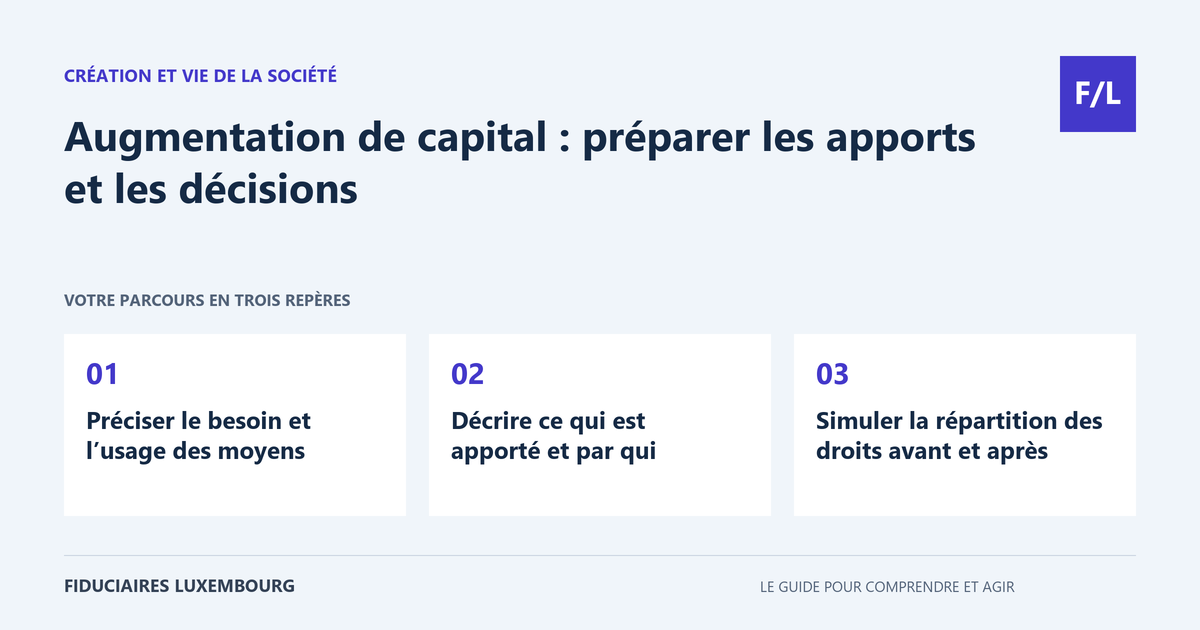
A shareholder wishes to finance the company or an investor is considering joining. Increasing the capital may meet the objective, but it is first necessary to understand what enters the company and what changes between the shareholders. The amount paid alone does not explain the new allocation of rights. This guide helps you prepare the questions and documents before setting the terms of the transaction.
The framework to review
The decisions, instruments and controls depend on the corporate form, the articles of association and the nature of the contribution. A cash contribution, an asset contributed or a debt conversion require different documents and analyses. For an SARL, capital changes fall within the scope of shareholder resolutions under the applicable framework. Have the majorities, notarial involvement and any reports determined before launching the transaction; do not apply the formalities of an SA to all companies.
Clarifying the need and use of funds
Set out what the company seeks to finance and by what date: investment, development, strengthening equity or reorganising financing. Compare this need with the cash flow forecast. This step makes it possible to distinguish a transaction intended to bring in cash from a transaction that only changes the balance sheet structure.
A conversion of an advance into capital does not create a new cash receipt at the time of conversion. The money may have been received and used previously. Similarly, the capitalisation of reserves must be distinguished from a new contribution. Have the expected effect on equity, debts and the bank account clarified before presenting the transaction as financing that is immediately available.
Describing what is contributed and by whom
For a cash contribution, prepare the amount, the subscriber’s identity, the documented source of funds and the agreed timetable. For a contribution in kind, identify precisely the asset and the rights transferred. It must be possible to review its ownership, value and any encumbrances that could affect it. An amount stated in a commercial presentation is not sufficient justification.
If the project concerns a receivable, reconcile its existence, amount and terms with the contracts and accounting records. The shareholder advances file provides a useful starting point. The terms of conversion must be reviewed from a legal and tax perspective. Do not turn a trial balance line into capital through a simple entry without the required instruments.
Simulating the allocation of rights before and after
Prepare a current ownership table and a post-transaction table. Distinguish share capital, amounts paid and rights attached to the securities. Depending on the terms retained, part of the price may constitute a premium rather than nominal value. Request that the economic value and voting rights be explained separately so that each participant understands the agreement.
Dilution is measured in the new allocation, but the percentage does not explain all rights. Review the classes of securities, agreements between shareholders and applicable protections. The rights of existing shareholders must be addressed according to the corporate form and relevant legal texts. An arithmetic simulation is not sufficient to determine the formalities or the fairness of the price.
Preparing approvals and a realistic timetable
Gather the articles of association, the register of shareholders and relevant agreements. Determine which bodies make the decisions, what information must be communicated and which instruments or reports are required. The valuation of a contribution in kind does not follow an identical procedure for all corporate forms. Coordinate the parties involved early enough to avoid promising a signature before the documents are available.
Check the conditions precedent with the bank and the relevant professionals. Record the dates, responsibilities and expected evidence. If the transaction depends on financing, a transfer of ownership or another agreement, reflect this dependency in the timetable. The table should make visible what is still preventing completion.
Updating registers and accounting records
Once the transaction has been completed, reconcile the instruments, financial movements and accounting entries. Keep the final allocation of securities and the documents supporting it. Organise the applicable RCS and RESA formalities, then verify the information recorded. The share capital figure on the company’s materials must correspond to the situation actually completed.
Review the beneficial ownership file if ownership or rights change. Also review powers, contracts and, where relevant, the director’s social security status. A capital increase is an event in the life of the company; its follow-up does not end with recording the transfer.
The table for taking action
| Proposed method | Immediate new cash? | Key document or question |
|---|---|---|
| Cash contribution | Yes, depending on actual payment | Subscription and evidence of the movement |
| Contribution of an asset | Not necessarily | Ownership, valuation and transfer |
| Conversion of a receivable | No, at the time of conversion alone | Existence of the debt and conversion terms |
| Capitalisation of reserves | No | Available reserves and required resolution |
Dilution to understand before signing
Purely arithmetic fictional example: two shareholders each hold 50 securities of the same class. A new investor receives 100 additional securities which, in this scenario, carry the same rights per unit. The total rises to 200 securities: each initial shareholder then holds 25% and the investor 50%. This calculation indicates neither the appropriate price nor the value of the company. It does not prejudge premiums, special rights or legal issuance conditions. The table is used to make the allocation visible, so that the discussion of price and protections is not discovered after signing.
Your preparation checklist
- Define the objective and the date of the need.
- Identify the actual effect on cash flow.
- Document the contributor, funds, assets or receivable.
- Compare ownership and rights before and after.
- Review value, nominal value and any premium.
- Determine the required resolutions, instruments and reports.
- Reconcile completion, bank records and accounting.
- Follow up on registers, beneficial owners and company materials.
Frequently asked questions
Does increasing capital always bring in money?
No. A capitalisation of reserves or a debt conversion may change the balance sheet without a new cash receipt at the same time.
Does the capital percentage describe all powers?
Voting rights and relevant agreements must also be reviewed. Two economic allocations do not necessarily summarise the powers.
Can an advance be converted through a simple accounting entry?
The accounting records must reflect a validly completed transaction. The conversion instruments and conditions must be determined before its final recording.
Useful terms in this guide
Questions to ask the professional
- Which method genuinely meets the financing need?
- How can the value and new rights be justified?
- Which updates result from the new allocation?
To clarify the assignment to be entrusted, also consult our company formation file.
What about your situation?
Prepare a before-and-after table, the articles of association and supporting documents for the proposed contribution. To turn this project into a documented transaction, search our directory for a professional able to coordinate the accounting, tax and necessary legal stakeholders.
Sources and verification
References consulted on 20 September 2026. Official procedures specify the applicable conditions and exceptions.
- Guichet.lu — SARL, capital et décisions des associés
- Guichet.lu — financement par fonds propres
- Guichet.lu — dépôts modificatifs et rectificatifs au RCS
This guide explains a general process. The applicable rules depend on your situation; it does not constitute personalised advice. Report a correction.
Your next step
A specific need deserves the right contact
Accounting, taxation, company formation or payroll: prepare your questions, then search the directory for the professional who can review your situation. Check their assignments and status before entrusting them with your file.