A company appears in the list of shareholders, but who is behind it? And if no one exceeds the commonly cited ownership threshold, is the analysis complete? The RBE requires looking at natural persons and actual means of control. To avoid a filing made too hastily, build a file that explains your conclusion and can be updated when the next change occurs.
The framework to check
The entities concerned must identify and declare their beneficial owners in accordance with the applicable law. For a company, ownership of more than 25% is an indicator, but control by other means must also be examined. Reliance on the senior managing official is subsidiary, after all searches have been exhausted and in the absence of grounds for suspicion. The application for registration or amendment must, in principle, be made within one month of becoming aware, actually or as should reasonably be expected, of the event making it necessary.
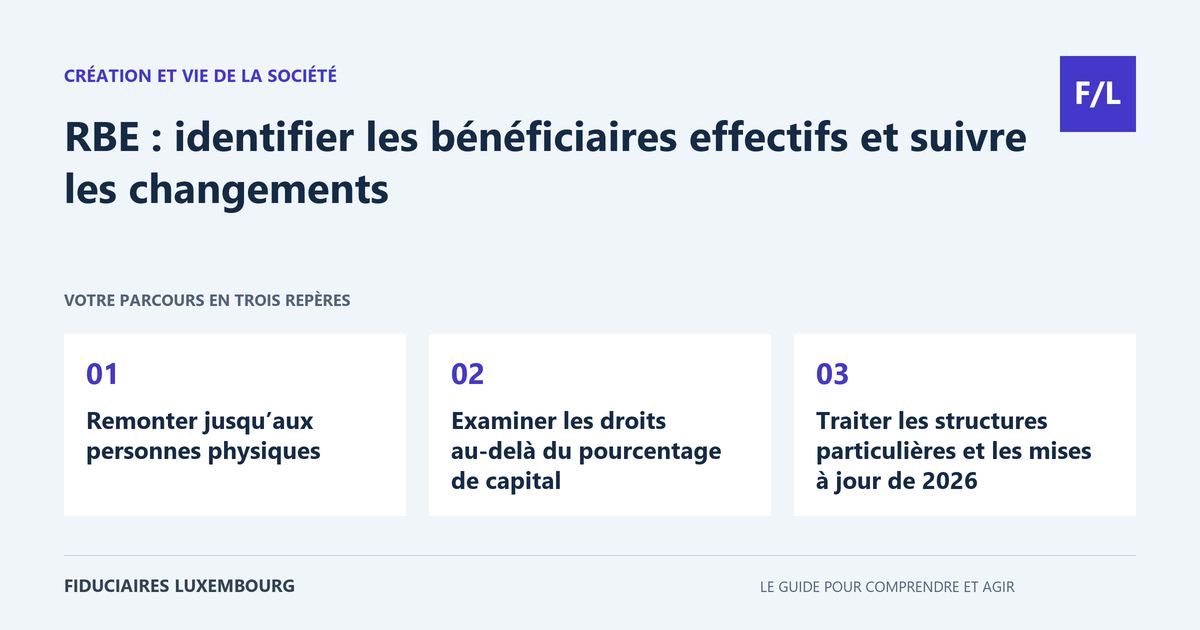
Trace back to the natural persons
Prepare an organisational chart of the direct holders and then the intermediate levels. For each link, state the proportion and the document establishing it. A shareholder company is not the natural person sought as a beneficial owner. The analysis must continue to the persons concerned, while taking into account the specific regimes that may apply to certain entities.
Date the chart and avoid versions with no source. An organisational chart received several years earlier may no longer reflect the structure. Request missing information and retain a record of the steps taken. Difficulties in obtaining information should not be removed from the file: they are among the issues to address with the professional.
Examine rights beyond the percentage of capital
Shareholdings do not necessarily reflect all powers. Analyse voting rights, shareholder agreements and other relevant means. Indirect control may differ from the simple result of multiplying percentages. Have the documents governing decision-making reviewed rather than limiting yourself to a capital table.
The person preparing the file must distinguish what they know, what a document confirms and what remains to be verified. A line stating “no beneficial owner” should never be the automatic conclusion of a shareholding split into small fractions. Reliance on senior managing officials requires the prescribed subsidiary reasoning, not an easy solution for completing the form.
Address specific structures and 2026 updates
A chain involving a trust or foundation requires a specific review. LBR Circular 26/01 of 19 August 2026 clarifies the register’s position on the persons to be disclosed in these structures. Provide the professional with the relevant instruments and roles; do not reduce this situation to a calculation of percentages between companies. This documentary position must be distinguished from the applicable texts and their judicial interpretation.
LBR Circular 26/02 announces a coercive compliance phase starting on 21 September 2026. As of 20 September, this is therefore an announced launch. Check the registered data and pending applications now. Change monitoring must have a designated person responsible, with a backup solution during their absences.
Gather data and protect its circulation
Once the persons have been identified, gather the information required for the filing and verify its consistency. Use the portal’s current requirements for identification details and supporting documents to be attached. Do not send all available personal documentation by default: separate the information required for the filing from that which supports the analysis in the internal file.
Organise access to identity documents and personal contact details. Identify the necessary recipients and an appropriate channel. If an agent prepares the filing, specify who checks the data before it is submitted. A data-entry error and an error in identifying the person are two different issues; the review must look for both.
Monitor the filing and changes
Keep the submitted content, proof of filing and feedback from the Register of Beneficial Owners. Check the registered status against the conclusion of the file. An application prepared but not submitted does not constitute a registration. If the register requests regularisation, assign the response to a person and follow it through until it has been dealt with.
Integrate the RBE into the preparation of transfers, capital increases, changes in rights and amendments to relevant personal data. The trigger is not limited to the annual meeting. Keep a list of events and have the consequences reviewed when they become known. An annual reminder may supplement this organisation, but does not replace compliance with the deadlines linked to each change.
Distinguish filing, consultation and the KYC file
The RBE should no longer be presented as a directory fully open to every internet user. Current arrangements distinguish, in particular, access to one’s own file and authorised categories, subject to conditions that may include a legitimate interest in combating money laundering. Use the procedure corresponding to your capacity; do not share the entity’s means of access as though they were a public link.
An extract reproduces registered data; it does not exempt a professional from their own identification obligations. Your bank or fiduciary may request additional documents for its KYC file. Prepare consistent information, but do not assume that all parties have exactly the same role and level of review.
The practical action table
| Question | Useful documents or information | Point to document |
|---|---|---|
| Who owns? | Registers, instruments and ownership chain | Natural persons and intermediate levels |
| Who controls? | Voting rights, articles of association, relevant agreements | Powers beyond capital |
| What data must be declared? | Identity and interests according to the current form | Consistency with the conclusion |
| Which event changes the file? | Transfer, new rights, amended data | Date of awareness and required action |
| Has the filing been processed? | Acknowledgement of receipt and registered status | Consistency and any corrections |
Four equal shareholdings: do not stop at the calculation
Fictional example: four persons each hold 25% of a company. The administrative manager notes that none exceeds this percentage, but does not immediately conclude that it is sufficient to register the manager. They gather the articles of association, voting rights and existing agreements, then have the means of control reviewed. The conclusion depends on this analysis and the facts, not only on the arithmetic split. The file retains the documents reviewed and the reasoning. When a shareholder agreement changes, the company revisits the issue even if capital percentages remain identical.
Your preparation checklist
- Prepare a dated organisational chart down to the natural persons.
- Link shareholdings to the documents establishing them.
- Examine voting rights and other means of control.
- Document searches and unresolved questions.
- Check the data required for the current form.
- Monitor filing, feedback and consistency of information.
- Trigger a review for each relevant event.
- Control access to personal data and the file.
Frequently asked questions
Can only the company that is the shareholder be declared?
The analysis seeks the natural persons who ultimately own or control, under the applicable rules and specific cases. An intermediate company does not bring the search to an end.
Is being exactly at 25% sufficient to complete the analysis?
No. The ownership indicator does not replace the review of control and rights. Both dimensions must be analysed.
Does an RBE extract replace the bank’s checks?
No. The professional retains their own obligations and may request the documents necessary for their analysis.
Useful terms in this guide
Questions to ask the professional
- Which rights should we examine beyond the shares?
- Does our ownership chain involve a specific case?
- Who monitors changes and prepares filings within the deadlines?
To clarify the assignment to be entrusted, also consult our company formation file.
And for your situation?
Start with a dated organisational chart and the documents explaining shareholders’ rights. Highlight unknowns rather than concealing them. If the chain is complex or an event has just amended it, search our directory for a professional to whom you can entrust the review and monitoring of the file.
Sources and verification
References consulted on 20 September 2026. Official procedures specify the applicable conditions and exceptions.
- LBR — déclaration des bénéficiaires effectifs
- LBR — guide d’identification des bénéficiaires effectifs
- LBR — consultation des bénéficiaires effectifs
- LBR — conditions des services, accès au RBE
- LBR — circulaire 26/02 du 14 septembre 2026, mise en conformité RCS et RBE
- LBR — circulaire 26/01 du 19 août 2026, entités détenues par un trust ou une fondation
This guide explains a general process. The applicable rules depend on your situation; it does not constitute personalised advice. Report a correction.
Your next step
A specific need deserves the right contact
Accounting, taxation, company formation or payroll: prepare your questions, then search the directory for the professional who can review your situation. Check their assignments and status before entrusting them with your file.