You have signed a decision and received an acknowledgement of receipt. Does that mean everything is complete? Not necessarily: the decision, the information entered in the register and the publication serve different purposes. To properly monitor the life of your company, you need to know what each document proves and what still needs to be checked. This guide helps you build a clear file, from the initial event to the final review.
The framework to review
The RCS receives the entries and documents provided for by the applicable texts; the RESA ensures the publications prescribed therein. Formalities depend on the legal form and the event. The filing deadline is generally one month, subject to the rules specific to the procedure. A change in facts and the correction of a clerical error do not follow the same reasoning. Have the applicable documents and deadlines determined before choosing the form.
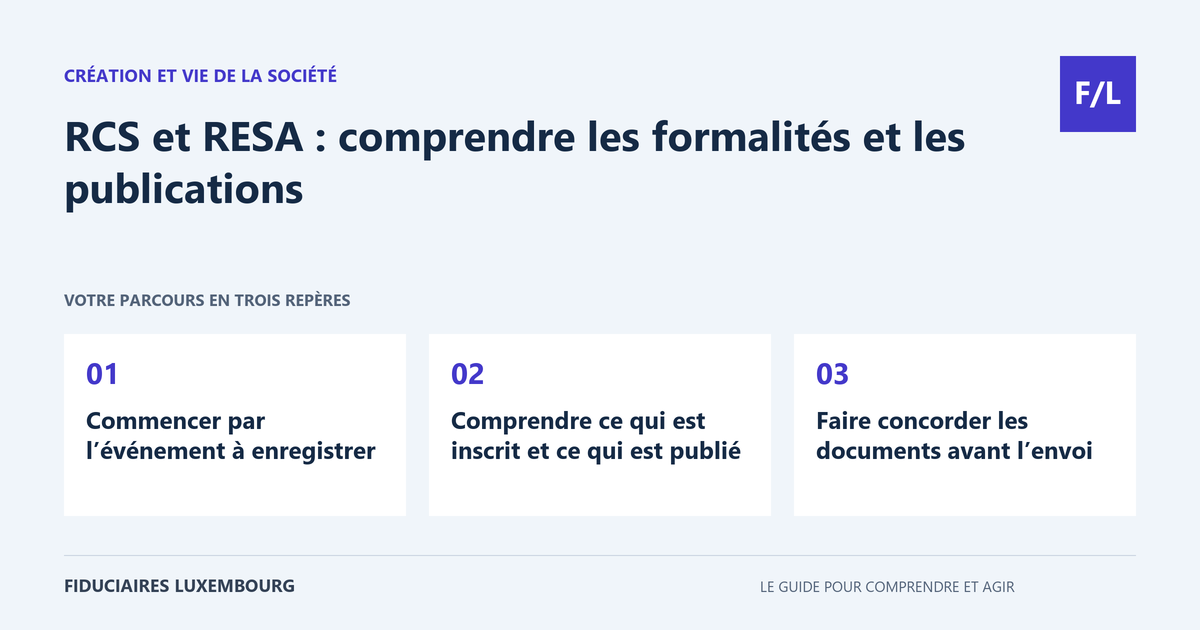
Start with the event to be registered
The right first question is: what happened? Incorporation, replacement of a manager, change of address or change in capital require different documents. Prepare a short sheet stating the entity, its RCS number, the decision, its date and its intended effective date. This sheet serves as a reference for the person preparing the procedure.
Do not choose a form simply because it resembles the one in the previous file. The same term may cover different legal transactions. If several events are grouped together, keep track of their respective dates. The convenience of a single submission must not cause the first deadline to be overlooked.
Understanding what is entered and what is published
Registration opens the entity's file; subsequent procedures track its life. The form provides data intended for the register. Attached documents may have a different purpose depending on their nature. The RESA is therefore not another name for the RCS: it is the electronic publication collection.
Prepare one column for data to be entered and another for documents to be published. Ask which documents must accompany the transaction, particularly where the articles of association are amended. Do not include personal or commercial information unrelated to its purpose in a public document. A complete working file and a document intended for publication are not interchangeable copies.
Ensure documents are consistent before submission
Compare the company name, number, address, names, positions and dates on each document. Review the figures and accents, but above all the meaning of the information. A term of office starting on a future date should not be presented without consideration as already effective. In the event of a discrepancy, return to the approved decision rather than choosing the most recent version of the file.
LBR specifies that the information on the form is entered as provided on it: the filer cannot rely on the register to spontaneously reword it. The review must therefore be carried out before submission. For documents, use the applicable format requirements and keep a working version separate from the version actually submitted.
Keep evidence and verify the outcome
Create a file containing the signed decision, the submitted documents, the acknowledgement of receipt and the outcome of the procedure. Record the person who made the submission and the person who checks its processing. If an intermediary is involved, agree on the document they will provide to confirm completion. An entry reading “sent to the service provider” must not be treated as a completed formality.
Then check the entered data and the publication where required. The acknowledgement of receipt evidences an administrative step, without in itself guaranteeing the validity of the entire underlying transaction. If an error appears, identify whether it originates from the form, the document or the decision. The remedy must address the cause, not merely the display.
Organise amendments and regularisation requests
A genuine change requires an amendment procedure; a clerical error in an earlier filing requires consideration of a correction with its reference. Do not attempt to rewrite the history to present a decision as having existed earlier. Keep the versions and explain the link between them. This discipline also facilitates exchanges with banks and new shareholders.
LBR circular 26/02 provides for enhanced monitoring of files and escalating measures in the event of persistent non-compliance. Partial regularisation does not close the procedure. Address each requested point in a table with evidence of its resolution; the usual deadlines do not thereby become an invitation to wait for a reminder. At the same time, examine the consequences for the RBE file.
The table to take action
| Step | Control question | Evidence to keep |
|---|---|---|
| Decision | Has the competent body made a decision? | Approved deed or minutes |
| Filing | Has the correct procedure been submitted? | Copy and acknowledgement of receipt |
| Entry | Does the register contain the expected data? | Reviewed status or extract |
| Publication | Has the required publication been completed? | Reference of the published document |
A new manager, two dates to distinguish
Fictitious example: in September, the shareholders decide that a new manager will take office in October. The person responsible for the file prepares a table showing the decision date and the effective date, then asks the professional how to organise the formalities. They check that the form and the deed do not contradict each other. After processing, they review the relevant data and retain the evidence. They also prepare the update of bank powers and internal access at the appropriate time. The RCS file is thus connected to the actual operation of the company, without assuming that the register automatically updates all its contacts.
Your preparation checklist
- Identify the entity by its RCS number.
- Describe each event and its dates.
- Determine the required documents, entries and publications.
- Compare the data between the form and the documents.
- Check the document format.
- Keep the submitted version and the acknowledgement of receipt.
- Check the expected entry and publication.
- Handle formalities with other bodies separately.
Frequently asked questions
Do the RCS and RESA refer to the same thing?
No. The register and the publication collection have distinct functions, even though the formalities are linked.
Does an accepted filing validate the entire legal arrangement?
It does not constitute general validation of the transaction. The decision and the substantive conditions must still be reviewed.
Can an error be corrected by deleting the previous filing?
The correction must follow the appropriate procedure and retain its connection with the filing concerned. Do not assume that the history disappears.
Useful terms in this guide
Questions to ask the professional
- Which steps evidence completion of this formality?
- Who checks the outcome after filing?
- What additional procedures does this event trigger?
To clarify the assignment to be entrusted, also consult our company formation file.
And for your situation?
For your next change, start with an event sheet and a table of the expected evidence. You will then know what you are entrusting and what remains to be checked. Search our directory for a professional able to coordinate the formalities corresponding to your company form.
Sources and verification
References consulted on 20 September 2026. Official procedures specify the applicable conditions and exceptions.
- Guichet.lu — dépôts modificatifs et rectificatifs au RCS
- LBR — démarches administratives, dépôt et publication
- LBR — circulaire 26/02 du 14 septembre 2026, mise en conformité RCS et RBE
This guide explains a general process. The applicable rules depend on your situation; it does not constitute personalised advice. Report a correction.
Your next step
A specific need deserves the right contact
Accounting, taxation, company formation or payroll: prepare your questions, then search the directory for the professional who can review your situation. Check their assignments and status before entrusting them with your file.