Choosing a fiduciary firm affects your day-to-day operations, not just your budget. The right question is simple: who will do what, using which information and when? This guide helps you compare proposals that do not always cover the same work.
Request a detailed engagement letter and verify the professional's status. A listing in a directory, a rating or a promise of low prices is not enough to qualify a firm.
The framework to verify
The term fiduciary firm does not constitute universal authorisation. The title of chartered accountant, the activities carried out and any approvals must be verified separately. Inclusion in our directory is a starting point for your search, without automatic validation of status.
Describe your needs before requesting a quote
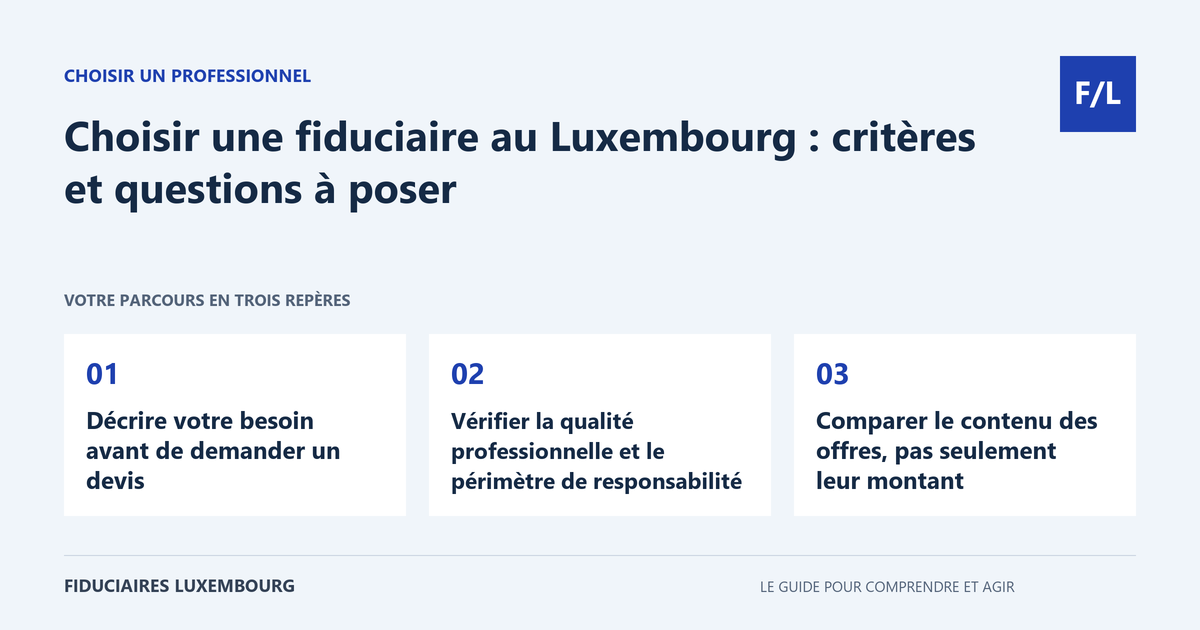
Present your business activity, your company's legal form, the countries in which you operate and the number of employees. Add the approximate monthly volume of invoices, bank accounts and currencies. A company selling services in several countries does not have the same needs as a local business.
Distinguish recurring tasks — accounting, VAT, payroll — from one-off requests: incorporation, file takeover or reorganisation. This scoping enables you to request the same work from each candidate and then genuinely compare the offers.
Verify professional quality and the scope of responsibility
The title of chartered accountant corresponds to a regulated profession. Consult the official process relating to access to the profession and the Order's register; check the exact name of the person and company that will sign the engagement. The term “fiduciary firm” does not in itself describe a single approval covering all services.
Ask who prepares the documents, who checks them and who handles the filings. The involvement of an accountant, lawyer or auditor depends on the need. A registry logo on a commercial page does not replace verification with that registry.
Compare the content of offers, not only their amount
Have them specify bookkeeping, annual accounts, tax returns, payroll, audit assistance and answers to routine questions. A fixed fee may limit the number of documents or exclude the takeover of historical records. Also ask about the cost of additional work, setup fees and termination terms.
Review the day-to-day arrangements: submission channel, access to data, replacement contact person and frequency of exchanges. Response times should be agreed; a quick reply on first contact does not in itself demonstrate the quality of ongoing support.
Organise a useful initial meeting
Prepare a practical case, for example a cross-border sale or a planned hire. The professional should be able to explain what information is missing and how they will establish the answer. A cautious, structured answer is more useful than an unquantified promise of savings.
Keep your access credentials and request an export of your data in a reusable format. Define the documents you must provide and their deadlines. Service quality also depends on this cooperation: no engagement letter turns missing documents into complete accounts.
Send the same consultation file to each firm
Prepare a one-page sheet with your business activity, volumes and upcoming deadlines. Attach a list of requested services, without immediately sending your entire confidential file. Specify matters requiring particular experience: foreign transactions, inventory, variable payroll or related companies.
Ask each firm to respond using the same framework. For each service, note the deliverable, frequency, volume limits and excluded items. Have setup costs, the takeover of historical records and annual operations distinguished. A price may be consistent for a well-maintained file and become different if several financial years require correction.
The guide to the role of the chartered accountant helps describe assignments. For a transition, also consult the file on changing firms before setting the takeover date.
Test the organisation before signing
During the meeting, follow the path of a specific document: an invoice arrives, information is missing, a deadline is approaching. Who alerts you? Where do you reply? How is the correction validated? This small exercise reveals how the firm works and what it expects from you.
Review the tools without stopping at their appearance. You must understand access, exports and document retention. Data reversibility is prepared at the beginning of the relationship: which files and supporting documents will you be able to recover, in which formats and under which arrangements? The guide to data exchanges with the fiduciary firm provides useful questions on access and confidentiality.
To decide, rank your criteria by importance rather than assigning an artificially precise score. An essential unmet need merits discussion, even if the total score appears favourable. Keep the selected proposal and written clarifications, then schedule an initial collaboration review. It will make it possible to adjust exchanges and verify that deliverables correspond to what was agreed.
| Criterion | Question to ask | Item to retain |
|---|---|---|
| Scope | Which returns and which periods? | List of deliverables and exclusions |
| Fees | What volumes and what additional charges? | Quote and billing rules |
| Organisation | Who prepares, checks and provides cover? | Contacts and timetable |
| End of engagement | Which exports and which arrangements? | Return clause and formats |
Let us look at a practical case
Fictitious educational example intended to explain the reasoning.
A manager receives two quotes. The first includes only bookkeeping; the second also provides for returns and a management review. Comparing their annual amounts without reading the scope would be misleading. The manager therefore requests a list of deliverables, exclusions and takeover fees, then checks who will respond in the event of a missing document. The choice becomes a trade-off between an explicit need and written commitments, rather than a preference based on the displayed price.
Points to prepare
- Identity of the contracting party and professional registration checked.
- Included services, exclusions and volumes set out in writing.
- Contact person, timetable and approval procedure identified.
- Access, confidentiality, export and end-of-engagement arrangements provided for.
Frequently asked questions
Should you choose the closest firm?
Proximity can make meetings easier. It should be compared with sector knowledge, working languages and the quality of remote exchanges.
Does a fiduciary firm automatically handle all tax matters?
No. The scope depends on the signed engagement and the expertise involved. Ask for the taxes, countries and persons concerned to be specified.
Useful terms in this guide
Questions to ask the professional
- Which tasks remain my responsibility?
- How will my data be recovered if I change firms?
To clarify the scope of your request, also consult our accounting section.
And for your situation?
Your next step is to prepare a comparable request for several firms. Then choose based on written commitments, verified status and an organisation compatible with your way of working. Search our directory for the professional suited to your needs, then ask them for a detailed engagement and quote.
Sources and verification
References consulted on 20 September 2026. Official procedures specify the applicable conditions and exceptions.
This guide explains a general process. The applicable rules depend on your situation; it does not constitute personalised advice. Report a correction.
Your next step
A specific need deserves the right contact
Accounting, taxation, company formation or payroll: prepare your questions, then search the directory for the professional who can review your situation. Check their assignments and status before entrusting them with your file.