Would you like to save time on accounting? First look at the journey of an invoice, from its receipt to its filing and payment. Tools become useful when this journey and its controls are clear.
The automatic extraction of an invoice or an AI-generated response is not accounting or tax validation. Controls and responsibilities remain necessary.
The framework to review
Automation does not transfer all responsibilities to the tool. Retention obligations, access rights and data protection must be reviewed together with the contracts. A document recognised by OCR or an AI response remains a result to be checked.
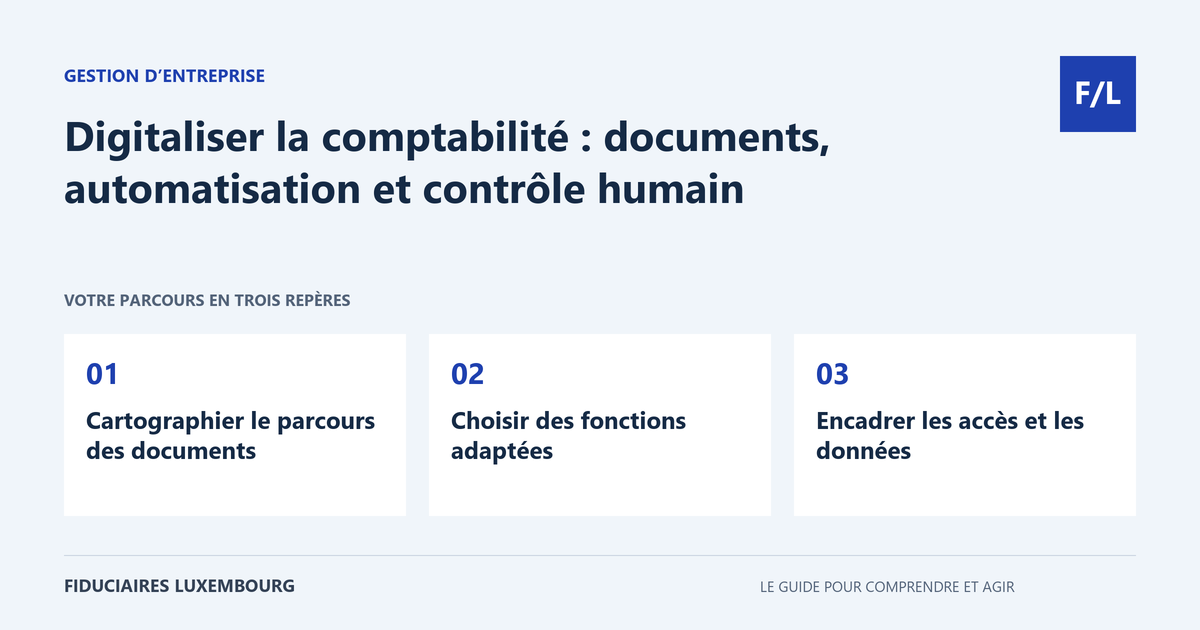
Mapping the document journey
Identify how invoices are received, who approves them and where they are retained. List duplicates, missing supporting documents and manual transfers. Start with the points that create the most errors or delays.
Define a filing convention, the mandatory data and the person responsible for exceptions. A tool does not correct an organisation in which no one knows whether an invoice has been accepted or disputed.
Choosing suitable features
Compare document capture, bank reconciliation, approval, invoicing and export. Test the currencies, credit notes, foreign invoices and specific entries encountered in your business. A demonstration based on perfect examples is not enough.
Check the exchange formats and the retrieval of historical data. The company must be able to obtain usable data at the end of the contract. Quantify set-up, usage, support and exit costs, not just the displayed subscription fee.
Managing access and data
Assign rights according to roles and separate sensitive information, particularly payroll. Check authentication, backups, logs and retrieval procedures. Contracts must specify the roles of service providers and subcontractors.
Before using an AI tool, consider which data would be transmitted to it, for what purpose and with what safeguards. Customer or payroll documents must not be copied into an external service without an appropriate framework. Tools can assist processing; they do not make their results reliable by default.
Measuring quality on a pilot scope
Test one month or a representative set of transactions. Measure missing supporting documents, corrections, processing time and consistency with the accounts. Keep a manual process for exceptions.
Roll out after checking the results and training users. Success is measured by data quality and its availability at the right time, not by the number of features activated. Reassess the rules when the business or tools change.
Writing the test protocol before the demonstration
Choose documents that resemble your day-to-day work: a multi-page invoice, partial credit note, foreign currency, purchase with several rates and a poorly legible document. For each one, prepare the expected result. The test must show errors as well as successes. Check whether the tool flags uncertainty or proposes an apparently certain value when information is missing.
Then measure the complete work: receipt, verification, correction, approval and export. In a hypothetical example, extraction that saves three minutes but requires five minutes of correction is not a gain. Compare results on the same set of supporting documents and include the time spent on exceptions. Our guide to bank reconciliation provides another practical control point.
Keep a log of pilot anomalies, including their cause and resolution. An isolated reading error does not call for the same response as incorrect VAT settings or an overly broad reconciliation rule. Do not roll out before knowing who will receive alerts and how a correction will be reflected in data already exported.
Managing uses and preparing for the end of the contract
For AI uses, define the authorised tasks, usable data and results subject to validation. The CNPD points out that the GDPR remains applicable when personal data are processed. Review purpose, legal basis, data minimisation and the provision of information to data subjects. It also highlights the requirement to maintain control over AI: users must understand the tool's limitations and the controls suited to its use.
The Fit 4 AI programme can support a study of adoption possibilities and a roadmap. The published conditions distinguish between funding for the study and implementation of the project. The application must precede the first legally binding commitment to order the study. Therefore, check the scheme before signing the quotation or paying a deposit, without assuming that the aid has been granted.
Finally, test retrieval: original supporting documents, entries, links between the two and an explanation of the formats. The guide on data exchanges with a fiduciary helps to define access; the guide on filing supporting documents helps to organise their retention. An archive that no one can reread is not a satisfactory operational exit.
| Test | Expected evidence | Decision |
|---|---|---|
| Extraction | Comparison of the document and recognised fields | Accept or correct before integration |
| Exceptions | Visible alert and responsible person | Suspend uncertain processing |
| Access | Appropriate rights and testable removal | Validate the scope of users |
| Retrieval | Reviewed export with associated supporting documents | Confirm the possibility of taking over |
Let us look at a practical case
Fictitious educational example, intended to explain the reasoning.
A company replaces the sending of supporting documents by email with a platform. During testing, it finds that some invoices are sent twice and that credit notes are incorrectly identified. It defines a single entry point, controls and a person responsible for exceptions before rolling out. It also tests the export of supporting documents and entries. This exit check is as useful as the demonstration of input functions.
Points to prepare
- Document process and exceptions defined.
- Exports and reversibility tested.
- Access and sensitive data protected.
- Pilot checked before rollout.
Frequently asked questions
Can OCR replace all checks?
No. It can misinterpret an amount, a currency or a tax. The results must be reconciled with the documents and the rules of the file.
Should you choose the fiduciary's software?
Compatibility is useful, but compare needs, access rights, costs and data retrieval before deciding.
Useful terms in this guide
Questions to ask the professional
- How are anomalies detected and corrected?
- Can I retrieve the documents and data in a usable format?
To clarify the scope of your request, also consult our accounting section.
And for your situation?
Prepare a few representative documents, your current process and the difficulties you want to eliminate. Ask a professional to test exchanges with your accounting and specify the controls that will remain your responsibility. Search our directory for the professional suited to your needs, then ask them for an engagement and a detailed quotation.
Sources and verification
References consulted on 20 September 2026. Official procedures specify the applicable conditions and exceptions.
- CNPD — outils et obligations des professionnels
- CNPD — mécanisme de certification GDPR-CARPA
- Guichet.lu — dépôt des comptes annuels au RCS
- CNPD — IA et obligations RGPD
- CNPD — systèmes prohibés et maîtrise de l’IA
- Guichet.lu — Fit 4 AI
This guide explains a general process. The applicable rules depend on your situation; it does not constitute personalised advice. Report a correction.
Your next step
A specific need deserves the right contact
Accounting, taxation, company formation or payroll: prepare your questions, then search the directory for the professional who can review your situation. Check their assignments and status before entrusting them with your file.