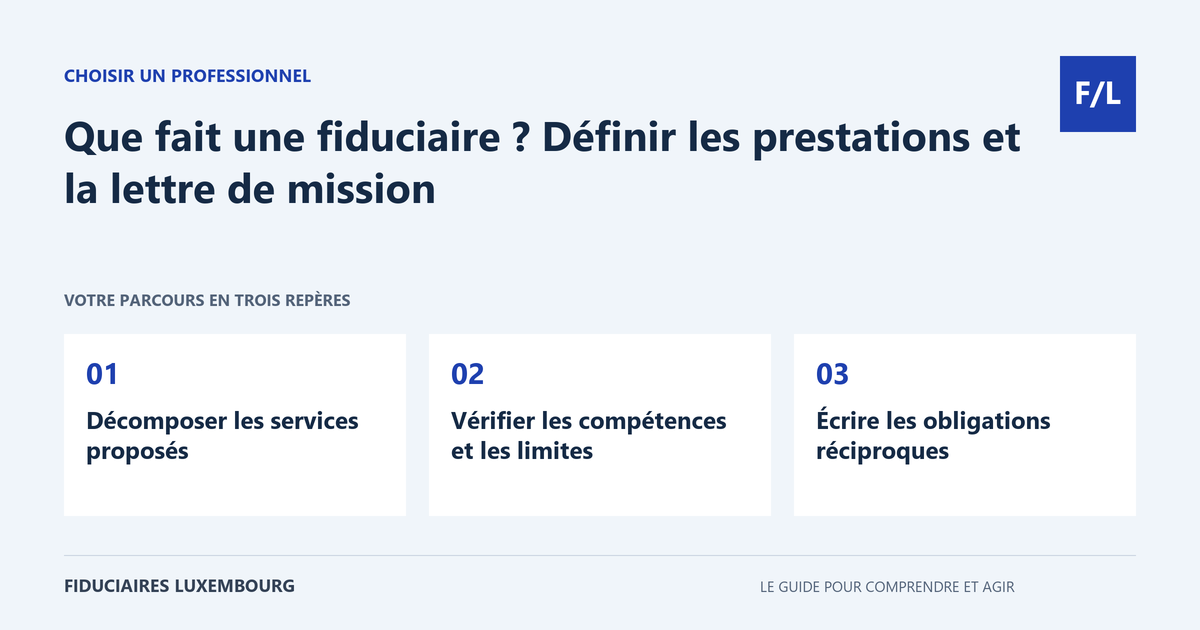
What can a fiduciary firm do for your business? The useful answer starts with the services you need, then with the provider's skills and authorisations. Let us clarify the terms and responsibilities.
Accounting, taxation, payroll and domiciliation are not automatically included in the same engagement. Authorisations must be verified for the relevant services.
The framework to check
Fiduciary firm is a commonly used term that does not guarantee all authorisations. Accountancy expertise, audit, domiciliation and legal services may be subject to different requirements and professionals. The contract must specify the services actually undertaken.
Breaking down the services offered
Bookkeeping organises transactions and their supporting documents. The preparation of accounts takes place at year-end. Tax returns, payroll management and company administration address other needs.
Request a list of deliverables: periodic financial statements, balance sheet, returns, payslips or a schedule of deadlines. This description makes it possible to understand what will be produced, how often and based on which information.
Checking skills and limitations
The title of chartered accountant and other professional activities are subject to regulated frameworks. Domiciliation also has its own requirements. A firm's commercial name does not prove universal authorisation.
Identify the people involved and those to whom questions will be referred. For a contract, an international transaction or a statutory audit, other expertise may be required. Limitations must be explained before signing.
Setting out mutual obligations in writing
The engagement letter must detail the work requested, exclusions, fees and timetable. Specify what the company provides and what it must approve. An engagement cannot be properly performed if documents arrive too late or without explanation.
Agree on a procedure for additional requests and emergencies. Define communication channels, access rights and data retention. The end of the engagement must provide for usable handover and the revocation of authorisations that are no longer needed.
Assessing the service based on observable results
Monitor the completion of returns, the quality of reconciliations and the understanding of documents. Ask for discrepancies or missing data to be clearly reported.
Good follow-up makes decisions easier: amount payable, document expected, assumption to confirm or action to take. Claims of proximity and optimisation do not provide this information. Compare firms on their ability to explain and deliver the agreed scope.
Map out the allocation of tasks before discussing a flat fee
Start with your current organisation. Who receives invoices? Who approves purchases? Who can explain unusual transactions? The firm can process the data received, but it does not necessarily know about a commitment signed the day before or a dispute with a supplier. The flow of information must therefore be described in both directions.
Then ask for an example of a work timetable: submission of documents, questions from the firm, approval and delivery of deliverables. For the accounting close, inventories and estimates may require a specific contribution from the company. For payroll variables, an internal submission deadline prevents an item known too late from being discovered after payment.
Also specify who monitors messages from public authorities and who reports an urgent request. A letter received at the registered office, a digital notification and correspondence addressed to an employee do not always circulate automatically. The engagement must make it possible to know to whom the information should be passed and how to verify that it has been handled.
Assessing evidence of work and continuity
A useful relationship produces usable documents: explained accounts, submitted returns, filing acknowledgements and outstanding items. Ask where these elements will be accessible and in what form. If a table shows an estimate, it must be distinguishable from an amount that has been approved or definitively assessed by a public authority.
The engagement letter helps set the framework for responsibilities, fees and exclusions. Check the skills required for each service. Guichet.lu notably sets out the conditions for access to the profession of chartered accountant; the term “fiduciary firm” is therefore not sufficient to prove the status of each person involved.
Plan for absences and the end of the relationship: alternate contact person, return of data and removal of access rights. The guide on personal data exchanged with a fiduciary firm helps prepare these points. To compare several proposals once the need has been defined, continue with our criteria for choosing a fiduciary firm. You will be able to compare specific commitments, not merely service labels.
| Work | Company contribution | Deliverable to request |
|---|---|---|
| Accounting | Complete supporting documents and explanation of transactions | Financial position and list of outstanding items |
| Taxation | Requested information and approvals | Return and proof of filing according to the engagement |
| Payroll | Approved events and variables | Agreed payslips and returns |
| Administrative follow-up | Decisions of the competent bodies | Formalities and evidence provided for in the contract |
Let us look at a practical case
Fictitious educational example, intended to explain the reasoning.
A founder requests “all-inclusive” support. This expression may cover incorporation, address, accounting and payroll, but each item has its own limitations and stakeholders. The founder requests a detailed proposal including formalities, exclusions and recurring fees. The founder also retains the necessary contacts and access rights. The relationship becomes simpler when everyone knows who prepares, who approves and who files the documents.
Points to prepare
- Services translated into deliverables.
- Appropriate authorisations checked.
- Mutual obligations and fees set out in writing.
- Data and end-of-engagement arrangements organised.
Frequently asked questions
Is a fiduciary firm a government service?
No. It is a private service provider. Procedures with public authorities remain separate processes.
Can an engagement letter be amended?
The scope may change depending on the contractual terms. Have changes and their effect on fees formally documented.
Useful terms in this guide
Questions to ask the professional
- Which engagements does your firm carry out, and which are entrusted to a third party?
- Which deliverables, deadlines and responsibilities will be set out in writing?
To clarify the scope of your request, also consult our accounting guide.
And for your situation?
Describe your business activity, your volume of documents and the tasks you wish to delegate. Ask the firms you meet for a clear proposal: deliverables, frequency, responsibilities, fees and terms for returning data. Search our directory for the professional suited to your needs, then ask them for an engagement and a detailed quote.
Sources and verification
References consulted on 20 September 2026. Official procedures specify the applicable conditions and exceptions.
- Guichet.lu — profession d’expert-comptable
- Ordre des experts-comptables — tableau des membres
- Guichet.lu — domiciliation de sociétés
This guide explains a general process. The applicable rules depend on your situation; it does not constitute personalised advice. Report a correction.
Your next step
A specific need deserves the right contact
Accounting, taxation, company formation or payroll: prepare your questions, then search the directory for the professional who can review your situation. Check their assignments and status before entrusting them with your file.