A chartered accountant can become a regular point of contact for your business. To make the most of this, define what you expect from them: preparing the accounts, helping you understand them, organising filings or supporting a decision.
Verify the professional’s identity and the entity responsible for the engagement. Professional status and the service actually ordered are two distinct pieces of information.
The framework to verify
The title of chartered accountant is regulated. A firm's engagements must be considered within the scope of its authorised activity and the contract. Statutory audit falls within a separate scope; it does not automatically result from bookkeeping.
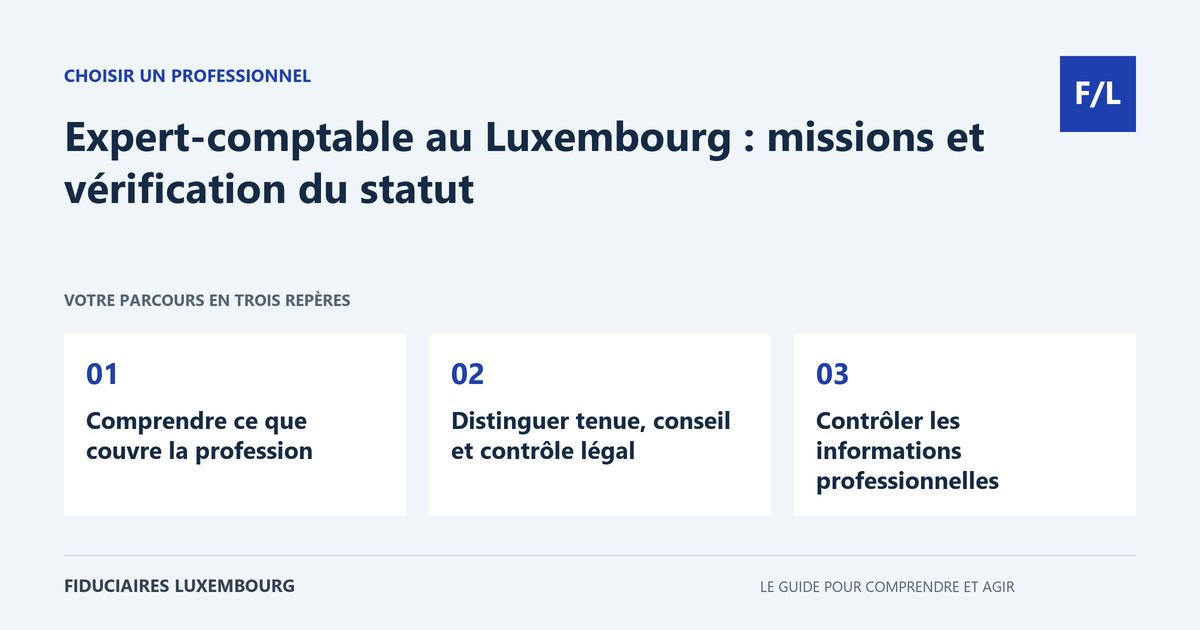
Understanding what the profession covers
The official Guichet.lu procedure presents the conditions for access to the profession and its activities, particularly regarding accounts, taxation and contractual audit. The authorisation applies to professional practice; it does not mean that all possible services will be included in your package.
Before choosing, describe the expected outcome: annual accounts, returns, dashboard or support for a transaction. Ask which documents you will receive and which approvals will remain your responsibility.
Distinguishing bookkeeping, advisory services and statutory audit
Bookkeeping produces and organises information. Advisory services help interpret a situation and make decisions. Statutory audit is subject to a specific framework and authorisations; it cannot be inferred from the mere preparation of accounts.
A file may require several professionals. Check who is involved for articles of association, payroll, international taxation or audit. Avoid vague expressions such as “everything is covered” without a list of services, exclusions and responsibilities.
Checking professional information
Consult the OEC directory and compare the name, address and identity of the signatory. In the event of a discrepancy, ask the firm for an explanation. A trading name may differ from the company name stated in the contract.
A private directory makes searching easier, but does not replace the professional register. Likewise, a satisfaction rating establishes neither registration nor experience in your sector. Limit your conclusions to the elements actually verified.
Defining a lasting collaboration
The engagement letter must specify the information to be provided, the schedule, the deliverables and the remuneration terms. Add a procedure for exceptional questions and for the absence of the main contact.
During the initial period, check that you understand the documents received. A useful dashboard contains reliable data, a clear period and possible actions. The purpose of monitoring is not to multiply reports, but to make obligations and decisions manageable.
Verifying a complete identity before handing over documents
Start with the quotation: which person or company is committing, under which name and with which signatory? Look for the corresponding information in the OEC directory. It allows searches for members and companies. Keep a record of your verification and ask the firm to clarify any difference between its trade name and the contracting entity.
Then set out the exact nature of the need. Prepared accounts, a contractual review and a statutory audit report do not meet the same requirement. If a bank, an investor or a legal text requires a specific document, provide this requirement to the professional before ordering the service. This will prevent you from discovering after delivery that the expected document had a different scope.
The guide to comparing fiduciary firms supplements this verification with service criteria. Professional registration is an essential benchmark; availability, organisation and relevant experience are discussed separately.
Turning advisory expectations into useful meetings
Choose a few questions that the accounts should help you answer: margin, customer payment delays, fixed costs or financing needs. Agree on the necessary data and schedule. Monthly monitoring requires documents to be provided early enough; it is necessary to specify how information that is still provisional will be identified.
Prepare a short agenda: what has changed, variances that require an explanation and decisions to be made. The dashboard and the cash flow forecast can serve as different tools. The former helps assess performance; the latter makes upcoming payments and receipts visible.
After the discussion, retain the agreed actions with their person responsible and the expected document. If a question falls outside the engagement, ask for its cost and timeframe before starting the work. When an additional specialist is involved, ask who coordinates the responses. You will thus build a relationship in which everyone knows what they must provide, without assuming that an informal conversation has automatically expanded the contract.
| Need | Deliverable to agree | Your contribution |
|---|---|---|
| Annual accounts | Accounts and explanations of significant items | Complete documents and answers to questions |
| Returns | List of obligations and filing evidence | Approval and payments according to the engagement |
| Management | Indicators, period and meetings | Recent data and prepared decisions |
| Specific transaction | Written analysis and scope | Facts, contracts and project objective |
Let us consider a practical case
Fictitious educational example, intended to explain the reasoning.
A business receives its accounts every year, but lacks information to manage the following months. It can request periodic monitoring, provided it specifies the indicators, frequency and data it will provide. The professional explains the possible deliverables and their cost. This discussion turns a vague expectation of “advice” into a usable engagement, with a meeting, updated figures and questions prepared by the business owner.
Points to prepare
- Title and contracting entity verified in the relevant register.
- Preparation and statutory audit distinguished.
- Deliverables and responsibilities set out in writing.
- Monitoring arrangements agreed.
Frequently asked questions
Do fiduciary firm and chartered accountant mean the same thing?
No. “Fiduciary firm” is a term used by entities with various activities. The title and authorisations must be verified separately.
Can the firm delegate the work?
The internal organisation may provide for several professionals. Ask who prepares, reviews and is responsible for the engagement in your file.
Useful terms in this guide
Questions to ask the professional
- Which contact handles my file on a day-to-day basis?
- What management monitoring is actually included in your proposal?
To clarify the scope of your request, also consult our accounting section.
And for your situation?
Prepare a page describing your business, your obligations and the decisions for which you expect assistance. The first discussion will be more useful if you can compare specific deliverables and arrangements, in addition to the price. Search our directory for the professional suited to your needs, then ask them for a detailed engagement and quotation.
Sources and verification
References consulted on 20 September 2026. Official procedures specify the applicable conditions and exceptions.
- Guichet.lu — profession d’expert-comptable
- Ordre des experts-comptables — tableau des membres
- Institut des réviseurs d’entreprises
This guide explains a general process. The applicable rules depend on your situation; it does not constitute personalised advice. Report a correction.
Your next step
A specific need deserves the right contact
Accounting, taxation, company formation or payroll: prepare your questions, then search the directory for the professional who can review your situation. Check their assignments and status before entrusting them with your file.