One group company has cash available, while another needs to finance its business. The transfer is straightforward; preparing the financing requires greater care. You need to explain the purpose, the terms and the expected repayment, then organise the monitoring of interest. This guide helps compile the file before bank movements become an account that is difficult to interpret.
The framework to review
Financial transactions between related companies must be reviewed in light of the arm’s length principle and the relevant tax rules. The limitation under Article 168bis LIR applies to exceeding borrowing costs and tax EBITDA, under a general framework retaining the higher of 30% of that EBITDA and EUR 3 million. This reference point does not validate either the classification of the financing or deductibility under other rules. The scope, exceptions and group situations must be reviewed.
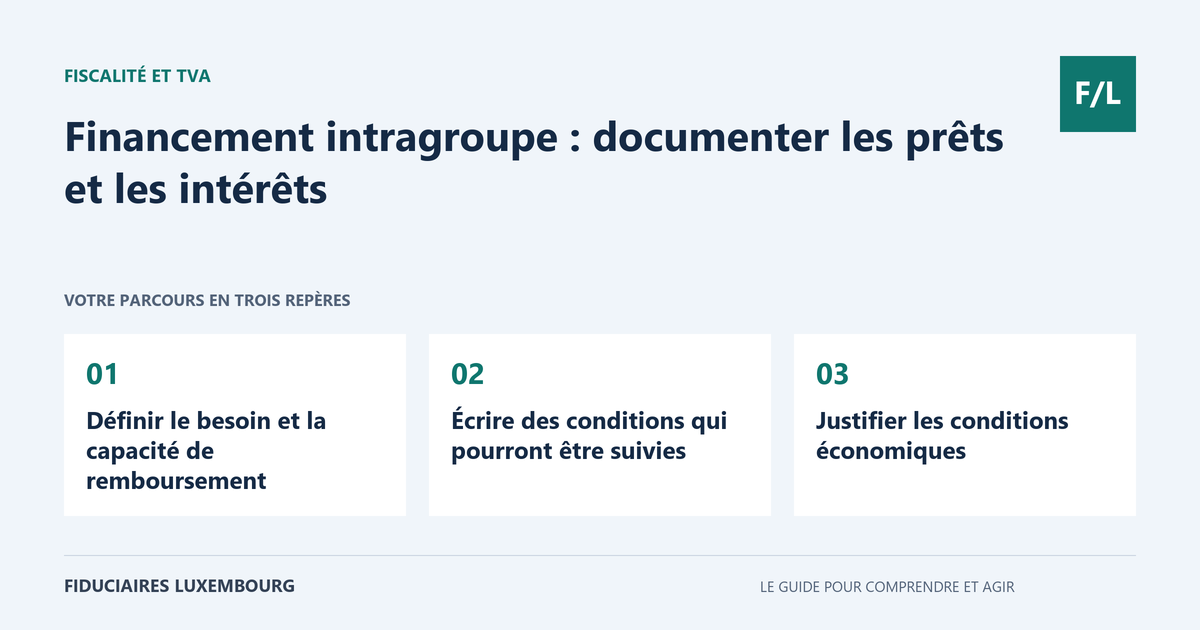
Define the need and repayment capacity
Describe the intended use of the funds: investment, a cash-flow timing gap or another identified need. Attach a timetable and repayment assumptions. A revolving advance without explanation over several years is not managed in the same way as a one-off need lasting a few weeks. The file must make it possible to understand why this financing is appropriate for the borrower’s situation.
Prepare a realistic forecast and several simple scenarios: delayed customer payment, additional cost or reduced activity. The cash-flow plan helps in the short term; a longer project requires an appropriate time horizon. Also identify the people who make decisions and monitor the risk. The availability of funds in another entity does not remove the need to examine the interest of each company.
Set out terms that can be monitored
Prepare the amount, currency, date on which funds are made available, term, instalments, rate or rate mechanism, any guarantees and repayment terms. Specify the changes that require a decision or an amendment. The agreement must be understandable to the person who will calculate interest six months later; an imprecise formula quickly produces conflicting versions.
Then reconcile the written agreement with the actual movements. If funds are received in several instalments or if repayment takes place earlier, the monitoring should show this. For shareholder advances, also consult the guide on the shareholder current account. Avoid grouping capital, expense reimbursement and loans under a single balance without identifying the nature of each transaction.
Substantiate the economic terms
The rate depends on the context of the transaction, including the term, currency, borrower’s situation and agreed protections. Transfer pricing documentation is used to review comparable terms. A bank rate taken from an offer intended for another profile does not by itself constitute sufficient substantiation.
Describe in the functional analysis the decisions and resources actually deployed. The study should not merely conclude with a percentage: it must specify its scope and the assumptions to be monitored. OECD guidance on financial transactions and the relevant Luxembourg rules provide an analytical framework, to be applied using the data specific to the file.
Calculate and reconcile interest
Prepare a schedule showing opening principal, movements, period, rate, calculation convention and interest. Distinguish accrued, invoiced, paid or capitalised interest depending on the terms selected. Both entities must be able to reconcile their entries. A difference may arise from a value date, an omitted repayment or a different calculation method.
Keep bank references and approved amendments. Where a variable rate changes, archive the reference data used and the applicable period. Do not apply the latest rate retrospectively to the whole year. Before closing, have balances confirmed and resolve differences rather than creating a balancing entry without a documented source.
Review taxation beyond the contractual calculation
Prepare the data needed to calculate exceeding borrowing costs and tax EBITDA where the interest limitation applies. Management EBITDA shown on a dashboard is not automatically this tax basis. An expense below the financial threshold mentioned does not become deductible as a matter of principle if another rule excludes it or if its classification is incorrect.
The adviser must also review, depending on the facts, the connection with exempt income, specific instruments and any obligations in the other country. Link this analysis to the guide on documentation of intra-group transactions. Keep the validated treatment in the closing file, together with the amounts carried forward or adjusted and the events that will require a reassessment.
The table for taking action
| Section | Information to gather | Control |
|---|---|---|
| Need | Use of funds and forecasts | Planned repayment |
| Agreement | Amount, term and conditions | Approval and versions |
| Pricing | Context and relevant study | Economic assumptions |
| Calculation | Movements, rates and periods | Reconciled interest |
| Taxation | Classification and tax bases | Validated deductions and adjustments |
An accurate calculation does not prove that the rate is appropriate
Fictitious example: a loan of EUR 100,000 remains fully outstanding for a full year. For illustrative purposes, the agreement provides for simple annual interest of 4%. The calculation gives EUR 4,000. This result does not prove either that 4% complies with the arm’s length principle in this file or that the EUR 4,000 is fully deductible. A repayment during the year or another calculation convention would change the calculation. The example shows why arithmetic verification, economic substantiation and tax analysis must be distinguished.
Your preparation checklist
- Describe the need and use of the funds.
- Prepare repayment assumptions.
- Formalise the terms and approvals.
- Document the economic context of the rate.
- Monitor each principal movement.
- Reconcile interest between the entities.
- Verify the applicable deductibility rules.
- Update the file when there is a change.
Frequently asked questions
Is a rate agreed between the companies sufficient?
The contractual agreement must be reviewed together with the economic terms and rules applicable to related companies.
Is the tax threshold calculated on all gross interest?
The rule mentioned applies to exceeding borrowing costs and a defined tax basis. The corresponding calculation must be prepared.
Is correctly calculated interest necessarily deductible?
No. Arithmetic, classification, arm’s length compliance and deductibility are separate checks.
Useful terms in this guide
Questions to ask the professional
- Does the planned repayment match the borrower’s capacity?
- What data substantiates the rate and term?
- What events will trigger a new analysis?
To clarify the assignment to be entrusted, also consult our taxation section.
And for your situation?
Prepare the agreement, the movements of funds and the repayment forecast. Search our directory for a professional to coordinate the financing analysis, transfer pricing and the accounting and tax treatment of interest.
Sources and verification
References consulted on 20 September 2026. Official procedures specify the applicable conditions and exceptions.
- ACD — prix de transfert des financements intragroupe
- OCDE — principes applicables aux prix de transfert, édition 2022
- ACD — limitation de la déductibilité des intérêts
This guide explains a general process. The applicable rules depend on your situation; it does not constitute personalised advice. Report a correction.
Your next step
A specific need deserves the right contact
Accounting, taxation, company formation or payroll: prepare your questions, then search the directory for the professional who can review your situation. Check their assignments and status before entrusting them with your file.