An invoice for “group charges” arrives every quarter. Can you explain what it covers, who provides the service and how the amount was determined? Transfer pricing issues often begin with these very concrete facts. Before discussing a margin or a method, the actual transactions must be described. This guide helps you compile a useful working file for the specialist.
The framework to review
The arm’s length principle governs transactions between related companies: the analysis seeks conditions consistent with those of independent companies in comparable circumstances. In Luxembourg, Articles 56 and 56bis LIR and relevant guidance inform this analysis. The documentation must correspond to the facts of the case. This guide does not set out a report format or a single obligation threshold applicable to all groups and all countries.
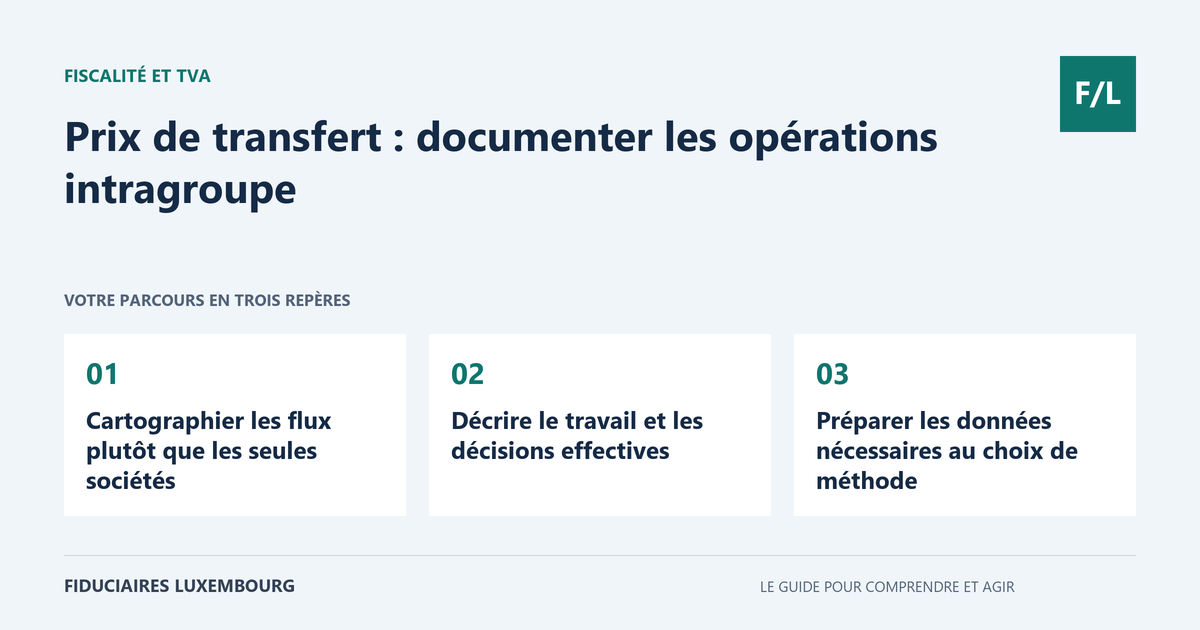
Map the flows rather than just the companies
Start with an organisation chart, then add the transactions: services, goods, financing, licences or guarantees. For each flow, record the parties, countries, annual amount and operational manager. A legal organisation chart alone does not show the services actually exchanged. It must be possible to trace the relationships through to the relevant contracts and entries.
Identify transactions without invoices, offsets and changes made during the year. A new team, a transfer of customers or a guarantee may change the file even if the equity holdings remain the same. The definition of transfer pricing helps share this vocabulary with the staff collecting the documents.
Describe the actual work and decisions
The functional analysis connects activities, resources used and risks assumed. Prepare interviews with the people who know the transactions, not only with those who sign the invoices. Job descriptions, approvals and deliverables can help clarify who does what. The file must explain responsibilities as they are actually exercised.
Compare this description with the contracts. If a contract assigns a responsibility to one entity while decisions are made elsewhere, report the discrepancy to the specialist. A documentation update must not retrospectively invent an activity. Describe the facts, dates and changes to be organised so that the analysis and documents become consistent.
Prepare the data needed to select the method
Gather amounts by flow category, cost items and available business information. State the source of the data and any adjustments already made. The choice of a method and comparables requires an appropriate analysis; a percentage taken from another group does not become relevant simply because it produces an easy-to-calculate invoice.
For shared services, prepare a description of the services and an explanation of the proposed allocation key. Show the data that makes it possible to recalculate the amount. Distinguish invoiced amounts, budgets and true-ups. The file must enable the specialist to test the relevance of the assumptions, without requiring them to guess the content of a general ledger account.
Review recent rules without generalising them
The Luxembourg circular of 13 April 2026 addresses “Amount B” for certain marketing and distribution activities involving covered jurisdictions. Its application depends in particular on the jurisdiction concerned, a convention in force and the adoption of the framework by that jurisdiction, as well as on eligible transactions. It is not a standard margin to apply to every recharge.
Financial transactions also have their specific features. An analysis of economic substance and actual operations may be necessary, but an address or a contract alone does not answer the questions. Have the countries, years and flows covered specified in the engagement to prevent a limited study from being reused outside its scope.
Link the policy to year-end closing and evidence
At year-end closing, reconcile invoices with the selected method, actual data and agreements. Document the adjustments reviewed, their period and their treatment in each entity. A price change may also require VAT or local formalities to be reviewed. The guide on cross-border B2B services helps organise this other review without confusing it with transfer pricing.
Keep a dated version of the file and a list of events requiring it to be updated. Include these checks in the year-end closing file. The person in charge must be able to retrieve the contract, service provided, calculation and accounting entry from an invoice. This chain of evidence makes discussions more effective than an isolated report in a folder that is never consulted.
The table to take action
| Section | Useful information | Question for the specialist |
|---|---|---|
| Flows | Parties, countries, nature and amounts | What scope should be analysed? |
| Functions | Activities, resources and decisions | Does the contract reflect the facts? |
| Data | Costs, volumes and adjustments | Which method is appropriate? |
| Implementation | Invoices and evidence of services | Is the policy being applied? |
| Maintenance | Changes and versions | When should the file be reviewed? |
An allocation key must be explainable
Fictional example: three subsidiaries receive IT charges allocated in equal shares. However, the person in charge notes that the number of users and the services differ significantly. They gather the licences, services actually provided and usage data, then submit the key to the specialist. The specialist can assess whether it reflects the facts or whether another approach should be considered. The example does not validate any allocation key or margin: it shows how to turn a question about an invoice into a workable file before changing the amounts recorded in the accounts.
Your preparation checklist
- List the flows and countries concerned.
- Identify the operational managers.
- Reconcile contracts with actual practice.
- Keep evidence of the services.
- Document the data and proposed allocation keys.
- Have the appropriate method selected and justified.
- Reconcile the policy with actual invoicing.
- Plan a review when changes occur.
Frequently asked questions
Is a contract sufficient to justify the price?
The file must also describe the economic reality and the data supporting the calculation.
Can a margin found in another file be applied?
Not without verifying comparability and context. A method must be justified for the transactions reviewed.
Does Amount B cover all intra-group services?
No. It applies to a specific scope of transactions and jurisdictions. It does not replace the overall analysis of all flows.
Useful terms in this guide
Questions to ask the professional
- Which flows have not yet been documented?
- Which people can explain the actual activities?
- How will we verify the application of the method in the accounts?
To clarify the engagement to be entrusted, also consult our tax section.
And for your situation?
Start with the organisation chart, the list of flows and a few representative invoices. Search our directory for a professional with the necessary international tax expertise to define a documentation engagement proportionate to your transactions.
Sources and verification
References consulted on 20 September 2026. Official procedures specify the applicable conditions and exceptions.
- ACD — prix de transfert des financements intragroupe
- OCDE — principes applicables aux prix de transfert, édition 2022
- ACD — circulaire Montant B du 13 avril 2026
This guide explains a general process. The applicable rules depend on your situation; it does not constitute personalised advice. Report a correction.
Your next step
A specific need deserves the right contact
Accounting, taxation, company formation or payroll: prepare your questions, then search the directory for the professional who can review your situation. Check their assignments and status before entrusting them with your file.