A company may need to review net wealth tax even where its result for the year is low. This tax is not calculated simply as a percentage of profit. Taxable net wealth, the reference date and any applicable minimum must be considered. Let us take the steps in order to compile a file that makes it possible to understand the calculation and track commitments made over several years.
The legal framework to review
This guide mainly concerns a resident capital company subject to NWT. Since the key date of 1 January 2025, the minimum is based on three total balance sheet asset brackets. It must be compared with the standard calculation and applicable reductions must be reviewed. Circular ACD I. Fort. 56 of 12 May 2026 clarifies this framework and replaces two previous circulars. Vehicles subject to a special regime and group situations require a specific analysis.
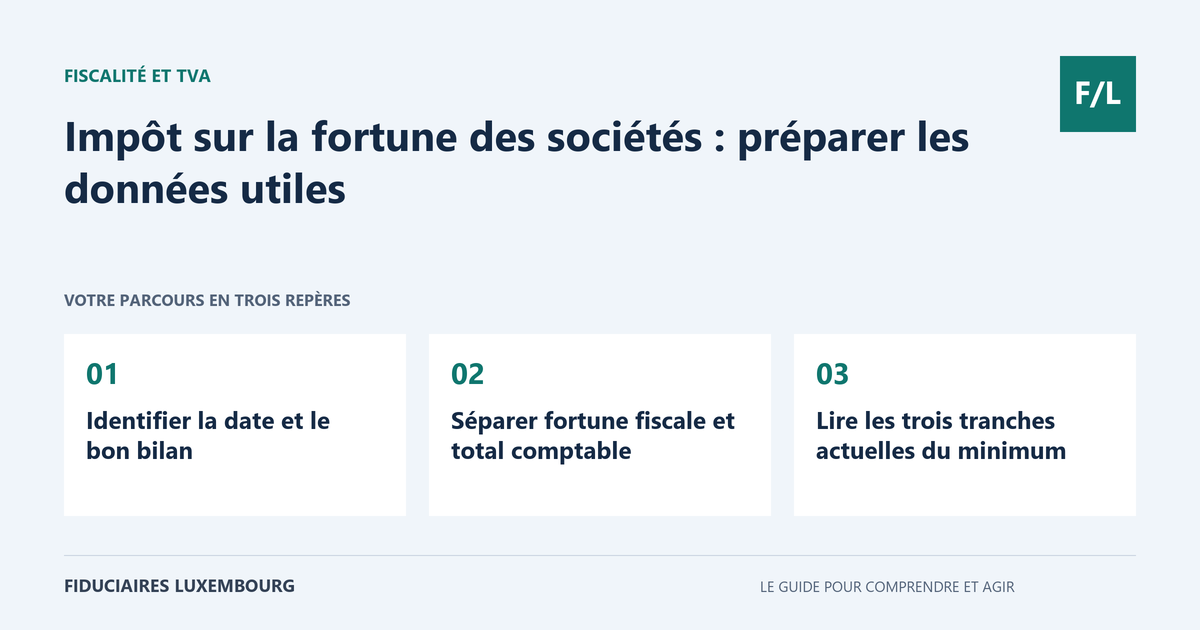
Identify the date and the correct balance sheet
The file must clearly state the relevant key date, normally 1 January, and the balance sheet used. For the minimum tax, the reference is the latest closing balance sheet of the previous tax year, in accordance with the rules set out by the ACD. A non-calendar year-end or a change in financial year therefore requires verification of the document selected, rather than automatically choosing the most recent available balance sheet.
Prepare the accounts, incorporation dates and transactions affecting the company's situation. Report a change of residence, a restructuring or a liquidation. The treatment of these events must not be inferred simply from an absence of turnover. Reconcile the file with the year-end closing preparation to have validated versions available.
Separate taxable net wealth and accounting total
Taxable net wealth requires a review of assets, liabilities, valuations and any relevant exemptions. Total balance sheet assets serve another control purpose: they do not replace this calculation. Prepare a list of shareholdings, receivables, cash, property and liabilities, together with supporting documents enabling their nature and value to be understood.
Keep the reconciliation between the accounts and the tax calculation, including items subject to validation. An exempt asset in a given framework must not automatically be removed from all schedules. Likewise, a recognised liability does not in itself prove that it reduces the tax base in every situation. Links between assets and financing deserve to be explained to the adviser.
Read the current three minimum tax brackets
The table below presents the minimum tax rates since 2025, before any applicable reductions. This is neither a tax on turnover nor a progressive scale to be applied section by section to the balance sheet. The former criterion based on the proportion of financial assets must no longer be used to determine these current brackets.
The standard rate remains separate: 0.5% up to €500 million of taxable net wealth, then 0.05% on the excess, in addition to €2.5 million. These two benchmarks are not sufficient to determine the amount payable. The file must show the comparisons and mechanisms used, together with the assumptions explaining the final result.
Do not confuse the reduction mechanisms
The minimum tax may be adjusted in particular based on the corporate income tax of the previous year, including the surcharge and after relevant tax credits. The optional reduction of standard NWT through a reserve is a different mechanism. Ask for the two calculations to be given separate names in the file in order to avoid an imprecise explanation such as “the reserve cancels out the minimum tax”.
Reduction through a reserve requires, in particular, an application and a reserve equal to five times the requested reduction, to be maintained for the following five tax years, subject to the applicable conditions and limits. It does not allow the minimum tax to be reduced by this means. A premature distribution may trigger a clawback: before an appropriation or distribution, therefore check the reserves still subject to a commitment.
Create tracking that survives a change of firm
For each year, retain the application, calculation, appropriation decision and reserve movements. A table may show the relevant year, amount, holding period and validation document. This tracking must be handed over when an employee or a firm takes over the file. An overall balance without history does not make it possible to know what may be used.
Then reconcile the tax advances, the tax assessment and the accounting entries. Organise the review of NWT together with that of corporate income tax (IRC), without confusing their reference years. Before the approval and appropriation of the accounts, provide the decision-maker with an overview of existing commitments and outstanding issues.
The table to take action
| Reference total balance sheet assets | Minimum tax rate | Reading point |
|---|---|---|
| Up to and including €350,000 | €535 | First bracket |
| More than €350,000 and up to and including €2,000,000 | €1,605 | Second bracket |
| More than €2,000,000 | €4,815 | Third bracket |
A reserve must remain identifiable in the file
Fictitious example: a company tracks several reserves, one of which is linked to an NWT reduction requested previously. As a distribution approaches, an overall equity table does not make it possible to distinguish freely distributable amounts from amounts still covered by a commitment. The firm reviews appropriation decisions and tax applications to reconstruct the history. The manager can then decide on the basis of an explained statement. The example illustrates a documentary review; it assumes neither eligibility for a reduction nor the date on which a specific reserve might be released.
Your preparation checklist
- Identify the key date and tax status.
- Select the relevant reference balance sheet.
- Document assets, liabilities and valuations.
- Separate the standard basis and the minimum tax.
- Use the rates applicable since 2025.
- Distinguish reduction of the minimum tax from the NWT reserve.
- Track each commitment by year.
- Review reserves before a distribution.
Frequently asked questions
Does the minimum tax depend on turnover?
The current brackets refer to total balance sheet assets selected under the tax rules, rather than turnover.
Does creating a reserve always reduce NWT?
No. The optional reduction requires specific conditions and limits and does not allow the minimum tax to be reduced in this way.
Can the tracking be discontinued after filing the tax return?
No. The maintenance commitments and their consequences must remain documented throughout the relevant period.
Useful terms in this guide
Questions to ask the professional
- Which balance sheet substantiates our bracket?
- How were the standard calculation and the minimum tax compared?
- Which reserves are still subject to a commitment?
To define the engagement to be entrusted, also consult our taxation section.
What about your situation?
Prepare your latest accounts, tax calculations and appropriation decisions. Search our directory for a professional to explain the amount selected and establish sustainable tracking of reserves and deadlines.
Sources and verification
References consulted on 20 September 2026. Official procedures specify the applicable conditions and exceptions.
- ACD — tarif de l’impôt sur la fortune
- ACD — circulaire I. Fort. 56 du 12 mai 2026
- ACD — réduction de l’impôt sur la fortune
This guide explains a general process. The applicable rules depend on your situation; it does not constitute personalised advice. Report a correction.
Your next step
A specific need deserves the right contact
Accounting, taxation, company formation or payroll: prepare your questions, then search the directory for the professional who can review your situation. Check their assignments and status before entrusting them with your file.