You wish to bring an end to a company that is no longer useful to your project. Voluntary liquidation organises this ending, but it is not simply a request for removal from the register. You must first know what the company owns, what it owes and which steps are still required. Let us look at how to prepare a file that enables the parties involved to work in the right order.
The framework to review
Voluntary liquidation must be distinguished from judicial liquidations and procedures related to insolvency. The conditions for making the decision and the form of the documents depend on the company and the applicable rules. The company continues to exist for the purposes of its liquidation until its completion. This guide presents a preparation process; it does not validate eligibility for a simplified dissolution and does not replace an assessment of a situation of cessation of payments.
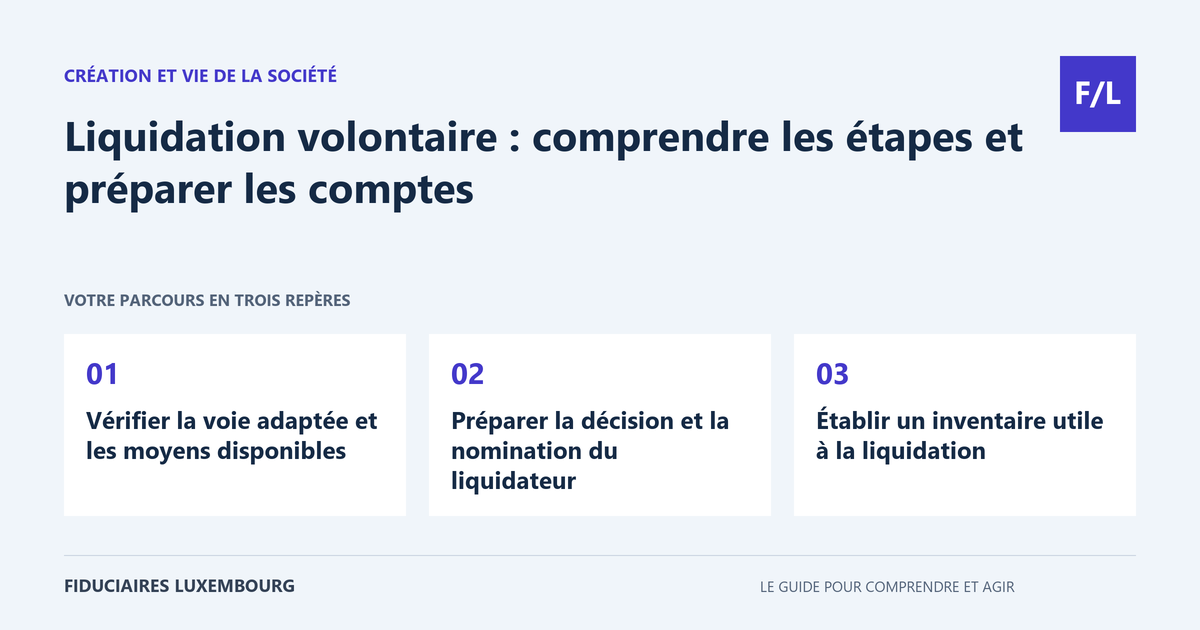
Checking the appropriate route and available resources
Start with the articles of association, the recent accounting position and a list of commitments. Overdue debts, litigation or assets that are difficult to sell may alter how the file is handled. Have payment difficulties identified promptly. The unanimous wish of the shareholders to close the company does not make it possible to ignore obligations towards creditors or freely choose an inappropriate procedure.
Also plan for liquidation costs: documents, publications, support, document retention and charges that continue during the operations. Their amount depends on the file. A company with no activity may still have a lease, bank charges or filing obligations. A realistic closure budget avoids distributing resources that you will subsequently need to complete the procedures properly.
Preparing the decision and appointing the liquidator
The professional responsible for the documents must verify the applicable rules on convening, voting and form. Do not apply a majority found for another company. Identify the liquidator or liquidators, their powers and the arrangements adopted. Prepare the documents and certificates required for the procedure actually selected, as well as the corresponding filing and publication formalities.
Clarify how information is to be passed to the liquidator: accounts, bank, contracts, tax matters, employees, archives and administrative access. They must be able to monitor the operations without relying on memories or scattered inboxes. The cessation of activity guide supplements this preparation for the bodies to be informed and contracts to be dealt with. Appoint the people who remain available to answer questions.
Preparing an inventory useful for the liquidation
List cash available, receivables, inventory, assets and shareholdings. For each item, distinguish between book value, expected realisation value and probable timeframe. A disputed receivable does not offer the same availability as money in the bank. The guide to reading a balance sheet helps raise the first questions, but an old balance sheet does not replace an updated inventory.
At the same time, list debts and commitments: suppliers, employees, public authorities, banks, guarantees and disputes. Add the foreseeable costs of the procedure. A balance confirmation may be useful, without necessarily covering every future obligation. Keep records of supporting documents and uncertainties: the audit trail must make it possible to understand why an amount was paid, kept pending or disputed.
Realising assets and settling obligations
Liquidation operations aim, in particular, to recover amounts due, realise the necessary assets and deal with liabilities. Document the terms of disposals, receipts and payments. Transactions with shareholders or related persons require the same attention to their justification. An asset cannot be removed from the file as though it already belonged personally to one of the shareholders.
Have the tax and accounting consequences of the operations monitored, as well as any filings still required. The sale of an asset, the closing of an activity and a final distribution are not interchangeable events. If a debt or tax liability remains uncertain, the way to secure its treatment must be examined with the parties involved. Do not set a distribution based solely on the available balance at a given date.
Preparing the liquidation accounts and closure
The liquidator reports on the operations in accordance with the applicable rules. Prepare a summary linking the initial inventory, realisations, settlements, costs and final balance. The documents submitted to the competent bodies and the required checks must correspond to the legal form and the procedure. Voluntary liquidation does not have a universal duration applicable to all files.
Any balance that may be distributable must be determined after the obligations have been dealt with, with consideration of shareholders' rights and tax consequences. The liquidation surplus is not synonymous with the final bank balance. Then organise the closure documents, deregistration and necessary publications. Keep a point of contact for subsequent administrative matters and determine archiving arrangements according to the periods actually applicable to each category of documents.
The table for taking action
| Stage | Documents or work | Checkpoint |
|---|---|---|
| Choice of procedure | Articles of association, accounts and debts | Situation compatible with the intended route |
| Opening | Decision and appointment | Powers, documents and publications |
| Operations | Inventory, sales and settlements | Justification of amounts and risk monitoring |
| Closure | Accounts and final formalities | Obligations dealt with, archives organised |
The bank balance is not enough to calculate what remains
Simplified fictional example: the company has 50,000 euros in the bank. The file shows 18,000 euros of known debts and 7,000 euros of estimated costs or taxes. The calculation 50,000 − 18,000 − 7,000 gives 25,000 euros, but this figure remains a working assumption until the items and other risks have been validated. It does not automatically constitute a distributable liquidation surplus. In particular, shareholders' rights, remaining operations and tax treatment must be checked before deciding on a distribution.
Your preparation checklist
- Check the financial situation and appropriate procedure.
- Gather the necessary articles of association and decisions.
- Define the powers and transfer the file.
- Update assets, liabilities and commitments.
- Budget for the remaining operations and costs.
- Document settlements and tax consequences.
- Prepare accounts, decisions and closure formalities.
- Organise archives and a contact person for follow-up.
Frequently asked questions
Does dissolution make the company disappear immediately?
In the liquidation process described here, the company continues to exist for the purposes of the liquidation until its completion.
Does a company with no activity no longer have anything to pay?
It may retain debts, contracts, costs and filing obligations. These must be inventoried.
Is there a guaranteed time limit for completion?
No. It depends in particular on the assets to be realised, debts, disputes and formalities in the file.
Useful terms in this guide
Questions to ask the professional
- Does our situation allow for the intended procedure?
- Which obligations could delay closure?
- Which documents and checks are required before any distribution?
To define the assignment to be entrusted, also consult our company formation section.
And for your situation?
Gather the recent accounts, articles of association and list of commitments. Search our directory for a professional to prepare the figures, estimate the remaining work and coordinate the liquidation with the competent parties.
Sources and verification
References consulted on 20 September 2026. Official procedures specify the applicable conditions and exceptions.
- Justice Luxembourg — liquidations
- Guichet.lu — dissolution et liquidation volontaire
- Guichet.lu — cessation d’activité d’une société
This guide explains a general process. The applicable rules depend on your situation; it does not constitute personalised advice. Report a correction.
Your next step
A specific need deserves the right contact
Accounting, taxation, company formation or payroll: prepare your questions, then search the directory for the professional who can review your situation. Check their assignments and status before entrusting them with your file.