Closing the doors on a Friday does not bring all obligations to an end the following Monday. Invoices still need to be collected, contracts continue and authorities expect different information. To properly cease an activity in Luxembourg, you need to establish a timetable for each step and keep one person responsible for follow-up until the final file is closed.
The framework to review
This guide concerns the organisation of a cessation of activity, primarily for a commercial company. It does not by itself describe a liquidation, bankruptcy or the cessation of activity of a self-employed person. Each procedure has its own conditions. Steps with the AED, the CCSS, the Ministry of the Economy and the RCS must reflect the actual situation; a declaration to one body does not replace the others. Where there are payment difficulties, have the applicable obligations identified promptly.
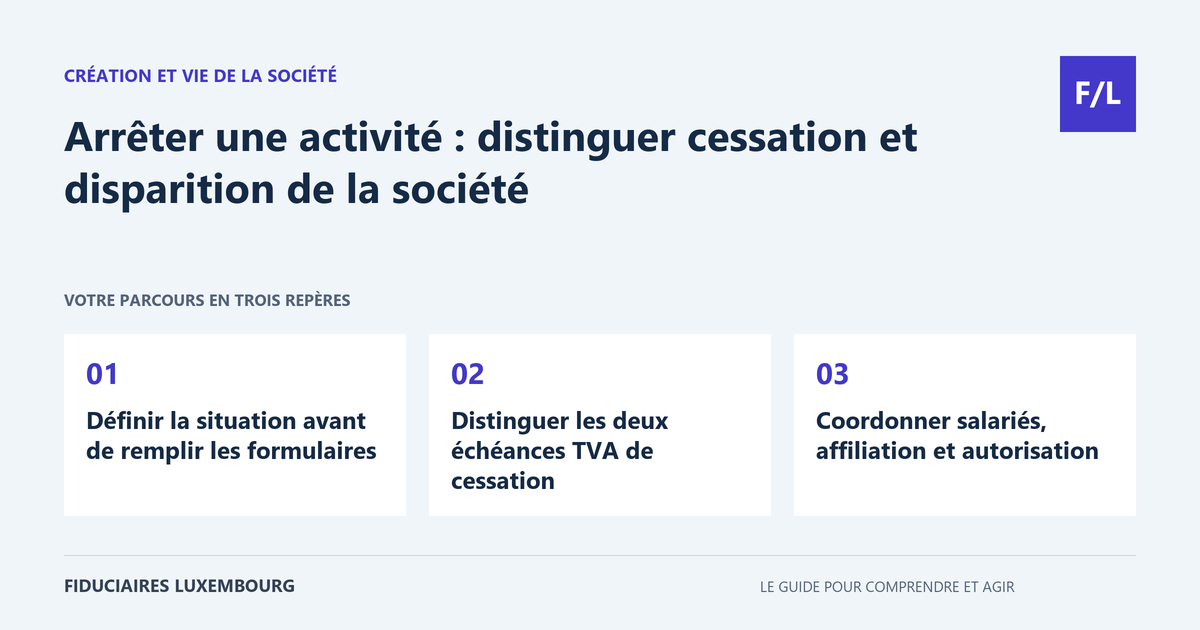
Define the situation before completing the forms
Is the activity ceasing completely, partially, or is it being transferred to a buyer? Will the company continue to hold assets or enter into liquidation? These questions guide the steps to take. Prepare a note stating the decision, the planned date, the authorised persons and the obligations that remain outstanding. A lack of turnover does not, in itself, mean that the company no longer exists.
Voluntary liquidation is a separate procedure. If it is contemplated, consult the guide to the liquidation steps and accounts. The handling of registrations and deregistration from the register must follow the required instruments. Do not close communication channels or administrative access before arranging their transfer to the person responsible.
Distinguish the two VAT cessation deadlines
The AED states that a declaration of total or partial cessation must be submitted within fifteen days. This information is not the final quantified VAT return. When a taxable person ceases operations during the year, the administration also requires a return serving as the annual return and payment of any balance within two months of cessation. Record these two steps on separate lines.
Have end-of-activity transactions reviewed: final sales, inventories, retained or transferred assets, credit notes and any adjustments. The treatment depends on the facts; transferring an activity does not automatically make every transaction exempt. Gather invoices, the asset register and supporting documents for any transfer. Ask your contact person to specify the transactions that still need to be declared and the evidence expected.
Coordinate employees, affiliation and authorisation
Closure does not remove employees’ rights. Contracts, notice periods, outstanding balances and any specific rules must be reviewed before setting departure dates. The ITM specifies that notice indemnities may remain due beyond the cessation of activity. The CCSS requires the declaration of departure within eight days following the end of the contract: this date does not necessarily coincide with the closure of the premises.
Deal separately with the situation of the affiliated manager and the steps relating to the business permit. Guichet.lu indicates a period of one month to inform the Minister of the Economy of the cessation. Designate the person who submits the information, the person who checks receipt and the person who responds to additional requests. For salaries, retain the data needed to prepare the final payroll statements and corresponding declarations.
List the contracts and amounts to be settled
List leases, subscriptions, insurance policies, financing and service contracts together with their notice periods and termination procedures. The desired cessation date does not override a contractual clause. Add guarantees received or given, deposits and equipment to be returned. Request written confirmations where necessary and keep them in the same place as the contract.
Set up follow-up for customers and suppliers with outstanding items. An invoice issued before cessation may be paid afterwards; a dispute may last longer. Provide for the means to receive funds and pay final charges. The cash flow plan remains useful during this period. A positive bank balance must be reconciled with remaining obligations before any decision to distribute funds or close the account.
Organise the final accounts and record retention
Notify the tax contact person and prepare the declarations still required by the ACD. Review the advance payments called for and whether an adjustment request is needed, without treating their discontinuation as automatic. The guide on corporate income tax advances and adjustment explains how to reconcile forecasts and payments for this tax. A file remains under follow-up as long as the necessary declarations, statements and exchanges have not been completed.
Finally, designate the person responsible for the archives, their location and the persons authorised to access them. Retention periods depend on the documents and applicable rules; closure does not allow everything to be destroyed. Export useful data in a readable format before terminating software. Keep proof of filing and a register of open items, with a date for the next review of each item.
The table to take action
| Step | Reference point | Check |
|---|---|---|
| AED information | 15 days after total or partial cessation | Does not replace the VAT balance |
| VAT cessation return | 2 months after cessation during the year | Return serving as the annual return and balance |
| Employee departure to the CCSS | 8 days after the end of the contract | Actual date, including applicable notice period |
| Business permit | Inform the Minister within one month | Step adapted to the cessation |
A closure with several end dates
Fictitious example: an activity closes its point of sale at the end of a month, but certain employment contracts continue during their notice periods. A lease also requires follow-up and two customers still have to pay their invoices. The manager creates separate lines for the cessation of commercial activity, VAT declarations, each social security departure and the settlement of contracts. They maintain an administrative contact and the necessary means of payment. The example does not set any notice period: it shows why a single date can lead to obligations being overlooked.
Your preparation checklist
- Classify the situation as cessation, transfer or liquidation.
- Set out dates and responsibilities.
- Distinguish VAT notification from the final VAT return.
- Handle notice periods and social security departures.
- Inform the competent department regarding the permit.
- Follow up on terminations, receivables and debts.
- Review taxes, advance payments and accounts to be prepared.
- Organise access, mail and archives.
Frequently asked questions
Does no longer issuing invoices make the company disappear?
No. The obligations of the legal entity and the formalities related to its dissolution must be reviewed separately.
Is the VAT cessation declaration sufficient?
No. It does not replace quantified returns and payment of any amounts due.
Can archives be destroyed upon closure?
No. Record-retention obligations continue to apply according to the documents concerned.
Useful terms in this guide
Questions to ask the professional
- Which dates trigger each formality?
- Which contracts and payments will continue after cessation?
- Who will retain the file and follow up on subsequent requests?
To clarify the engagement to be entrusted, also consult our company formation section.
And for your situation?
Prepare the planned dates, contracts and list of amounts still outstanding. Search our directory for a professional to organise the cessation timetable and coordinate the accounting, tax and social aspects of your situation.
Sources and verification
References consulted on 20 September 2026. Official procedures specify the applicable conditions and exceptions.
- Guichet.lu — cessation d’activité d’une société
- AED — déclaration de cessation d’activité économique
- AED — déclarations de TVA, cessation en cours d’année
- CCSS — engager du personnel
- ITM — préavis après cessation d’activité
This guide explains a general process. The applicable rules depend on your situation; it does not constitute personalised advice. Report a correction.
Your next step
A specific need deserves the right contact
Accounting, taxation, company formation or payroll: prepare your questions, then search the directory for the professional who can review your situation. Check their assignments and status before entrusting them with your file.