You have a project, but the list of steps already seems long? Let us make the decisions in order: what you will do, with whom, using which resources, and then in which form. You will then have a start-up file that can be used by your contacts.
Start with the activity and the people involved, then compare legal forms. The cost of incorporation should not be the sole decision-making criterion.
The framework to check
The legal form governs, in particular, the persons involved, commitments and decisions. The business permit concerns access to certain activities. Registration with the RCS and VAT registration serve other purposes. None of these elements replaces the others.
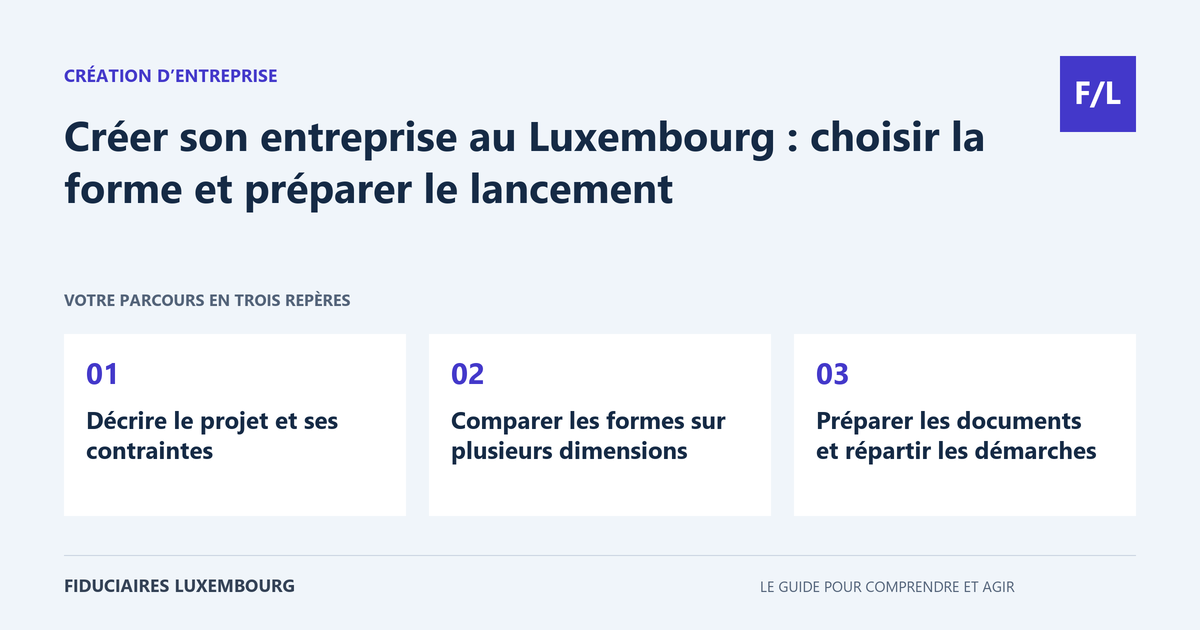
Describe the project and its constraints
Set out the services or products, clients, countries and resources required. Identify professional qualifications, premises and any required authorisations. If several people are involved, clarify roles, contributions and time commitment.
Prepare an initial sales and expenditure forecast. It helps identify financing needs before choosing a structure. A project that is viable on paper may fail if it does not finance the gap between expenditure and cash receipts.
Compare legal forms across several dimensions
Examine legal personality, liability, capital, governance, taxation and the entry of investors. A sole proprietorship and a company do not organise assets and decisions in the same way. The SARL-S has its own conditions, notably regarding shareholders and activity.
Use the official presentation of legal forms to prepare your questions. Have the consequences confirmed in your case, especially where foreign shareholders, a regulated activity or significant assets are involved. No general table covers every possible commitment.
Prepare the documents and allocate the procedures
Gather identity documents, supporting documents, the business plan and information about the registered office. For a company, organise the articles of association, capital, powers and beneficial owners. Allocate tasks between the manager, notary, accounting firm and other professionals.
The timetable must show dependencies: authorisation, incorporation, bank, register and affiliations. For each stage, distinguish between a prepared document, a submitted application and a completed formality. A checklist of completed tasks without acknowledgement or decision is not sufficient evidence.
Build the first management timetable
Before the first transactions, plan for invoicing, filing documents and sending them to the accounting firm. Identify upcoming returns, payments and approvals. If employees are hired, organise their onboarding and payroll before the first month worked.
Set a review point after launch to compare forecasts with reality. It should make it possible to correct procedures, check the first invoices and identify cash-flow needs. Monitoring starts at launch, not only at the annual closing.
Avoid the most common shortcuts
Registration does not replace every authorisation; minimum capital does not represent the full budget; an address does not demonstrate the operating resources. These distinctions must remain visible in discussions with service providers.
Request quotations that separate incorporation, formalities and ongoing operations. Ask for the included services and the situations that would result in an additional charge to be specified. Finally, keep your documents, access credentials and evidence in a file that you can consult independently of the service provider.
Build a launch process with validation points
Think of your start-up as a succession of gates to open. The first concerns the right to carry out the activity: describe the services sold precisely and check the conditions applicable to the activity. The second concerns the structure that will sign the contracts. The third concerns the resources actually available: premises, bank account, financing, tools and people. An announced commercial launch date does not replace any of these checks.
Prepare a shared table with one row per procedure, a person responsible, the expected documents and evidence of completion. Record separately “file submitted”, “request for additional information received” and “approval obtained”. This distinction prevents you from ordering equipment or promising delivery on the assumption that a submitted application already permits the launch. Our guide on the business permit helps prepare the first step.
Before the first invoice, have the planned transactions classified: business or private customer, goods or services, Luxembourg or another country. The guide on VAT registration helps gather the useful information. Do not choose a VAT treatment solely because your company has just been incorporated.
The first months must be organised before the first sale
From the outset, determine how invoices will be sent, expenditure approved and receipts monitored. Annual accounting may meet certain obligations without alerting you in time to a lack of liquidity. Therefore, prepare a thirteen-week cash-flow plan in addition to the start-up budget.
If you are setting up the business with others, also agree on the person who approves commitments and the information each shareholder will receive. Identify beneficial owners and prepare the RBE file. A subsequent change in shareholding must trigger a new review. If recruitment is planned, incorporate the social timetable into the launch rather than discovering it when the first salary payment is due.
| Stage | Document or decision | Useful check |
|---|---|---|
| Activity | Description of services and applicable conditions | Who confirms the right to carry out the activity? |
| Structure | Articles of association and documents required according to the legal form | Who can bind the company? |
| Financing | Available resources and signed commitments | Are the initial outflows covered? |
| VAT and management | Classification of transactions and document flow | Who monitors returns and deadlines? |
Let us look at a practical case
Fictitious educational example, intended to explain the reasoning.
Two people want to launch a service. One contributes financing, the other their work and software developed previously. Before choosing a SARL or a SARL-S, they must clarify ownership of the software, the allocation of capital, remuneration and joint decisions. The incorporation quotation comes afterwards: it does not resolve these issues on its own. Their file becomes much more useful if it includes a budget, a description of the activity and the points on which they do not yet agree.
Four legal forms to compare
| Form | Reference capital | Decisive question |
|---|---|---|
| Sole proprietorship | No minimum share capital | How do business commitments affect your personal assets? |
| SARL | €12,000 minimum, fully subscribed and paid up upon incorporation | How should shareholders, powers and financing be organised? |
| SARL-S | From €1 to €12,000, fully subscribed and paid up upon incorporation | Do the shareholders and the activity meet the specific conditions? |
| SA | €30,000 minimum; subscription and payment-up rules to be examined | What governance and shareholding structure are sought? |
These amounts are not the total cost of the project. Fees, authorisations, equipment and start-up cash flow must be budgeted separately. Also check any personal guarantees and commitments you may sign.
Points to prepare
- Project, shareholders and resources defined.
- Legal forms compared in light of risks and financing.
- Authorisations and formalities allocated.
- Initial transactions and monitoring timetable prepared.
Frequently asked questions
Is there an ideal form for all projects?
No. The choice depends on the activity, the people involved, commitments, financing and growth prospects.
Should you wait until incorporation to contact an accounting firm?
A preliminary discussion can help define the budget, documents and monitoring, while distinguishing the necessary legal and regulated services.
Useful terms in this guide
Questions to ask the professional
- Which form corresponds to our commitments and shareholders?
- Which steps must be completed before our first invoice?
To clarify the scope of your request, also consult our company formation guide.
And for your situation?
Your next step is to gather a description of the activity, the start-up budget and the decisions still open. A professional can then help you organise the procedures and future management, while identifying the necessary legal or regulated interventions. Search our directory for the professional suited to your needs, then ask them for an engagement and a detailed quotation.
Sources and verification
References consulted on 20 September 2026. Official procedures specify the applicable conditions and exceptions.
- Guichet.lu — choix de la forme juridique
- Guichet.lu — autorisation d’établissement
- Guichet.lu — business plan et prévisions financières
- Guichet.lu — immatriculation et publications au RCS
- Guichet.lu — société à responsabilité limitée
- Guichet.lu — société à responsabilité limitée simplifiée
- Guichet.lu — société anonyme
This guide explains a general process. The applicable rules depend on your situation; it does not constitute personalised advice. Report a correction.
Your next step
A specific need deserves the right contact
Accounting, taxation, company formation or payroll: prepare your questions, then search the directory for the professional who can review your situation. Check their assignments and status before entrusting them with your file.