A foreign partner requests a residence certificate before making a payment. First, it is necessary to understand the expected document and its purpose: certifying tax residence does not amount to proving commercial registration or the absence of debt. A precise application avoids unnecessary exchanges and enables the professional to verify whether the certificate genuinely meets the contemplated transaction.
The framework to check
The ACD states that an application for a company residence certificate must be sent to the competent tax office by post or via its contact form. It specifies the information expected and may request additional supporting documents. Its FAQ excludes the issuance of this certificate for a partnership. It is therefore necessary to verify the entity’s legal form and status, as well as the basis sought, before reusing a procedure intended for a company limited by capital.
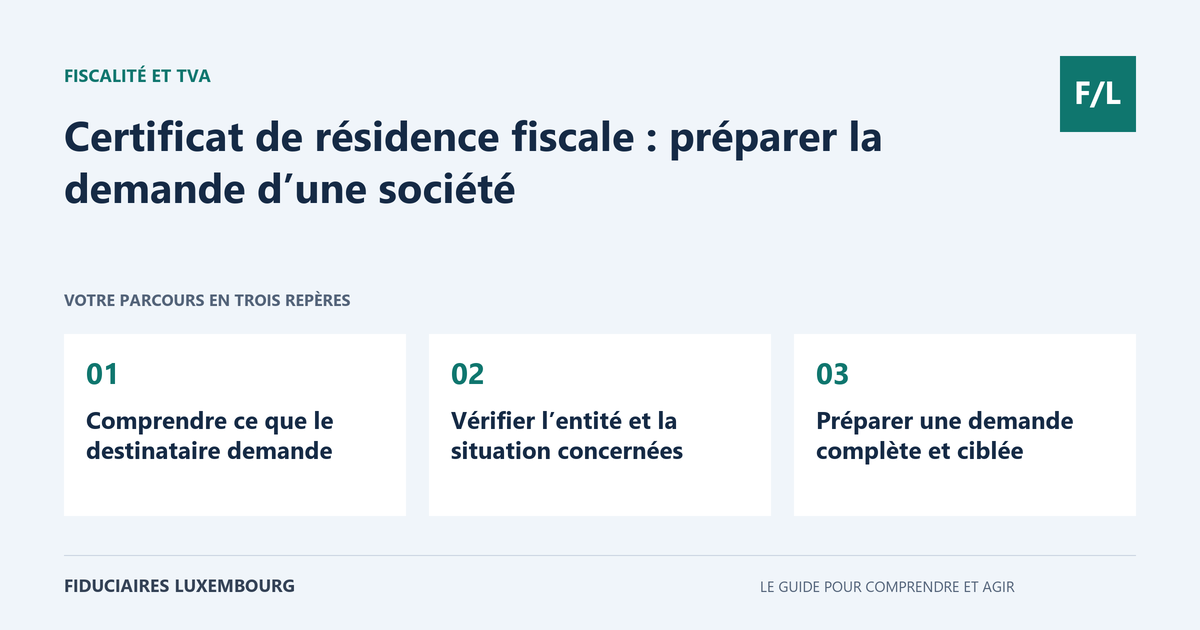
Understanding what the recipient requests
Ask the partner for the exact purpose of the document, the authority concerned, the country and the period. Is it intended to prepare for a dividend, interest payment or another transaction? Is there a local form to complete? A vague request for a “tax certificate” may result in a document different from the one expected. Keep the written request so that all parties share the same understanding of the need.
Distinguish a tax residence certificate from an RCS extract or a certificate relating to tax obligations. These documents answer different questions. The commercial extract may help identify the entity without replacing the certificate required for a treaty. Do not promise the partner an exemption from withholding tax before having its basis reviewed.
Checking the entity and situation concerned
Record the exact company name, legal form, registration number, address and date of incorporation. Compare this information with the documents received from the partner. A holding company and its subsidiary may have similar names: the certificate must concern the beneficiary or entity actually involved in the transaction, not simply the group company whose file is most readily accessible.
Report changes of registered office, effective management or status occurring during the requested period. Economic substance and residence are not demonstrated solely by an address. The professional must know the relevant facts in order to assess the application. An entity falling under a specific regime may require an analysis different from that of a fully taxable company.
Preparing a complete and targeted application
The ACD FAQ notably requires the applicant’s identity and address, registration number, reason, recipient authorities and date of incorporation. It allows the language to be specified: French is used by default, while German or English may be requested. Add useful details regarding the transaction and period so that the file can be understood without reconstructing your exchanges.
Identify the competent tax office using the ACD’s current information and the tax file. If an agent is involved, define their assignment and the documents they must receive. Limit submissions to the necessary data, using an appropriate channel. An accumulation of documents without explanation can complicate processing just as much as an incomplete application.
Following up on processing and checking the document received
Keep the sending date, the content submitted and any requests for additional information. The ACD may verify the taxpayer’s situation and request supporting documents; do not turn an expected timeframe into a commitment announced to the partner. If a commercial deadline is approaching, inform the persons concerned and have solutions compatible with the applicable obligations reviewed.
Upon receipt, check the company name, period, scope, language and any intended recipient. Also check that the document does not answer another request from the group. File it together with its original request and the transaction documents. A certificate kept without a reference becomes difficult to reuse correctly when several countries and several years are concerned.
Using the certificate within its actual scope
The application of a treaty may depend on conditions other than residence: the nature of the income, the beneficiary’s status and the rules relevant to the transaction. The certificate forms part of this file; it does not replace its analysis. For a dividend payment, consult our guide on distribution and withholding tax to prepare the additional information.
Before a new use, check the requested period and changes in circumstances. A change of address must also be followed up in the steps described in the guide on transfer of registered office and change of address. Keep a simple register of certificates sent: entity, year, country, purpose and version. This will enable you to identify which document needs to be corrected or renewed if the facts change.
The table to take action
| Information | Question to ask | Purpose |
|---|---|---|
| Entity | Which company carries out the transaction? | Avoid confusion within the group |
| Purpose | Which income or procedure? | Define the scope |
| Period | Which year is requested? | Avoid an unsuitable certificate |
| Destination | Which authority and which country? | Prepare the useful details |
| Use | What other conditions must be proven? | Complete the tax file |
The right document, but for the wrong company
Fictitious example: a partner requests a certificate for the company that is to receive interest. The shared file contains a recent certificate for the parent company, while the loan agreement identifies a subsidiary. The person responsible compares the company names and identifies the discrepancy before sending it. They prepare the application for the relevant entity and have the income treatment reviewed. The presence of a recent document within the group is therefore not sufficient: the certificate, contract and actual beneficiary of the transaction must be linked. The example does not prejudge the subsidiary’s access to a treaty benefit.
Your preparation checklist
- Obtain the recipient’s precise requirements.
- Identify the entity and its legal form.
- Specify the country, period and transaction.
- Update the tax file data.
- Choose the appropriate language.
- Keep the application and submitted documents.
- Check the scope of the certificate received.
- Verify the other conditions before use.
Frequently asked questions
Does an RCS extract replace the certificate?
No. It describes commercial registration and does not necessarily fulfil the requested tax purpose.
Does the certificate guarantee a reduced rate abroad?
No. The other conditions of the treaty and procedure must be reviewed.
Can a certificate from another group company be reused?
No. The document must correspond to the entity and situation concerned.
Useful terms in this guide
Questions to ask the professional
- What document does the recipient require exactly?
- Does our entity’s status allow this application?
- What other evidence accompanies the contemplated treaty use?
To clarify the assignment to be entrusted, also consult our taxation section.
And for your situation?
Gather the partner’s request, the company’s details and the relevant contract or income. Search our directory for a professional to prepare the process and check the scope of the certificate in your international file.
Sources and verification
References consulted on 20 September 2026. Official procedures specify the applicable conditions and exceptions.
- ACD — démarches et certificats des sociétés
- ACD — réduction ou remboursement de retenue sur dividendes
This guide explains a general process. The applicable rules depend on your situation; it does not constitute personalised advice. Report a correction.
Your next step
A specific need deserves the right contact
Accounting, taxation, company formation or payroll: prepare your questions, then search the directory for the professional who can review your situation. Check their assignments and status before entrusting them with your file.