Aid can support your project, provided that it is integrated at the right time. The first step is to check the criteria and timeline before incurring expenditure: an application prepared too late may lose its usefulness.
For the SME investment aid presented by Guichet.lu, the application must be submitted before work begins. Check this requirement before placing any relevant order or making any commitment.
The framework to verify
Each scheme has its own legal basis, beneficiaries, eligible expenditure and cumulation rules. A simulation is not an award decision. Any requirements regarding the prior submission of the application and the supporting documents must be read in the scheme actually applied for.
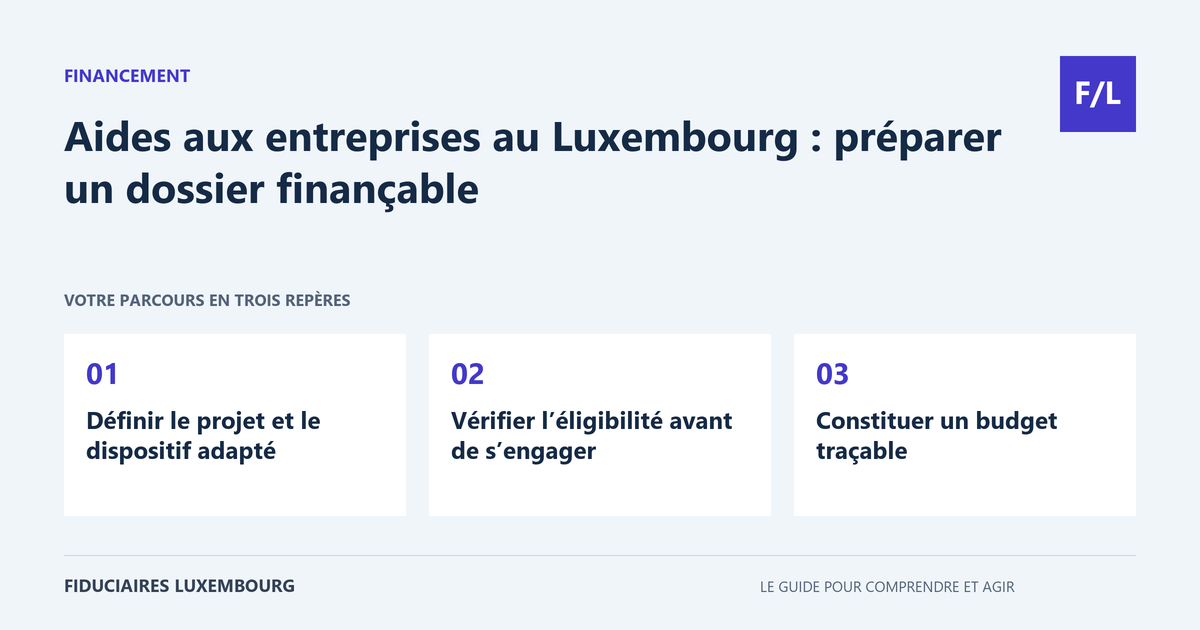
Defining the project and the appropriate scheme
Separate tangible investments, consultancy expenditure, innovation, digital transformation and working capital needs. Schemes do not all cover the same expenditure or the same companies. Review their conditions, exclusions, opening periods and payment arrangements.
Describe the expected outcome in concrete terms: production capacity, organisation, quality or product development. A general wording such as “accelerate growth” does not make it possible to match expenditure with the scheme's criteria.
Checking eligibility before making commitments
Identify the applicant company, its shareholding links, its activity and its size under the scheme's rules. An SME belonging to a group must not reason solely on the basis of its own accounts. Also review other aid applied for or received.
Submission of the application, acknowledgement of receipt and the award decision are three different events. A complete application does not guarantee a positive response. Establish a financing scenario that remains understandable if the aid is lower, later or refused.
Preparing a traceable budget
Gather detailed quotations, the financing plan, available accounts and information relating to shareholding. Classify expenditure by supplier, nature and period. Distinguish presumed eligible expenditure from other costs and state the assumptions.
Keep successive versions of the budget. If a provider, amount or deadline changes, check the effect on the application before assuming that the approval automatically covers the change. Payment documents and evidence of completion will be useful when the aid is disbursed.
Coordinating aid with accounting and cash flow
The decision date does not necessarily correspond to the receipt date. Your forecast must finance the period between expenditure and the expected payment. Do not record a commercial assumption as a definitively acquired receivable without reviewing the conditions.
The fiduciary can help organise the accounts, the size of the company and the supporting documents; the project holder remains responsible for the operational description. Appoint a person responsible for the file and establish a timetable for missing documents.
Understanding what the prior application must demonstrate
The incentive effect explains the importance of timing. For general SME aid, Guichet.lu states that the complete application must precede the start of work and that no binding commitment relating to the project concerned may be made before it is submitted. Have the scope of an order or contract reviewed before signing it.
For investment aid, the official information sheet updated on 15 September 2026 distinguishes eligible projects from simple replacements of machinery or equipment, which are not eligible under this tool. The purchase of shares in a company is not the same as the acquisition of assets meeting the conditions of the scheme.
Create a timeline with quotations, exchanges, applications, contracts and payments. This document allows the professional to see immediately which commitments have already been made. An expense does not become eligible because it is subsequently reclassified in the budget.
Monitoring conditions through to payment and after the project
List all aid applied for or received for the costs concerned. Cumulation may be limited: the ceilings of the applicable schemes must be checked. Keep this list up to date when other public funding is requested, then have the consequences for the ongoing file confirmed.
Upon receipt of the decision, note the accepted expenditure, timetable, payment supporting documents and commitments to be met. The budget variance dashboard helps identify a change in supplier, cost or scope before assuming that it is accepted. Assign the preparation of the payment application to an identified person.
In a fictional scenario, a €40,000 project is financed without assuming that a grant has already been secured. You can add an aid assumption in a separate column, then test a later payment or a lower amount. The cash flow plan shows whether expenditure can be paid during the interval. The fixed asset tracking then records investments and their movements. The completion of the work must not cause obligations linked to the decision to disappear: retain the documents and have any planned changes or disposals reviewed.
| Stage | Key document | Checkpoint |
|---|---|---|
| Before making commitments | Scheme and timeline | Eligibility and prior submission of the application |
| Application | Budget and financing | Complete file and cumulation reviewed |
| Decision | Notification and conditions | Accepted costs, deadlines and commitments |
| Payment and monitoring | Invoices, payments and evidence | Compliance with the decision and retention |
Let us look at a practical case
Fictional educational example, intended to explain the reasoning.
A company wants to acquire equipment. Before signing a firm order, it checks whether the contemplated scheme requires a prior application. It estimates the project with and without aid, then organises evidence of expenditure and other financing. If the decision comes later than expected, it knows which expenditure can wait. This discipline turns aid into an identified resource, rather than treating it as cash inflow assumed to have been secured.
Points to prepare
- Official scheme and version of the conditions retained.
- Eligibility and cumulation of aid reviewed.
- Timeline of commitments checked.
- Budget, financing and payment evidence organised.
Frequently asked questions
Does the aid finance all project expenditure?
No. The scheme defines its eligible expenditure and its limits. Your budget must distinguish between what is eligible and what is not.
Can the aid be counted as available cash as soon as the application is submitted?
No. The application, decision and payment must be distinguished, and financing for the interval must be planned.
Useful terms in this guide
Questions to ask the professional
- Which expenses and dates matter for this scheme?
- How can the project be financed before any possible payment?
To clarify the scope of your application, also consult our company formation section.
And for your situation?
Before placing an order, describe your project and the commitments already made. Have the scheme and financing for the interval checked, then organise monitoring through to payment and compliance with the aid conditions. Search our directory for the professional suited to your needs, then ask them for an engagement and a detailed quotation.
Sources and verification
References consulted on 20 September 2026. Official procedures specify the applicable conditions and exceptions.
- Guichet.lu — aides générales aux PME
- Guichet.lu — aide à l’investissement des PME
- Guichet.lu — conditions générales des aides aux PME
This guide explains a general process. The applicable rules depend on your situation; it does not constitute personalised advice. Report a correction.
Your next step
A specific need deserves the right contact
Accounting, taxation, company formation or payroll: prepare your questions, then search the directory for the professional who can review your situation. Check their assignments and status before entrusting them with your file.