A business plan should help you make decisions and enable a third party to understand your assumptions. There is no need to start with a lengthy document: begin with customers, costs and the time needed to collect payments.
Distinguish profitability from cash flow. A business can sell at a positive margin and lack liquidity if its customers pay too late.
The framework to verify
The business plan is a preparation tool; it does not constitute either authorisation to operate, a commitment from the financier, or a guarantee of profitability. Assumptions must remain distinct from signed contracts and resources that are actually available.
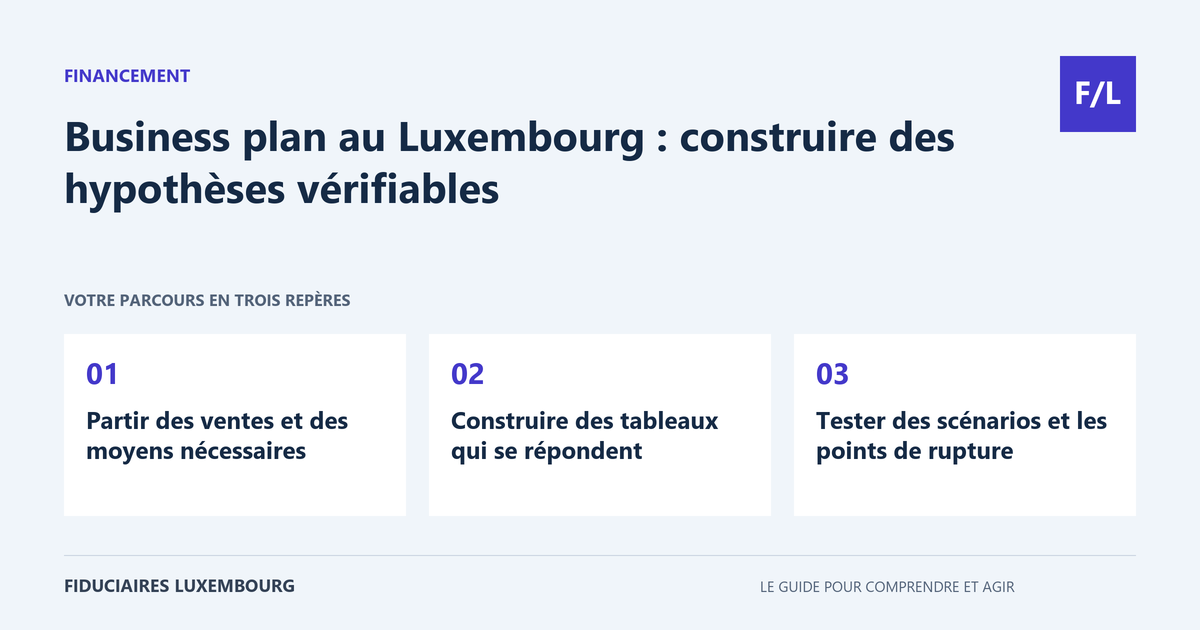
Start with sales and the resources required
Break down projected sales into number of customers, purchase frequency and price. Support assumptions with identifiable elements: contracts, trials, history or market research. A commercial intention is not the same as a firm order.
Match sales with the resources required: people, capacity, purchases, premises and tools. If turnover doubles, which costs or investments must increase? This question avoids forecasts that increase revenue without adjusting resources.
Build tables that tie together
The income statement reflects income and expenses; the cash flow plan reflects cash receipts and disbursements. Initial financing lists start-up needs and planned resources. The tables must share the same assumptions.
Include payment terms, VAT, investments, loan repayments and contributions. Depreciation does not generate the same cash movement as a purchase. Have the links between the tables checked rather than treating them as independent presentations.
Test scenarios and breaking points
Prepare a central scenario, a scenario with slower sales and a scenario with higher costs. For each, identify the month with the lowest cash position and possible actions. Variations must be plausible and explained.
Specify financing that has been secured, requested or merely contemplated. An expected grant or an unsigned fundraising round must not be presented as a certainty. Determine what must be decided before committing expenditure.
Use the plan after launch
Keep a reference version and compare actual results with the assumptions. Analyse variances by volume, price, cost and timing. This analysis is more useful than an overall comparison of turnover.
The business owner provides an understanding of the market; the fiduciary firm helps structure and check financial forecasts. The file intended for a bank or investor must explain assumptions and risks without promising approval or automatic financing.
Prepare an assumptions register
A figure becomes useful when you know where it comes from. Create a record for each important assumption: selected value, source, date, person responsible and review condition. For the sale price, keep a pricing schedule or contracts; for rent, an offer; for recruitment, an estimate of the full cost. Flag values that are still based on a simple target.
In a fictional example, twenty monthly assignments at 500 euros represent 10,000 euros in turnover excluding tax. If each assignment requires four hours, this already represents eighty hours of production, before prospecting, administration and revisions. The capacity test can therefore call the planned volume into question even where the turnover calculation is correct.
Repeat this check for purchases, recruitment and investments. The break-even point must use a margin consistent with the products or services sold. If several activities have different margins, explain the mix used. A comfortable average can conceal the growth of a less profitable offering.
Define what you expect from the professional
The professional can help you build the financial model, check the links between tables or prepare a presentation for a financier. Specify the engagement: creating the model, reviewing an existing document, scenarios or support during discussions. Formatting does not amount to checking every commercial assumption.
Request a version that you can update, an explanation of the calculations and a list of unresolved points. Agree on how missing information will be handled. To compare debt and an equity investment, consult the financing guide. To check the first weeks, supplement the model with a short-term cash flow plan.
After approval, freeze a reference version without overwriting the original assumptions at each revision. Budget and variance monitoring should make it possible to understand what changed and why. You can then discuss recruitment or an investment based on a comparison, rather than on forecasts rewritten to resemble actual results. This discipline makes the business plan useful long after it has been submitted to the bank.
| Assumption | Supporting evidence or method | Scenario to test |
|---|---|---|
| Sales | Documented customers, frequency and price | Lower volume or delayed launch |
| Production | Time, team and available capacity | Bottleneck or deferred recruitment |
| Costs | Quotes and contractual terms | Increase or omitted expense |
| Financing | Agreements and terms of availability | Delayed payment or reduced amount |
Let's consider a practical case
Fictional educational example intended to explain the reasoning.
A founder plans for ten new customers each month. They explain how they will find them, how much their acquisition costs and when they will pay. They then test a scenario with fewer customers and slower payments. If cash flow becomes insufficient, the plan makes it possible to review the timetable, expenditure or financing before committing. The value of the document lies in these concrete decisions, more than in a well-presented growth curve.
Points to prepare
- Sales assumptions linked to evidence.
- Consistent results, cash flow and financing.
- Adverse scenarios tested.
- Secured and contemplated financing distinguished.
Frequently asked questions
Does projected profit guarantee cash flow?
No. Payment terms, investments and repayments can create a financing need despite a positive result.
Who should write the business plan?
The project owner must understand their assumptions. A professional can help structure them and check the tables.
Useful terms in this guide
Questions to ask the professional
- Which assumptions account for most of the result?
- What cash requirement appears in the adverse scenario?
To clarify the scope of your request, also consult our company formation section.
And for your situation?
Bring your assumptions, even if still imperfect, along with their sources and the decisions to be made. Request support that enables you to understand and update the forecasts, with a clear scope of what will be checked. Search our directory for the professional suited to your needs, then ask them for a detailed engagement and quote.
Sources and verification
References consulted on 20 September 2026. Official procedures specify the applicable conditions and exceptions.
This guide explains a general process. The applicable rules depend on your situation; it does not constitute personalised advice. Report a correction.
Your next step
A specific need deserves the right contact
Accounting, taxation, company formation or payroll: prepare your questions, then search the directory for the professional who can review your situation. Check their assignments and status before entrusting them with your file.