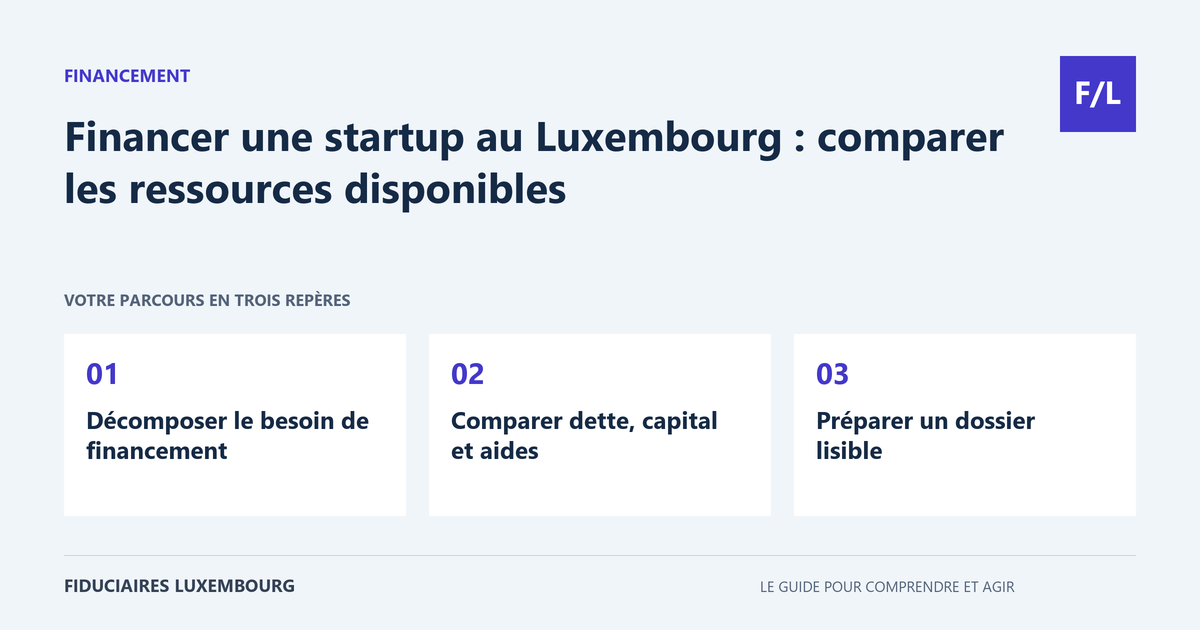
Your project needs financing: let us start with the amount, the date and the intended use of the funds. This level of precision makes it possible to compare resources that do not offer the same timelines or the same commitments.
Before choosing a financier, quantify the need, its due date and its duration. Distinguish between resources obtained, under negotiation and merely contemplated.
The framework to review
A loan, an equity contribution, an advance and a grant do not create the same rights and obligations. Guarantees, financial covenants and investor rights must be read before making a commitment. An agreement in principle does not necessarily mean that funds will be made available.
Breaking down the financing need
Separate investments, development, start-up costs and working capital requirements. Add the delay between the sale and receipt of payment. Rapid growth can increase cash requirements before improving profitability.
Present the amounts by month and the stages they finance. Financing durable equipment and financing a period of commercial testing do not necessarily call for the same resource.
Comparing debt, equity and aid
Debt requires, among other things, an understanding of repayment, interest, guarantees and covenants. Bringing in an investor changes the shareholding structure and may influence governance. Public aid depends on criteria, a decision and a disbursement schedule.
The official presentation of bank and non-bank financing provides a starting point. Compare options based on their full cost, availability, flexibility and consequences. Financing without dilution may involve significant constraints; equity is not a resource without consideration.
Preparing a clear file
Present the team, market, product, commercial evidence and financial assumptions. Add the available accounts, the capitalisation table and existing commitments. Explain the intended use of funds and the milestones that will make it possible to measure progress.
The financier must be able to distinguish signed contracts, opportunities and projections. Highlight dependencies: authorisation, recruitment, intellectual property or a main customer. Explained risks are more credible than forecasts with no downside scenario.
Preserving room for manoeuvre
Test the budget with delayed or lower financing. Identify deferrable expenses and the minimum cash level. Do not sign all commitments on the assumption that an agreement in principle is secured.
The fiduciary can help prepare forecasts and monitoring documents. Investment agreements, guarantees and shareholders’ rights require legal review. Have the whole package reviewed before accepting an offer.
Measuring the time available before negotiating
Let us take a deliberately simple fictional example. A startup has 120 000 euros of usable cash and consumes 15 000 euros net per month. At a constant rate, this represents eight months. But if it still has to pay 30 000 euros for equipment, its runway falls to six months. This calculation is not a sufficient forecast: it is used to identify commitments that the bank balance conceals.
Then replace the average with monitoring of cash inflows and outflows. Present three situations: financing received on the desired date, delayed disbursement and a lower amount. For each, indicate the commercial milestone that can be reached and the decisions to be made. Delayed recruitment does not have the same effect as stopping development; explain the operational trade-off.
If the shareholders advance funds, specify their nature. An amount paid into the company’s account is not automatically an equity contribution. The shareholder current account requires the terms to be documented, including repayment, possible remuneration and subordination. The bank or investor may require these advances to remain available for a certain period.
Assessing schemes against the actual project
SNCI presents four programmes, proStart, proDevelop, proInnovate and proTransfer, which correspond to different situations in the life of a business. This presentation does not confirm your eligibility. Have the purpose of the project, the expenses, viability, other financiers and the conditions of the relevant programme reviewed before including a resource in your secured scenario.
Aid and a loan do not necessarily follow the same timetable. Ask when to submit the file, which commitments may be made and what evidence will be required for disbursement. In your business plan, clearly separate available resources from those subject to a decision. The reader must understand what finances the next milestone even if an application remains unanswered.
| Resource | Point to negotiate or verify | Consequence to simulate |
|---|---|---|
| Equity | Valuation, rights and governance | Shareholding and decisions after the transaction |
| Loan | Repayment schedule, guarantees and covenants | Cash after each repayment |
| Shareholder advance | Repayment and subordination terms | Availability of funds over time |
| Aid | Eligibility, application and disbursement conditions | Financing expenses before receipt of payment |
Let us consider a practical case
Fictional educational example intended to explain the reasoning.
A startup finances technical development and its first sales. A loan may cover part of the need, but repayments may begin before the expected cash inflows. The team compares this constraint with bringing in an investor and accessible aid. It plans for a scenario in which the fundraising takes several additional months. This work makes it possible to choose realistic milestones and negotiate without concealing the cash risk.
Points to prepare
- Need quantified by period and objective.
- Debt, equity and aid compared.
- Assumptions and commitments documented.
- Delayed financing scenario prepared.
Frequently asked questions
Is a financing promise enough to incur expenses?
You need to verify the conditions, the scope of the agreement and the date on which funds will be made available. An agreement in principle does not necessarily replace a final contract.
Is the least expensive solution always preferable?
The cost must be assessed alongside guarantees, timing, governance and flexibility.
Useful terms in this guide
Questions to ask the professional
- Which resource matches the duration of the need?
- Which commitments remain if sales are delayed?
To clarify the scope of your request, also consult our company formation section.
And for your situation?
A financing file benefits from being discussed with its assumptions, not only with a target amount. Gather your cash flow plan, the offers received and the commitments under consideration to request a financial review, followed by a legal review of the relevant agreements. Search our directory for the professional suited to your needs, then ask them for an engagement and a detailed quote.
Sources and verification
References consulted on 20 September 2026. Official procedures specify the applicable conditions and exceptions.
- Guichet.lu — sources et types de financement
- Guichet.lu — business plan et prévisions financières
- Guichet.lu — outils de financement de la SNCI
- SNCI — vue globale des programmes
This guide explains a general process. The applicable rules depend on your situation; it does not constitute personalised advice. Report a correction.
Your next step
A specific need deserves the right contact
Accounting, taxation, company formation or payroll: prepare your questions, then search the directory for the professional who can review your situation. Check their assignments and status before entrusting them with your file.