Choosing a fund starts with its strategy, investors and constraints. Comparing acronyms only becomes useful when it sheds light on the project’s management, control and distribution rules.
The legal form, the product regime and the manager’s status are three different dimensions. They must be considered together.
The framework to verify
Legal form, product regime and manager regime are distinct levels. Obligations depend in particular on the structure, assets and investors. A vehicle described as not directly supervised may still be surrounded by obligations and regulated parties.
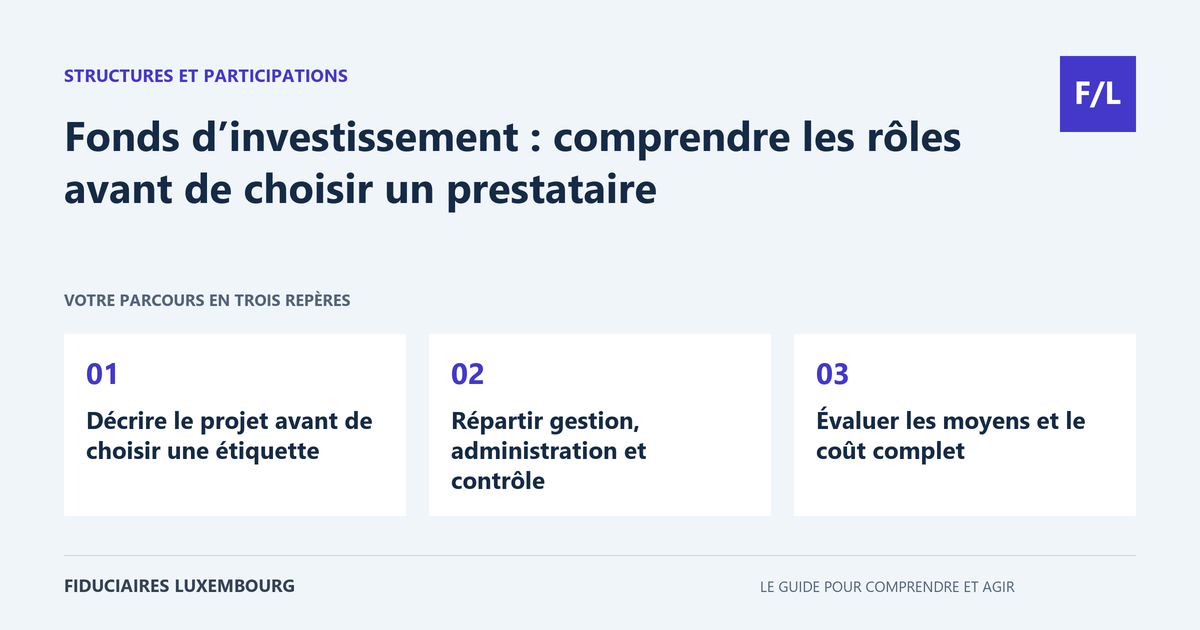
Describe the project before choosing a label
Identify the target investors, assets, countries and entry or exit arrangements. A liquid asset strategy and the holding of unlisted assets do not require the same organisation.
Also clarify financing, valuation and reporting requirements. These elements guide the assessment of the relevant regime; they should not be reconstructed after selecting an attractive acronym.
Allocate management, administration and control
Management covers the functions assigned to it by the applicable framework. Administration organises, in particular, data and operations in accordance with the mandate. The depositary has distinct duties, and audit serves its own purpose.
Ask each candidate for a written scope, the interfaces with other service providers and an escalation procedure in the event of missing data. Delegation must remain clear: who produces, who checks and who decides?
Assess resources and the full cost
Compare teams, systems, experience with the assets and business continuity. Define volumes, currencies, calculation frequency and reporting deadlines. Fees cannot be compared without these assumptions.
Quantify set-up fees, recurring fees and exceptional transactions. Provide for the cost of an exit or a change of service provider. A low initial price may exclude essential work from the contract.
Verify the official framework and documentation
CSSF pages make it possible to identify rules and procedures relating to managers and depositaries. Consult the regime corresponding to the exact project, without applying the obligations of one category to another.
Keep a structuring memorandum and the approved decisions. Documents intended for investors must be consistent with the planned operations. Assessing an investment and its risk remains separate from selecting the administrative service provider.
Compare three levels without mixing them up
Start with the legal form and constitutional documents: they organise, in particular, the rights of persons and decisions. Then identify the regime applicable to the product and the investors to whom it may be offered. Lastly, examine the status of the manager and the functions performed. A correct answer at only one level is not sufficient to validate the complete structure.
The CSSF presents several categories of management companies and alternative investment fund managers, with their own references. The structuring memorandum should state the framework selected and explain its suitability for the strategy. Also ask about marketing conditions in the countries actually targeted; do not confuse incorporation in Luxembourg with the possibility of offering units everywhere.
Our guide RAIF and FIAR explores a specific vehicle in greater depth. It is not the model for all funds. A company holding its own shareholdings, presented in the SOPARFI guide, should likewise not be treated as an investment fund without analysis.
Request a demonstration of the planned operation
Have a period-end closing described: data collection, position checks, cash reconciliation, calculations, validation and delivery of reports. The duties of the depositary remain separate from those of the administrator and manager. The same group may offer several services without their functions becoming interchangeable.
Request a list of information expected from portfolio companies or other partners. For complex assets, verify how supporting documents and valuation assumptions will be retained and discussed. Persons producing data must know to whom to report a correction after it has been transmitted.
Also test the departure of a service provider. Which documents, records and data will be returned? Who will ensure continuity during the transition? The guide on data exchanges with service providers provides general questions, to be supplemented by sector requirements. The final choice must take account of this continuity, the team’s resources and controls, in addition to the proposed price. Keep the volume assumptions used for the quote in order to understand costs when they change.
| Level | Subject of the analysis | Document to request |
|---|---|---|
| Form and governance | Rights, powers and decisions | Constitutional documents and organisation |
| Fund regime | Investors, assets and obligations | Product classification memorandum |
| Manager and service providers | Statuses, functions and responsibilities | Mandates and interface matrix |
| Distribution | Countries, target audiences and marketing conditions | Analysis tailored to the targeted markets |
Let us consider a practical case
Fictitious educational example, intended to explain the reasoning.
A team is considering a fund investing in unlisted companies. It specifies the holding period, the liquidity offered and the targeted investors. These elements enable professionals to compare possible structures and examine marketing. The vehicle’s accounting is only one part of the framework: valuation, risk management, safekeeping and disclosure must also find their place in the contracts and budget.
Points to prepare
- Investors, assets and liquidity defined.
- Product regime and manager distinguished.
- Interfaces and controls allocated.
- Full cost and exit assessed.
Frequently asked questions
Are all Luxembourg funds identical?
No. Their form, regime, investors and assets may differ significantly.
Does the presence of a depositary guarantee returns?
No. Its duties do not constitute a guarantee of performance or absence of loss.
Useful terms in this guide
Questions to ask the professional
- Which regimes apply to the product and its manager?
- Who assumes each function and how are the controls coordinated?
To clarify the scope of your request, also consult our guide on company formation.
And for your situation?
For an initial discussion, describe the assets, investors, envisaged liquidity and distribution countries. Request a team capable of coordinating structuring, administration and controls with the necessary regulated professionals. Search our directory for the professional suited to your needs, then ask them for an engagement and a detailed quote.
Sources and verification
References consulted on 20 September 2026. Official procedures specify the applicable conditions and exceptions.
- CSSF — cadre réglementaire des gestionnaires de fonds
- CSSF — missions du dépositaire
- CSSF — loi du 23 juillet 2016 sur les FIAR (traduction anglaise consolidée)
This guide explains a general process. The applicable rules depend on your situation; it does not constitute personalised advice. Report a correction.
Your next step
A specific need deserves the right contact
Accounting, taxation, company formation or payroll: prepare your questions, then search the directory for the professional who can review your situation. Check their assignments and status before entrusting them with your file.