Setting up an activity in Luxembourg requires linking the commercial project to tangible resources. An address, a structure and a bank account do not yet indicate where the activity is carried out or who manages it.
A business permit requires, in particular, premises and facilities suited to the activity where applicable. A domiciliation and operational premises meet different needs.
The framework to review
The registered office, place of business, tax residence and permanent establishment must be distinguished. The rules on permits, company law, taxation and social security must be reviewed according to the countries involved and the facts of the project.
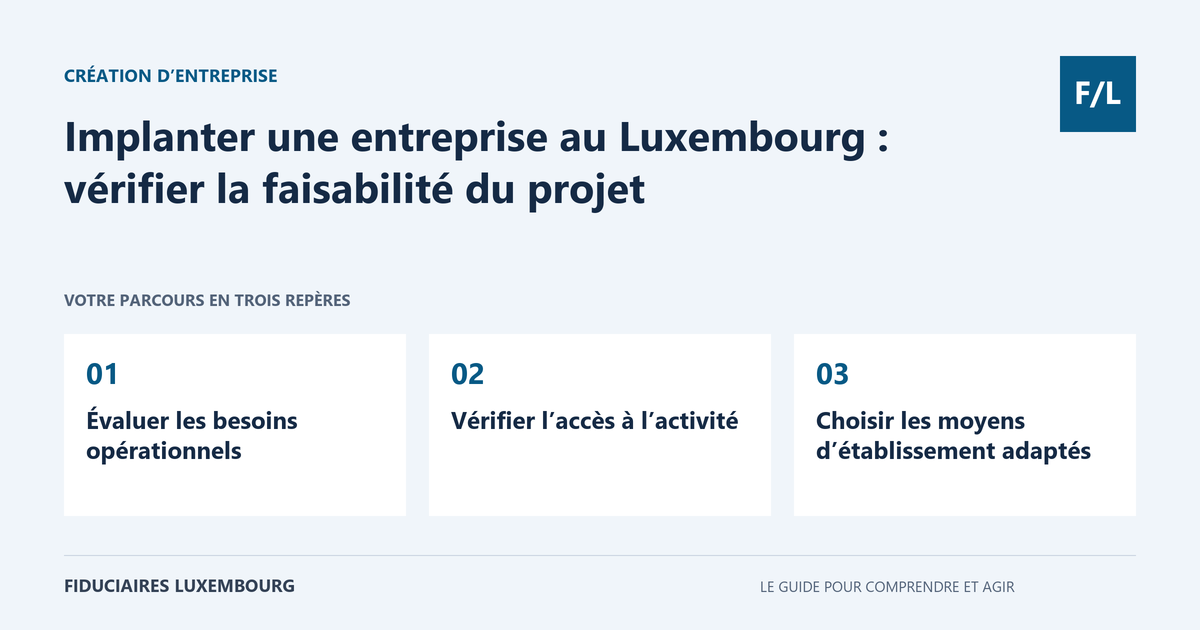
Assess operational needs
Describe the customers, suppliers, employees, workplaces and decisions to be made. Check the available skills, languages, access to premises and logistics. The choice of country must be linked to these practical needs.
Prepare a budget covering setup and operations. Compare rent, recruitment, tools, insurance and fees. Savings expected in one area may be offset by costs or constraints elsewhere.
Check access to the activity
Identify the permits, qualifications and conditions relevant to the project. The manager in charge of the activity must meet the applicable requirements and effectively perform their role.
Organise the timeline for the procedures before concluding that the business can start. Registration in a register does not amount to authorisation to carry out every activity. For a cross-border project, also identify the obligations that remain in the other countries.
Choose appropriate establishment resources
Domiciliation may meet certain situations provided for by law, but does not replace the premises and resources required by an activity. Have the contract, the status of the domiciliation agent and the services actually provided reviewed.
Document the organisation of decision-making, the availability of individuals and the tools. Questions of tax residence, permanent establishment and social security are governed by separate rules that must be compared with the facts.
Organise a measurable launch
Set out the steps: permits, incorporation, bank, accounting, VAT and initial operations. For each, identify the evidence of completion and the person responsible.
After the first few months, compare the budget with reality. Analyse sales, payment terms and fixed costs. This review makes it possible to adjust the project without waiting for the annual closing and provides the fiduciary with useful information for its support.
Write an operating brief before choosing the address
Describe a typical week of the activity: where people work, where customers are served, who negotiates contracts and who makes decisions. Add the equipment, travel and resources required. This factual description is more useful to your advisers than a general statement that the company will be “based in Luxembourg”.
Compare address services with the actual need. Receiving mail, making a meeting room available and regularly occupying premises are not equivalent. Request a detailed contract and have the specific conditions for domiciliation reviewed. The existence of an address contract does not by itself confirm that the requirements for an activity subject to authorisation are met.
At the same time, prepare the business permit application file. The information on the manager, qualifications and operational resources must describe the same organisation as the contracts and the budget. A change to the project may require several documents to be reviewed, not just one line in the business plan.
Coordinate countries and initial operations
If the founder, an employee or customers are abroad, draw up a list of cross-border facts: workplaces, days of presence, signing powers and invoiced flows. Send this same list to advisers in the countries concerned to avoid two analyses based on different versions of the project.
Cross-border teleworking illustrates why taxation and social security must be reviewed separately. For international services, the B2B services VAT file helps classify the flows. Neither the incorporation of the company nor its address automatically resolves these issues.
Finally, prepare a launch budget including one-off expenses, recurring costs and the resources actually available. If you subsequently change premises, the guide to changing the registered office helps organise the updates. Plan a review after the initial operations to compare the stated organisation with reality: people present, contracts signed, tools used and costs incurred. This review makes it possible to correct discrepancies early and keep the setup file consistent.
| Topic | Facts to describe | Question to have reviewed |
|---|---|---|
| Activity | Services and place of performance | Which permits and facilities? |
| Decisions | People, powers and locations | What management organisation? |
| Work | Statuses, presence and travel | Which tax and social security obligations? |
| Flows | Customers, contracts and payments | Which accounting and VAT treatments? |
Let us consider a practical case
Fictitious educational example, intended to explain the reasoning.
A foreign company wants to develop a customer base in Luxembourg with a local employee. It compares the methods of establishment, but must also describe the contracts, workplaces and powers of the employee. These facts may influence obligations beyond the choice of a subsidiary or a branch. A common file for advisers in the countries concerned helps identify discrepancies before commitments are signed or a start date is announced.
Points to prepare
- Activity and genuine establishment described.
- Permits and manager reviewed.
- Startup budget and financing prepared.
- Procedures and launch review planned.
Frequently asked questions
Is a Luxembourg address sufficient to carry out an activity?
No. The conditions for the activity, the tangible resources and the other applicable obligations must be reviewed.
Does setting up a company change the manager's personal residence?
Not automatically. The situation of the individual and that of the company must be analysed separately.
Useful terms in this guide
Questions to ask the professional
- What local resources are required for the planned activity?
- Which obligations must be coordinated with the country of origin?
To define the scope of your request, also consult our domiciliation and establishment file.
And for your situation?
Prepare a concrete description of your organisation, the budget and the countries concerned. Look for a contact person who can coordinate Luxembourg management with the other necessary advisers, specifying what their support covers. Search our directory for the professional suited to your needs, then ask them for an engagement and a detailed quote.
Sources and verification
References consulted on 20 September 2026. Official procedures specify the applicable conditions and exceptions.
- Guichet.lu — autorisation d’établissement
- Guichet.lu — domiciliation de sociétés
- Guichet.lu — business plan et prévisions financières
- ACD — conventions fiscales internationales
This guide explains a general process. The applicable rules depend on your situation; it does not constitute personalised advice. Report a correction.
Your next step
A specific need deserves the right contact
Accounting, taxation, company formation or payroll: prepare your questions, then search the directory for the professional who can review your situation. Check their assignments and status before entrusting them with your file.