The European company may be of interest for a project that extends beyond borders, but it requires careful consideration of the group’s organisation. Start with the operational reasons for the choice before comparing the formalities.
The SE is not a form that can be freely created from scratch. Guichet.lu describes several incorporation routes based on existing companies and a minimum capital of €120,000.
The framework to review
The SE is a form governed by a European framework and the applicable national provisions. Its incorporation routes, capital and employee involvement are subject to specific rules. An international dimension does not automatically make this form appropriate.
Start with the cross-border need
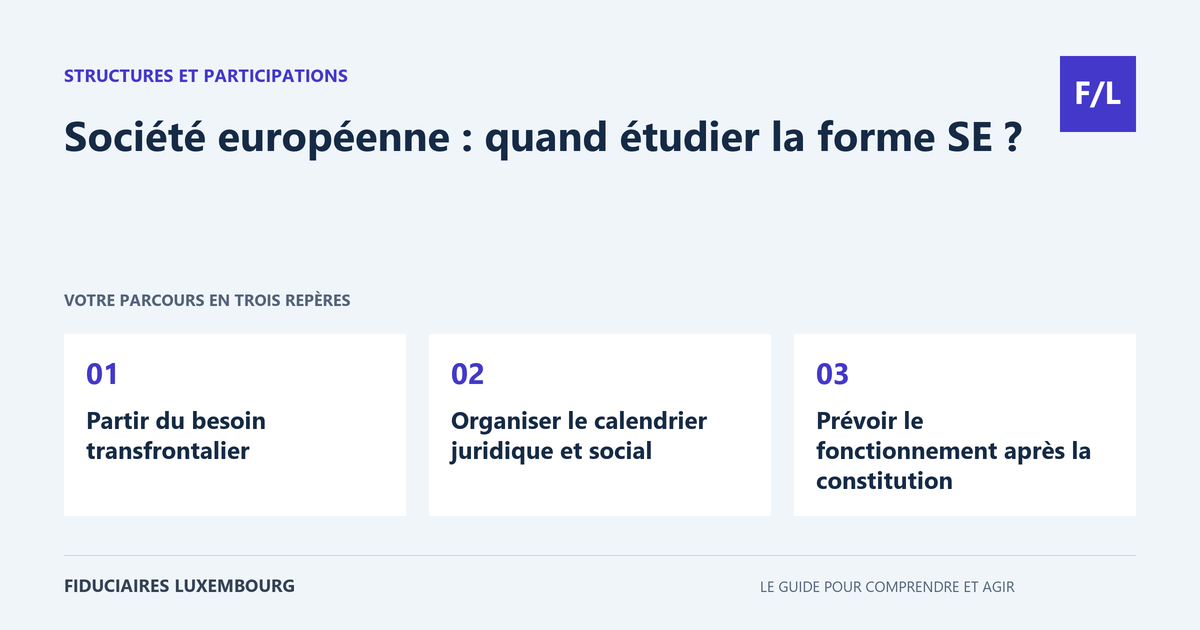
Identify what the structure needs to address: merger, holding company, joint subsidiary, conversion or mobility. The conditions differ depending on the route chosen and the history of the participating companies.
Compare the SE with national solutions before launching the project. A European designation does not automatically simplify authorisations, contracts, taxes or accounting obligations in each country of operation.
Organise the legal and social timetable
Incorporation involves specific instruments and formalities, including the issue of employee involvement. This aspect must be addressed during preparation and cannot be reduced to a last-minute formality.
Prepare the organisation chart, accounts, required decisions and list of stakeholders. The notary, legal advisers, experts from the countries concerned and relevant representatives must work to a common timetable.
Plan operations after incorporation
Define the governance bodies, delegations, conduct of meetings and expected financial documents. The organisation must reflect the reality of management and the activities carried out.
Transfer of the registered office does not eliminate tax consequences or the formalities to be completed. A transfer transaction must be considered in the States concerned, including its effects on assets, employees, contracts and establishments.
Assess the benefit in light of the costs
Estimate the preparation, advice, formalities and ongoing operating costs. Compare these costs with the intended operational benefit. A company without a concrete European need may find a national structure more suitable.
Request a feasibility memorandum before selecting the SE. It must set out the incorporation route, outstanding conditions, risks and alternatives. Accounting supports the transaction but does not replace its legal validation.
Request a feasibility memorandum before setting the incorporation timetable
Describe the participating companies, their form, their country and their history. Specify the contemplated transaction and the intended operational outcome. The feasibility memorandum must link these facts to an admissible incorporation route, then distinguish between conditions already met and those requiring further work.
Compare several possible organisations using the same criteria: shareholders’ rights, management, financing, employees and costs. A national structure may meet certain cross-border needs; an SE may offer a different benefit. The guide to forms and incorporation provides a general preparation framework, to be supplemented by specialised analysis of the group.
Request a timetable with dependencies. Certain steps require decisions or documents produced in another country. The date sought by the commercial team must not be presented as a guaranteed incorporation date before this review.
Prepare governance and employee involvement together
The SE may adopt a one-tier or two-tier structure. Describe in practical terms the envisaged bodies, their composition, their information and their decisions. The aim is not merely to choose a framework in the articles of association, but to understand how a significant transaction will be prepared, authorised and monitored.
The social aspect must be prepared from the outset of the project. The official presentation describes a special negotiating body responsible for discussing employee involvement with management. Gather information on headcount, countries, companies and existing participation arrangements. Have the rules suited to the method of incorporation reviewed, particularly where a company is converted.
Then organise financial operations: information for the bodies, closing procedures, accounts, cash management and coordination with group entities. The file on intra-group transactions helps document flows; the file on establishing in Luxembourg helps describe the actual resources. A European form does not make these issues secondary. If a transfer of registered office is contemplated, request a specific analysis of the timetable and consequences in both States, without following the process applicable to a simple change of local address.
| Question | Required data | Expected deliverable |
|---|---|---|
| Incorporation route | Forms, countries and history of the participating companies | Legal feasibility memorandum |
| Governance | Desired bodies and decisions | Proposed organisation and powers |
| Employees | Headcount and existing participation | Social process and timetable |
| Operations | Flows, resources and obligations by country | Budget and allocation of responsibilities |
Let us consider a practical case
Fictional educational example intended to explain the reasoning.
A group operating in several countries is considering a common structure. It must compare the SE with other options, taking into account governance, employees and the possible method of incorporation. A Luxembourg registered office alone does not resolve the obligations relating to activities carried out elsewhere. The decision file must therefore describe the intended operations and local constraints before estimating costs or launching the legal timetable.
Points to prepare
- Cross-border objective explained.
- Admissible incorporation route identified.
- Social aspects and governance prepared.
- Budget and alternatives compared.
Frequently asked questions
Can one person directly create an SE alone?
The SE is incorporated through specific routes involving existing companies. The conditions of the contemplated transaction must be reviewed.
Does the SE unify all European taxation?
No. National tax rules and obligations still need to be reviewed according to the activities and countries.
Useful terms in this guide
Questions to ask the professional
- Which incorporation route is appropriate for the existing group?
- What are the consequences for governance and employees?
To clarify the scope of your request, also consult our company incorporation file.
What about your situation?
To consider an SE, prepare the group organisation chart and the precise objectives of the change. Seek stakeholders able to coordinate company law, social aspects and financial organisation in the countries concerned. Search our directory for the professional suited to your needs, then ask them for an engagement and a detailed quote.
Sources and verification
References consulted on 20 September 2026. Official procedures specify the applicable conditions and exceptions.
This guide explains a general process. The applicable rules depend on your situation; it does not constitute personalised advice. Report a correction.
Your next step
A specific need deserves the right contact
Accounting, taxation, company formation or payroll: prepare your questions, then search the directory for the professional who can review your situation. Check their assignments and status before entrusting them with your file.