The term SOPARFI often appears as soon as a project involves shareholdings. To understand its relevance, let us put the concepts in their proper place: a company, investments, flows and tax rules to be reviewed together.
SOPARFI is not synonymous with a general exemption. The treatment of dividends, disposals, financing and distributions depends on specific conditions.
The framework to review
SOPARFI refers to a financial holding company; it is neither an independent legal form nor a general exemption. SARL or SA, in particular, have their own incorporation and governance rules. The regimes applicable to dividends and capital gains have separate conditions.
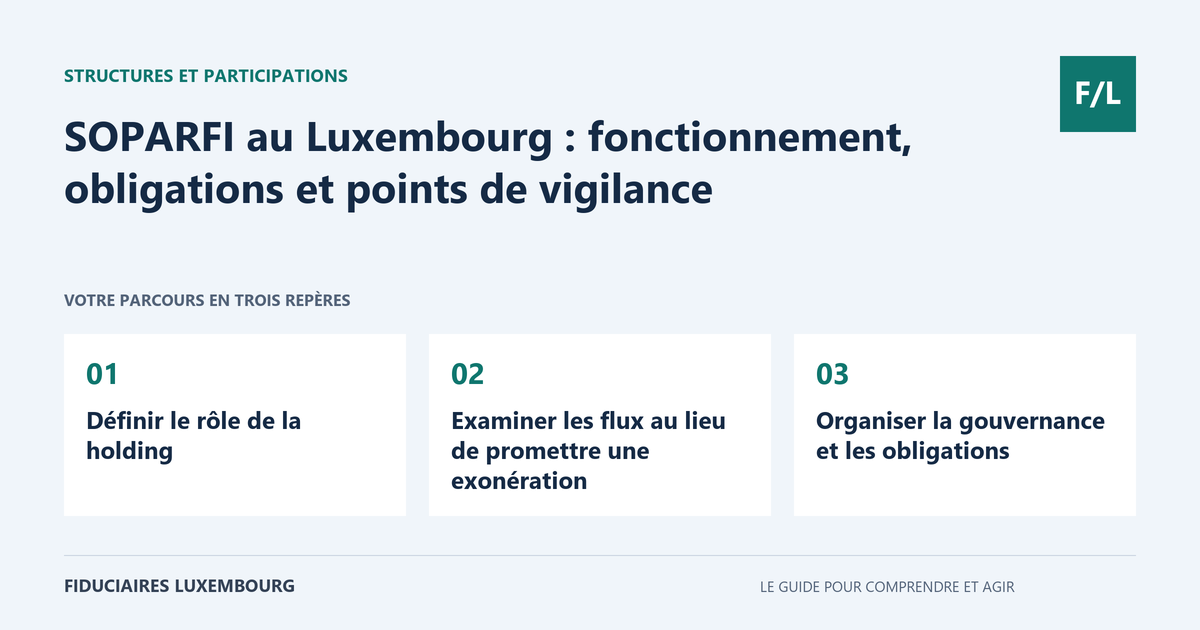
Defining the role of the holding company
Describe the shareholdings the company is to hold and the decisions it is to make: acquisition, management of subsidiaries, financing or transfer. Then choose the appropriate legal form, for example a SARL or an SA, with the relevant professionals.
The project must have understandable operational logic. Draw up the group chart, identify the beneficial owners and describe the countries of residence. Distinguish between the functions actually performed in Luxembourg and those carried out elsewhere.
Reviewing flows rather than promising an exemption
Separate received dividends, disposal capital gains, interest and distributions to shareholders. The parent-subsidiary regime may exempt certain income if the conditions are met. The rules for one category of flow do not automatically apply to another.
The analysis must cover the characteristics of the companies, the shareholding, the holding period and the applicable restrictions. The country from which income originates and the beneficiary's country of residence may also be relevant. Request a memorandum setting out the conditions, evidence and circumstances that would change the conclusion.
Organising governance and obligations
Specify who makes decisions, signs, oversees investments and keeps documents. An address or a domiciliation agreement alone does not prove that management is genuinely carried out. Financing agreements, invoicing and intra-group decisions must correspond to identifiable transactions.
The company must maintain its accounting records, comply with its tax obligations and complete the applicable registration formalities. The exact scope of the PCN, the accounts to be filed and statutory audit requirements must be reviewed according to the entity. The absence of commercial turnover does not mean the absence of obligations.
Costing the project and its exit
Prepare an incorporation and operating budget: administration, accounting, advice, banking, premises or domiciliation, and any audit. Add a disposal, distribution or liquidation scenario. A structure may be easy to create but costly to maintain or unwind.
Before deciding, compare this budget with the group's actual needs. The accounting firm organises the follow-up; legal, cross-border and financing matters must be assigned to competent professionals. No standard arrangement replaces this review.
Keeping a tracking sheet for each shareholding
Open a file for each subsidiary: identity, country, activity, legal form, percentage held, acquisition cost and transaction dates. Attach the deeds, decisions and payment evidence. This sheet makes it possible to link the accounts to the facts underpinning the tax analysis. A capital change at the subsidiary may change the percentage held without the holding company itself having bought or sold shares.
The guide to the parent-subsidiary regime explains why the conditions for dividends and capital gains must be checked separately. Record holding commitments and the supporting documents expected. When a transaction is proposed, consult this sheet before signing: a commercial decision may affect an anticipated tax treatment.
Do not confuse the value of shares, available cash and distributable income. A shareholding may have a high value without generating cash receipts this year. Build the budget based on the flows actually expected and identify distributions that are still subject to a decision.
Organising a year-end closing that tells the group's story
The annual file must explain acquisitions, disposals, distributions, financing and changes in governance. Prepare a reconciliation of reciprocal balances with subsidiaries. If two companies do not record the same amount, have the cause identified: timing difference, currency, interest or missing document.
For loans and other related-party transactions, retain the agreements and evidence supporting the economic terms. The transfer pricing file addresses this issue; interest deductibility is a separate review. A signed agreement is not sufficient to conclude that all expenses are tax deductible.
Finally, request a timetable that links accounts, returns and decisions of the competent bodies. Monitoring net wealth tax and preparing a dividend distribution must not be overlooked in favour of the year's result alone. Assign each task: who collects the documents, who prepares the analysis and who validates the decision. This enables the manager to retain a clear view of outstanding files.
| Flow | Evidence file | Issue to address |
|---|---|---|
| Dividend received | Shareholding, decision and payment | Regime conditions and withholding tax |
| Disposal of shares | History and disposal deed | Gain or loss and tax treatment of the exit |
| Intra-group loan | Agreement, interest and balances | Economic terms and deductibility |
| Distribution to shareholders | Accounts and proposed decision | Distributable amount and treatment of the beneficiary |
Let us consider a practical case
Fictitious educational example intended to explain the reasoning.
An entrepreneur wishes to hold two subsidiaries and receive their dividends. Before incorporation, they describe the percentages held, the countries, the activities and the financing. The professional can then review each flow, the conditions of the regimes relied upon and the management resources required. If a shareholding or country changes, the analysis may need to be revisited. The useful file is therefore a documented map of the group, not simply a request to create an « advantageous holding company ».
SARL, SA, SOPARFI, SPF: what are we talking about?
| Concept | What it describes | What it does not prove |
|---|---|---|
| SARL or SA | A legal form, with its capital and governance rules. | The automatic eligibility of income for an exemption. |
| SOPARFI | A financial holding company subject to ordinary law. | An independent form or a status exempt from all taxes. |
| SPF | A regulated wealth management regime, with conditions relating in particular to investors and activities. | A solution interchangeable with a commercial company or any holding company. |
To choose, start with the investors, assets and expected flows. The legal structure and tax treatment must then be reviewed together. The SPF guide details the comparison process.
Points to prepare
- Formalised economic objective and group chart.
- Flows and tax conditions analysed separately.
- Effective management and responsibilities documented.
- Annual cost and exit scenario quantified.
Frequently asked questions
Is a SOPARFI always exempt?
No. Any exemptions concern flows or shareholdings that meet conditions. The company retains its own obligations.
Is domiciliation sufficient to establish substance?
No. The functions, resources, decisions and rules applicable to the actual situation must be reviewed.
Useful terms in this guide
Questions to ask the professional
- Which flows are taxable and which conditions must be demonstrated?
- Which decision-making and management resources correspond to the structure?
To clarify the scope of your request, also consult our tax section.
And for your situation?
To review your holding company, bring the group chart, shareholding sheets and planned flows. Request an annual budget and an allocation of accounting, tax and legal assignments that also covers exceptional transactions. Search our directory for the professional suited to your needs, then ask them for an assignment proposal and a detailed quote.
Sources and verification
References consulted on 20 September 2026. Official procedures specify the applicable conditions and exceptions.
- Guichet.lu — régime des sociétés mères et filiales
- Guichet.lu — société à responsabilité limitée
- Guichet.lu — domiciliation de sociétés
- Guichet.lu — dépôt des comptes annuels au RCS
This guide explains a general process. The applicable rules depend on your situation; it does not constitute personalised advice. Report a correction.
Your next step
A specific need deserves the right contact
Accounting, taxation, company formation or payroll: prepare your questions, then search the directory for the professional who can review your situation. Check their assignments and status before entrusting them with your file.