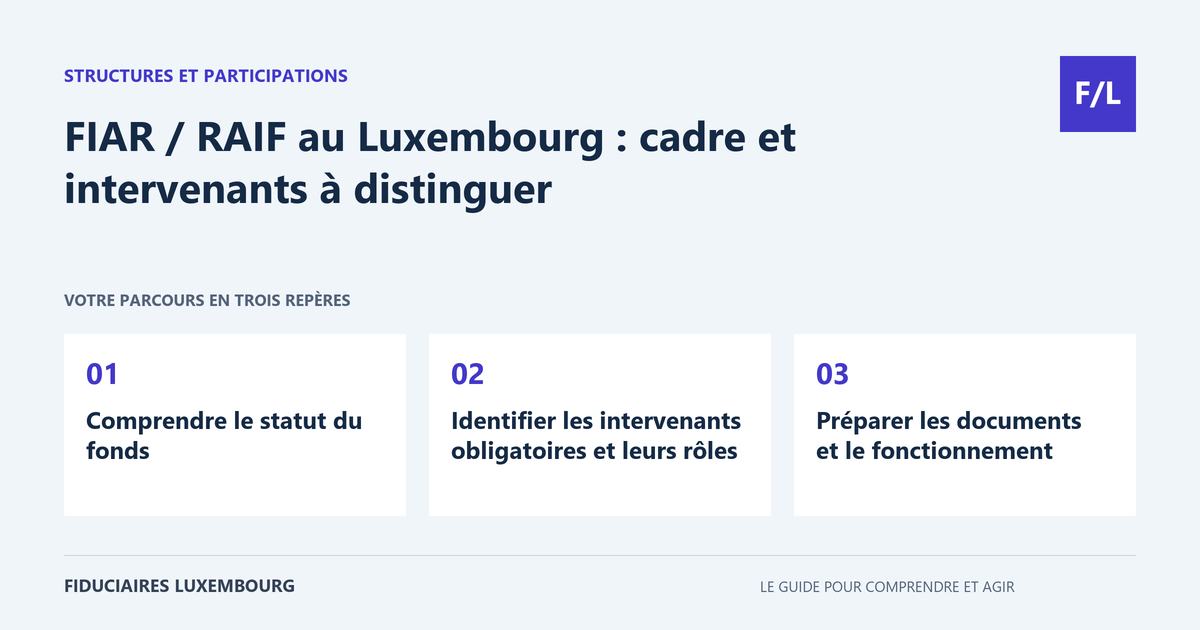
The RAIF is often referred to for its flexibility. To understand what this means, let us focus on the required parties, the investors concerned and the controls surrounding the vehicle.
Distinguish the fund, its manager, its depositary and its auditor. Accounting administration does not replace any of their functions.
The framework to review
The absence of direct approval of the product by the CSSF does not mean the absence of a regulatory framework. The authorised alternative investment fund manager and the other required parties play decisive roles. The conditions must be analysed for the selected structure.
Understanding the fund's status
The FIAR, often referred to by its English acronym RAIF, is governed by the law of 23 July 2016. The text published by the CSSF specifies that the fund itself is not subject to the supervision of a Luxembourg authority. This particular feature must be understood in conjunction with the rest of its framework.
It is a specialised vehicle, intended for investors eligible for the regime, rather than an ordinary investment account. The qualification as an alternative fund and the rules specific to the vehicle must be reviewed with the project's advisers.
Identifying the mandatory parties and their roles
The framework notably provides for the involvement of an authorised external manager. The manager and the fund are two entities whose functions must not be confused. The depositary and the auditor also have their own duties.
Establish a responsibility matrix: management, valuation, central administration, investor register, reporting and safekeeping of assets. The existence of an administrative service provider does not mean that it makes all investment decisions.
Preparing the documentation and operations
The documentation must make it possible to understand the strategy, risks, fees, liquidity and subscription rules. Valuation arrangements must be suited to the assets and consistent with the information provided to investors.
Before launch, test data exchanges between the parties, error management and closing deadlines. Illiquid or complex assets require an organisation that cannot be reduced to producing a periodic value.
Defining the role of a fiduciary firm
A firm may provide administrative or accounting services within the scope it is authorised and organised to cover. Check its experience, the persons assigned and its coordination with the other service providers.
The choice of vehicle, its marketing and investors' rights require dedicated legal and regulatory analysis. This guide provides a preparation framework; it recommends neither a fund nor an investment strategy.
Preparing the first operating cycle before launch
Describe a complete transaction: an investor's commitment, capital call, receipt of payment, acquisition, valuation and periodic information. At each stage, identify the data produced, its recipient and the person who validates it. Repeating this exercise with an example makes it possible to detect a missing field or an ambiguous responsibility before processing an actual transaction.
The fund depositary should not be reduced to a bank account. The CSSF distinguishes between asset safekeeping, oversight and cash flow monitoring. Ask how the information it needs will be transmitted for the contemplated assets. A portfolio of unlisted holdings notably requires different documents from those for a portfolio of securities traded on a market.
Provide for situations where data arrive late: missing accounts of a holding, a disputed valuation or an unreconciled transaction. The contract must clearly set out escalation, validations and communication between the parties. A calculation date entered in a calendar does not guarantee that the information will be sufficiently reliable on that date.
Linking fees and liquidity to the stated strategy
The budget must distinguish between launch, regular operations and exceptional events. Ask which services are covered by annual minimum fees, which volumes are included and what triggers additional billing. Compare offers using the same assumptions regarding compartments, classes, investors, currencies and processing frequency.
Then consider the consistency between the assets and the exit options presented to investors. An asset that is difficult to sell does not become liquid simply because a valuation is calculated regularly. Have the contractual arrangements, risks and information to be communicated reviewed by qualified advisers. This review is not a forecast of the fund's performance.
To place the RAIF in its environment, consult our investment funds guide. To prepare beneficial ownership and control documentation, the RBE file provides a general starting point to be adapted to the vehicle. Finally, keep a record of structuring decisions: it will enable new parties to understand the choices made and the matters requiring a new review if the strategy evolves.
| Stage | Expected information | Control question |
|---|---|---|
| Subscription | Investor file and contractual documents | Have the admission conditions been verified? |
| Acquisition | Contracts and data on the assets | Who validates and who informs the depositary? |
| Valuation | Data, method and assumptions | How should missing items be handled? |
| Information | Reports, fees and decisions | Who verifies consistency before distribution? |
Let us consider a practical case
Fictitious educational example, intended to explain the reasoning.
A promoter wishes to bring together investors around a real estate strategy. Before selecting a RAIF, it describes the assets, liquidity, investors and marketing countries. It then engages with specialised parties regarding management, the depositary, administration and audit. The timetable depends on the availability and acceptance of these parties as much as on the incorporation documents. A useful budget must incorporate their ongoing operations.
Points to prepare
- Vehicle qualification and eligible investors reviewed.
- Manager, depositary and auditor identified.
- Valuation, risks and liquidity documented.
- Responsibilities and exchanges tested.
Frequently asked questions
Does not supervised mean not regulated?
No. The product is subject to a law and a set of obligations, with parties subject to their own framework.
Can a fiduciary firm replace the manager?
The manager's function is subject to distinct requirements. An accounting contract does not replace it.
Useful terms in this guide
Questions to ask the professional
- Which parties are mandatory for our structure?
- Which investors and distribution countries are targeted?
To clarify the scope of your request, also consult our company formation file.
And for your situation?
To discuss a RAIF project, prepare the strategy, targeted investors, countries concerned and operating model. Seek support from someone with experience of these vehicles and able to work with the manager, depositary and legal advisers. Search our directory for the professional suited to your needs, then ask them for an engagement and a detailed quote.
Sources and verification
References consulted on 20 September 2026. Official procedures specify the applicable conditions and exceptions.
- CSSF — loi du 23 juillet 2016 sur les FIAR (traduction anglaise consolidée)
- CSSF — cadre réglementaire des gestionnaires de fonds
- CSSF — missions du dépositaire
This guide explains a general process. The applicable rules depend on your situation; it does not constitute personalised advice. Report a correction.
Your next step
A specific need deserves the right contact
Accounting, taxation, company formation or payroll: prepare your questions, then search the directory for the professional who can review your situation. Check their assignments and status before entrusting them with your file.