An SARL is not managed solely by keeping its accounts up to date. Decisions, powers and corporate documents must also remain clear. This guide helps organise this monitoring before an urgent signature reveals an uncertainty.
The limited liability of partners does not mean there is no personal risk in every situation. Personal commitments and management liabilities must be examined separately.
The framework to review
The powers of managers, partners’ decisions and formalities depend in particular on the law, the articles of association and the transaction. An internal signing rule should not be confused with all effects vis-à-vis third parties. Important agreements warrant a separate review.
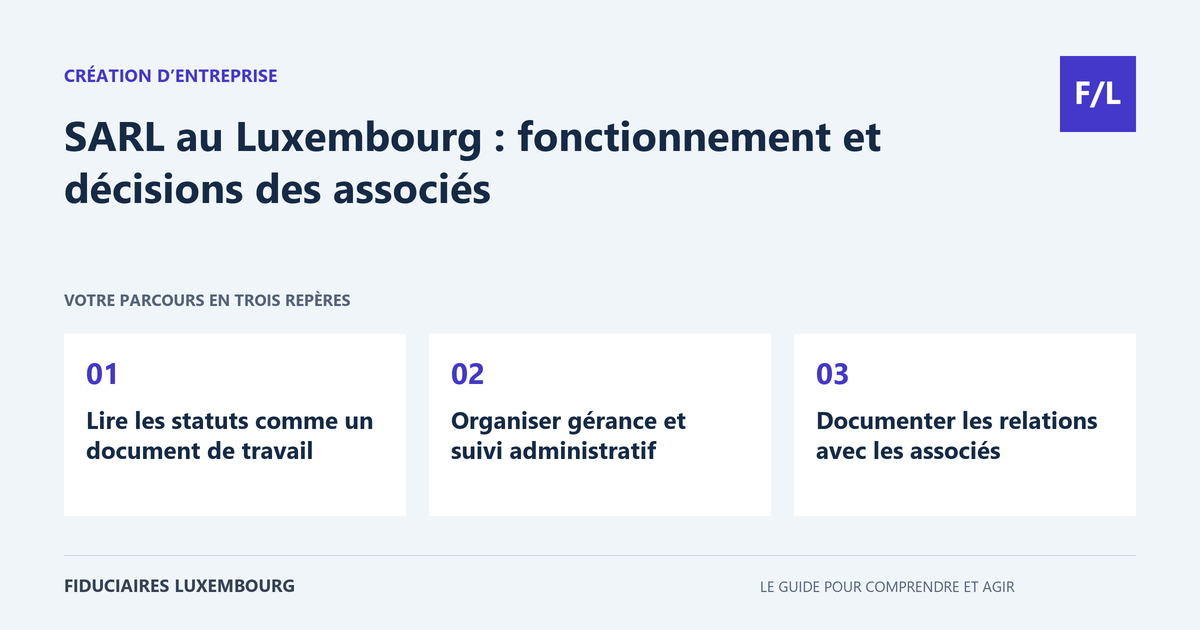
Read the articles of association as a working document
The articles of association specify the corporate purpose, capital, partners and organisational rules. Check who can bind the company, how decisions are made and which transactions require authorisation.
A clause must reflect the reality of the project. If two partners must decide together, anticipate disagreements. If an investor joins later, check the entry arrangements. The rules should not be discovered at the time of an emergency.
Organise management and administrative follow-up
Determine the relevant powers, delegations and access rights. A bank signing authority, an administrative mandate and a power of representation are not necessarily equivalent. Keep the decisions and documents that substantiate them.
Set a timetable for the accounts, approval and filings. The allocation of tasks with the fiduciary must keep visible the approvals falling within the remit of the managers and partners. An administrative service is not a general substitute for the company’s corporate bodies.
Document relationships with partners
Distinguish contributions, advances, remuneration and distributions. Each flow must have an appropriate classification, decision or agreement, and consistent accounting treatment. The company’s bank account must not be used as a personal cash account.
Before a repayment, transfer of shares or distribution, have the conditions and consequences reviewed. The company’s cash-flow needs must be considered together with the transaction, even where an accounting profit appears positive.
Prepare significant changes
A change of manager, registered office, corporate purpose or shareholding may require decisions and formalities. Organise their sequence and the updating of registers, banks, contracts and authorisations.
Ask the professional for a list of steps and evidence to retain. The proper management of an SARL relies on this continuity: legal, accounting and operational information must remain consistent throughout changes.
Maintain a corporate file that enables quick responses
Gather in an identifiable file the current articles of association, appointments, delegations, partners’ decisions and evidence of formalities. File previous versions as such rather than allowing them to compete with the applicable document. Add a summary sheet of authorised persons and points to check before an important transaction.
This file does not replace legal analysis; it makes it possible. Before a bank signature, a guarantee or an unusual agreement, compare the request against existing powers and any required authorisations. A person with technical access to a portal does not necessarily have the legal authority to make the corresponding decision.
The guide to RCS and RESA formalities helps distinguish between a decision, filing and publication. If the persons exercising control change, also have the RBE reviewed. A transaction may require several updates that do not automatically trigger one another.
Ensure that each movement of money is supported by an explanation
A payment by a partner may correspond to a contribution, an advance or another documented transaction. Keep the document that makes it possible to understand the classification adopted. Our guide to the partner current account details the questions to ask regarding advances and repayments; the guide on capital increases addresses a different transaction.
For an outgoing payment, also ask which instrument justifies it. Remuneration, expense reimbursement and a dividend are not treated in the same way. The guide on manager remuneration and dividends helps prepare this discussion. Avoid seeking a classification only after payment has been made.
Finally, organise the year around the accounts and the decisions they allow. The preparation for the approval of the accounts must bring together the necessary documents and proposals, then retain the decisions made. Have the timetable applicable to your company confirmed and coordinate the participants. A clear list of missing documents is better than a deadline assumed to be handled by another contact.
| Event | To review beforehand | To retain afterwards |
|---|---|---|
| Appointment or departure of a manager | Powers and decision-making rules | Instrument, formalities and updated access rights |
| Advance by a partner | Nature, terms and cash flow | Agreement and traceability of movements |
| Proposed distribution | Accounts, distributable amounts and taxation | Decision and evidence of treatment |
| Change of control | Articles of association, agreements and beneficial owners | Formalities and updated corporate file |
Let us look at a practical case
Fictitious educational example, intended to explain the reasoning.
A partner wishes to leave the company while financing is under way. The file requires rereading the articles of association, the rights of the other partners, the powers and the banking commitments. The contemplated transfer may require decisions and formalities going beyond a simple change of contact details. A register of decisions and an up-to-date statutory file make it possible to prepare the discussion with legal counsel and the accounting firm on the same basis.
Points to prepare
- Articles of association and powers understood.
- Decisions and delegations retained.
- Flows with partners identified.
- Changes reflected in registers and access rights.
Frequently asked questions
Is a partner automatically a manager?
No. The status of partner and that of manager must be distinguished, even where one person holds both roles.
Can the entire bank balance be distributed?
The bank balance does not measure distributable amounts. The accounts, necessary decisions and the company’s needs must be reviewed.
Useful terms in this guide
Questions to ask the professional
- Who can decide on and sign the contemplated transaction?
- Which documents must be updated and which formalities follow?
To define the scope of your request, also consult our guide on company incorporation.
And for your situation?
If a decision is approaching, start by gathering the articles of association, powers and transaction documents. Ask the professional to identify the necessary approvals and formalities, then to organise the related accounting follow-up. Search our directory for the professional suited to your needs, then ask them for an engagement and a detailed quote.
Sources and verification
References consulted on 20 September 2026. Official procedures specify the applicable conditions and exceptions.
- Guichet.lu — société à responsabilité limitée
- Guichet.lu — dépôt des comptes annuels au RCS
- Guichet.lu — déclaration des bénéficiaires effectifs
This guide explains a general process. The applicable rules depend on your situation; it does not constitute personalised advice. Report a correction.
Your next step
A specific need deserves the right contact
Accounting, taxation, company formation or payroll: prepare your questions, then search the directory for the professional who can review your situation. Check their assignments and status before entrusting them with your file.