An employee informs you that they are unable to work. What must you record, submit and check? The administrative monitoring of sick leave involves several exchanges, whose recipients and deadlines are not identical. A clear procedure helps manage the absence and payroll without requesting unnecessary medical information. Here are the key points to share with your team and payroll manager.
The framework to check
The employee must notify the employer on the day of the incapacity and submit the certificate no later than the third day of absence. This deadline must not be confused with the deadlines for sending documents to the CNS, which are expressed under its own rules, in particular in working days. Continued salary payment and coverage by the CNS are based on the rules applicable to incapacity. A difficulty with a declaration does not automatically justify a suspension of salary or the possibility of dismissal.
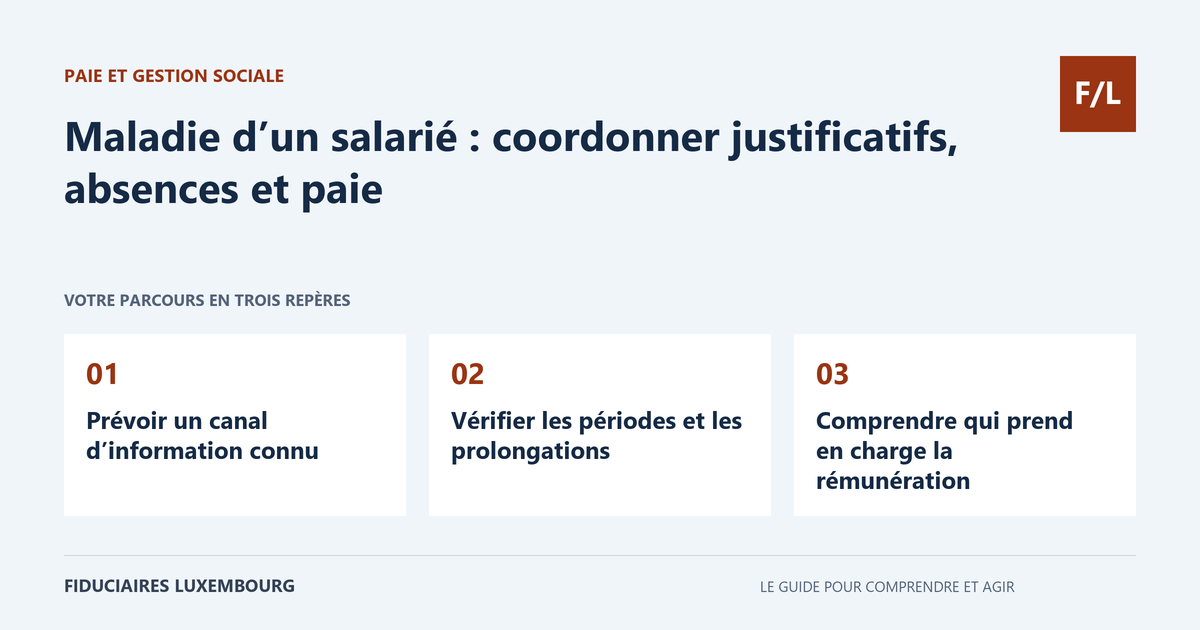
Provide a known communication channel
Tell the employee whom to notify of their absence and how to contact a replacement if their manager is unavailable. The procedure must remain easy to use in an unexpected situation. Record the date and information useful for organisational purposes, without requiring the diagnosis or details of medical treatment in a shared table.
Distinguish between the notification message and the certificate intended for the employer. Their receipt does not serve the same purpose. An internal rule may organise the channel, but it must not obscure legal rules. If a document is missing or arrives late, have the specific situation reviewed rather than applying an automatic penalty in the software.
Check periods and extensions
Record the start and end of the certified period, the date of receipt and any extensions. Compare the periods to identify an overlap, a gap or an incorrect entry. An extension must not be classified as an independent document unrelated to the initial sick leave; the person responsible for payroll must understand the timeline.
The employee also has their own obligations towards the CNS. Submission to their manager does not prove that it was sent to the fund. Clearly state the recipients without implicitly taking responsibility for a procedure that has not been entrusted to you. Digital systems must be used in accordance with their conditions; do not assume that every certificate issued in any country is automatically transmitted.
Understand who bears the cost of remuneration
Continued salary payment does not operate like a fixed number of days reset every January. The CNS explains the reference point of 77 calendar days of incapacity and the rolling 18-month reference period. The cost remains with the employer until the end of the month in which the threshold is reached, within the applicable framework; payroll must therefore not be stopped mechanically on the 78th day.
Monitor the changes in responsibility communicated by the CNS and reconcile them with the declarations. Weekends and public holidays included in the periods may count in the calendar-day calculation, while payroll hours follow their own logic. In the event of disagreement, prepare the record of periods and supporting documents rather than changing a total without explanation.
Provide the right data to payroll
Prepare a table of periods, extensions and coverage information, with the documents required by each party. The manager must distinguish the absence, the hours concerned and responsibility for payment. The same period must not be processed both as paid by the employer and compensated by the fund without reviewing the situation.
Include this information in the monthly payroll variables and monitor declaration feedback. The CCSS and the CNS perform distinct functions. Receipt of a certificate does not exempt the employer from the monthly declaration for which it is responsible; a file sent does not guarantee that all its lines are accepted.
Prepare the return to work and keep a limited file
Upon return to work, check the date actually communicated and any occupational health procedures or specific arrangements to be reviewed. A gradual return to work for therapeutic reasons must be handled within its own framework, with the relevant decisions and information. Do not improvise a distribution of working time based solely on an informal discussion.
File supporting documents with appropriate access rights and a retention period determined according to their purpose and the applicable rules. The manager may need to know about the absence and the organisation of the return to work without consulting all administrative documents. Also prepare a periodic review of open periods so that an expired certificate does not continue to generate an absence in the system.
The table to take action
| Monitoring | What to check | Confusion to avoid |
|---|---|---|
| Employer notification | Date of notification and recipient | Message treated as equivalent to all supporting documents |
| Certificates and CNS | Periods, extensions and relevant procedures | Sending to the employer assumed to constitute sending to the CNS |
| Payroll and declarations | Hours, periods and responsibility for payment | Calendar-day calculation confused with hours |
| Return to work | Date and any particular framework | Previous period left open |
An annual counter would have given the wrong answer
Fictitious example: in January, an internal table resets all sick days to zero. The payroll manager notices that this counter does not make it possible to track the rolling period needed to understand responsibility for payment. The company reconstructs prior periods and reconciles them with the information received from the CNS. It corrects its tool to retain dates rather than storing only an annual total. The example does not calculate an individual benefit: it shows why the data structure matters as much as the displayed total for properly managing the following months.
Your preparation checklist
- Specify the channel and replacement person to notify.
- Date the notification and receipt of documents.
- Link each extension to its period.
- Distinguish employer deadlines from CNS procedures.
- Keep the dates necessary for rolling monitoring.
- Check information on responsibility for payment.
- Process payroll and declaration feedback consistently.
- Prepare the return to work and restrict access to documents.
Frequently asked questions
Is the deadline for the employer the same as that for the CNS?
The rules and recipients are distinct. The CNS calculation in working days must not be applied to all obligations towards the employer.
Must salary be stopped exactly on the 78th day?
No. The mechanism takes account of the month in which responsibility changes and the rolling calculation. Coverage information must be monitored.
Must the manager know the diagnosis?
Administrative organisation must be limited to the necessary data. Detailed medical information does not need to appear in a shared schedule.
Useful terms in this guide
Questions to ask the professional
- Does our monitoring retain complete periods and extensions?
- Who reconciles the data with CNS notices?
- How can a discrepancy be corrected without creating duplicate processing?
To clarify the assignment to be entrusted, also consult our payroll and social administration section.
And for your situation?
Prepare a chronological record and coverage information before requesting a review. To ensure reliable administrative monitoring and payroll, search our directory for a professional accustomed to coordinating these exchanges, with a clearly defined scope of assignment.
Sources and verification
References consulted on 20 September 2026. Official procedures specify the applicable conditions and exceptions.
- ITM — information de l’employeur en cas de maladie
- CNS — déclaration d’incapacité du salarié
- CNS — indemnité de maladie des salariés
- CCSS — déclaration des rémunérations
This guide explains a general process. The applicable rules depend on your situation; it does not constitute personalised advice. Report a correction.
Your next step
A specific need deserves the right contact
Accounting, taxation, company formation or payroll: prepare your questions, then search the directory for the professional who can review your situation. Check their assignments and status before entrusting them with your file.