The schedule shows five days remaining, but the payslip shows eight. Before choosing the figure that appears most recent, trace its origin. A useful balance must show entitlements, leave taken and adjustments, together with the decisions that explain them. Here is a method for tracking leave without turning a simple software calculation into an automatic legal answer.
The framework to check
The legal minimum annual leave is 26 working days for a full year under the applicable regime, with adjustments in particular for working time and the periods concerned. More favourable entitlements may result from an agreement or collective agreement. Carry-overs depend on their cause and the applicable rules: 31 March is not a universal expiry date. Leave cannot be freely replaced by payment during the employment relationship.
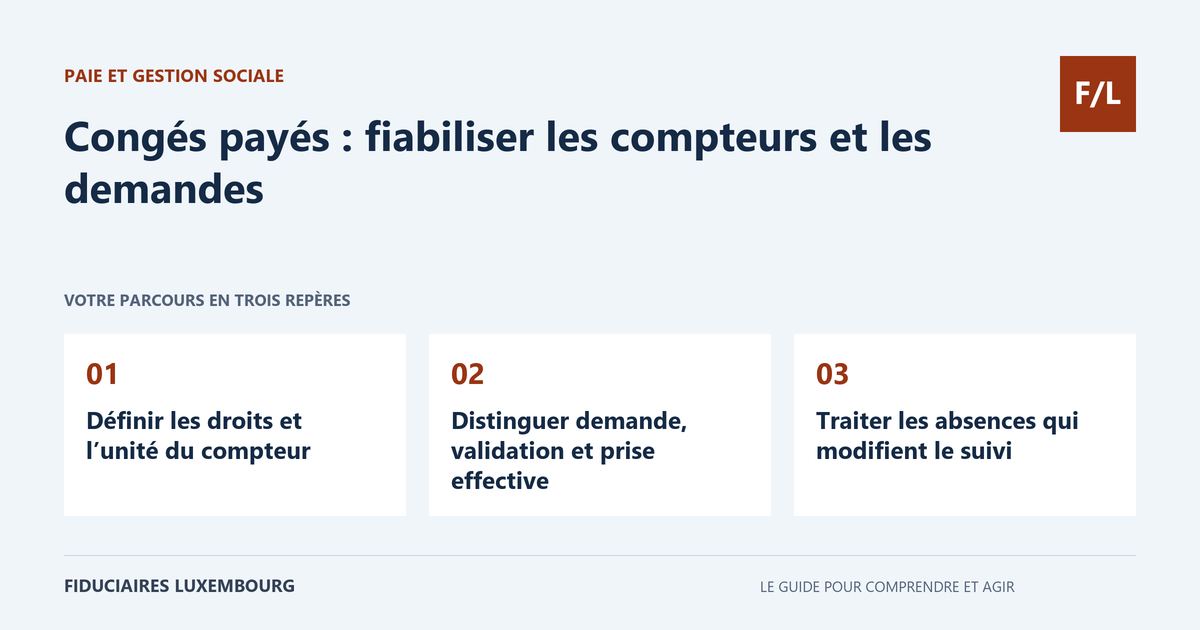
Defining entitlements and the balance unit
Review the contract, working time, start date and the applicable collective agreement. Identify any additional entitlements. A standard figure copied for the entire team may overlook part-time work, a start date during the year or a more favourable rule. Have the parameters validated before reviewing the history.
Choose a unit that allows actual working patterns to be handled correctly. Tracking in hours can make matters easier to understand where days are not all the same length, provided that conversion is consistent with entitlements. Do not compare five four-hour days with five eight-hour days without specifying the working schedule. Document the method so that it is understood by the employee and payroll.
Distinguishing request, approval and leave actually taken
Requested leave is not necessarily approved leave, and a schedule booking is not always final leave taken. Use separate statuses and keep the response. Setting the dates must take account of the applicable rules and the needs considered, without leaving the employee or manager to assume an agreement based on an incomplete calendar.
In the event of amendment or cancellation, update the schedule and the balance while retaining a record. The same day must not be deducted twice because the request was moved. Set up regular checks of pending requests and inform those concerned early enough to effectively organise rest periods.
Handling absences that affect tracking
Sickness, parental leave and other absences do not all have the same effects on the accrual or taking of annual leave. Have each event classified rather than applying a single rule of “absent, therefore no entitlement”. Keep the periods and decisions needed for the calculation, with restricted access to sensitive supporting documents.
If incapacity arises during leave, the formalities and consequences must be examined. Do not deduct or add days solely on the basis of a message without processing the required documents. The sickness and payroll monitoring guide helps organise the information; the new leave period must also be coordinated under the applicable rules.
Reviewing each carry-over and its cause
As the end of the year approaches, detail untaken days or hours and their origin. An incomplete first year, an impossibility due to operational needs, sickness or a more favourable agreement do not necessarily call for the same treatment. The table must retain the reason for the carry-over and the corresponding decision, not merely a transferred number.
Before any removal of entitlements, have the applicable conditions and the information given to the employee reviewed. A pre-programmed date in software does not prove that the entitlement has expired. Also check the consistency of carry-overs shown on payslips and the company's practices. Statutory entitlements and any additional entitlements may require separate analysis.
Reconciling the balance with payroll and departures
Each month, compare the approved schedule, balance movements and the information sent to payroll. The check concerns dates and the unit as much as the balance. If a discrepancy appears, reconstruct the missing movement and explain the correction rather than replacing the total without comment.
When an employee leaves, prepare the history and data useful for the final calculation under the applicable rules. Do not assume that all leave can be imposed during a notice period or that a negative balance permits any salary deduction. Have the situation reviewed before the payroll settlement. Evidence of entitlements and leave taken must remain legible after the employee's access is closed.
The table for taking action
| Movement | Information to retain | Check |
|---|---|---|
| Annual entitlements | Basis, schedule and period | Parameters adapted to the contract |
| Carry-over | Origin and conditions | No automatic transfer or expiry |
| Request | Dates and unit | Status distinct from approval |
| Leave taken | Period actually recorded | Single and consistent deduction |
| Correction | Reason and reference | Previous and new balances explained |
An hourly calculation to explain the discrepancy
Fictitious tracking example, without calculating statutory entitlement: a balance shows 24 hours available. The employee works four hours on Monday and eight hours on Tuesday. Approved absence covering these two days therefore represents 12 hours under this schedule. The balance becomes 12 hours, provided that these days are correctly classified as leave. If a tool mechanically deducted sixteen hours for “two days”, the discrepancy would result from the conversion. The company keeps the reference schedule and the chosen method so that the balance, schedule and payslip can be reconciled.
Your preparation checklist
- Identify statutory and more favourable entitlements.
- Check the schedule, start date and period.
- Document the unit and conversion.
- Separate requests, approvals and leave taken.
- Review the effects of other absences.
- Justify each carry-over and its conditions.
- Reconcile the balance and payroll regularly.
- Have adjustments checked upon departure.
Frequently asked questions
Do all remaining leave days disappear on 31 March?
No. The origin of the entitlements, the reasons for carry-over and the applicable rules must be reviewed before any expiry.
Does one day always correspond to eight hours?
The conversion must take account of the organisation and applicable rules. It cannot be applied indiscriminately to all schedules.
Can days simply be paid instead of taken?
The right to rest cannot be freely replaced by payment during the employment contract. The end of the employment relationship is subject to specific rules.
Useful terms in this guide
Questions to ask the professional
- Does our balance correctly handle different schedules?
- On what basis are carry-overs retained or adjusted?
- How can discrepancies between the schedule and payslip be explained?
To specify the assignment to be entrusted, also consult our payroll and social administration information file.
What about your situation?
Prepare an extract from the balance with its movements, the schedule and the applicable leave rules. To resolve discrepancies and make tracking reliable, search our directory for a professional who can link this information to payroll processing.
Sources and verification
References consulted on 20 September 2026. Official procedures specify the applicable conditions and exceptions.
This guide explains a general process. The applicable rules depend on your situation; it does not constitute personalised advice. Report a correction.
Your next step
A specific need deserves the right contact
Accounting, taxation, company formation or payroll: prepare your questions, then search the directory for the professional who can review your situation. Check their assignments and status before entrusting them with your file.